


For more than a decade, Indian Prime Minister Narendra Modi built his political appeal around economic development, welfare expansion, and the promise of opportunity. Millions of low income families benefited from subsidized cooking gas, direct cash transfers, and rural support programmes, strengthening the Bharatiya Janata Party’s electoral dominance across much of India.
Yet one of Modi’s most dependable constituencies is beginning to fracture. Young Indians who once viewed education and competitive examinations as pathways to social mobility are increasingly questioning whether the system still rewards merit. Recent nationwide protests over leaked examination papers have exposed frustrations that extend far beyond education, highlighting deeper concerns about unemployment, inequality, and the shrinking availability of stable careers.
The demonstrations suggest that India’s youth are no longer protesting a single administrative failure. They are challenging an economic model that many believe no longer delivers on its promise.
Exam Leaks Become the Spark
The immediate trigger was the government’s decision to cancel the results of India’s national medical entrance examination after authorities uncovered widespread question paper leaks.
Stay ahead of the geopolitical week.
MD Briefing delivers expert analysis across five global fronts — the Indo-Pacific, energy, geoeconomics, European security, and the Middle East — every Monday morning. Free.
Nearly two million candidates were affected.
For thousands of students, years of preparation suddenly became meaningless. Families had invested significant portions of their savings into coaching institutions, accommodation, and study materials, only to face the prospect of repeating the entire examination process.
The anger quickly spread beyond medical students. Across India, competitive examinations for civil services, government jobs, and professional education have repeatedly faced allegations of cheating and paper leaks.
According to Reuters’ review of public records and media reports, more than two dozen major examinations have been invalidated since 2014 because of similar irregularities.
For many young Indians, the latest scandal represented the breaking point.
Government Jobs Remain the Ultimate Prize
India’s examination culture reflects the country’s economic realities.
Government employment continues to offer one of the few guaranteed paths to financial stability through permanent contracts, pensions, housing benefits, and predictable career progression.
Competition is therefore extraordinary.
Success in some examinations is statistically more difficult than admission to the world’s leading universities, with millions competing for only a few thousand positions.
As private sector employment growth slows, these examinations have become even more important.
Corporate job creation has weakened considerably in recent years, leaving millions of graduates increasingly dependent on government recruitment as their best chance for economic security.
When the credibility of those examinations comes into question, public confidence in merit based advancement also begins to erode.
Youth Unemployment Deepens the Crisis
The protests also reflect broader weaknesses in India’s labour market.
Although India remains one of the world’s fastest growing major economies, economic expansion has not generated sufficient quality employment for its rapidly growing youth population.
Government data cited by Reuters indicate that Indians under the age of thirty are three times more likely to be unemployed than the national average.
Many educated graduates are either unable to secure employment or find themselves accepting low paying informal work that offers little long term security.
This growing disconnect between economic growth and employment opportunities has become increasingly visible among educated urban youth who invested heavily in higher education expecting better career prospects.
The Rise of the Cockroach Janta Party
Perhaps the most striking feature of the protests has been the emergence of the satirical Cockroach Janta Party.
The movement adopted a label originally used dismissively toward unemployed youth and transformed it into a symbol of political resistance.
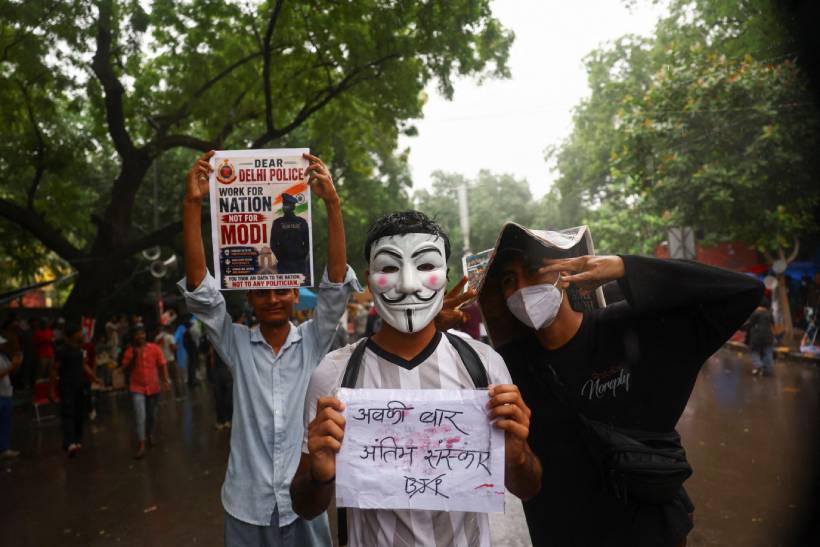
Thousands of demonstrators gathered near New Delhi’s Jantar Mantar, while protests spread across multiple cities.
Unlike many previous political movements in India, participants came from diverse religious, caste, and economic backgrounds.
For many protesters, education became a rare issue capable of uniting groups that are often politically divided.
The demonstrations attracted support from artists, public figures, and professionals, reflecting how examination scandals had evolved into a broader debate over governance and opportunity.
A Challenge to Modi’s Political Narrative
The protests represent more than dissatisfaction with administrative failures.
Narendra Modi has consistently presented himself as the architect of a modern, aspirational India built on development, opportunity, and efficient governance.
Repeated examination scandals undermine that narrative by raising questions about institutional credibility.
Many protesters argue that economic progress has become increasingly uneven, with rising inequality, stagnant wages, and limited employment opportunities affecting ordinary families despite impressive national growth figures.
The movement therefore challenges one of the central political messages that has helped sustain Modi’s popularity for more than a decade.
Government Moves to Contain the Fallout
Facing mounting public pressure, the government responded with several concessions.
Education Minister Dharmendra Pradhan resigned following sustained criticism.
Authorities announced tougher penalties for examination leaks and established a committee to review India’s competitive examination system.
The government also agreed to compensate families of students who died by suicide following examination irregularities and dropped legal proceedings against many protesters.
These measures appear aimed at restoring confidence in public institutions while preventing the unrest from evolving into a broader political movement.
Whether they will achieve that objective remains uncertain.
Beyond Education Lies a Question of Economic Mobility
The protests ultimately reveal that examination scandals are symptoms of a larger structural challenge.
For millions of young Indians, education represents the principal route out of poverty and into the middle class.
When repeated paper leaks, cancelled examinations, and recruitment delays undermine that pathway, frustration naturally extends beyond the education system.
Many protesters are questioning not only whether examinations are fair, but whether India’s economic model still offers realistic opportunities for upward mobility.
Without stronger private sector job creation and greater confidence in public recruitment, examination reforms alone may struggle to restore public trust.
A Defining Political Test
India’s examination crisis has evolved into one of the most significant political challenges of Narendra Modi’s current tenure.
The protests demonstrate that even governments with strong electoral mandates remain vulnerable when economic aspirations collide with institutional failures.
While Modi’s administration has acted quickly to address immediate grievances, the deeper issues of youth unemployment, unequal opportunity, and declining confidence in merit based advancement remain unresolved.
For a country where nearly 900 million people are under the age of 35, addressing those concerns may prove as important as sustaining economic growth itself.
With information from Reuters.
