


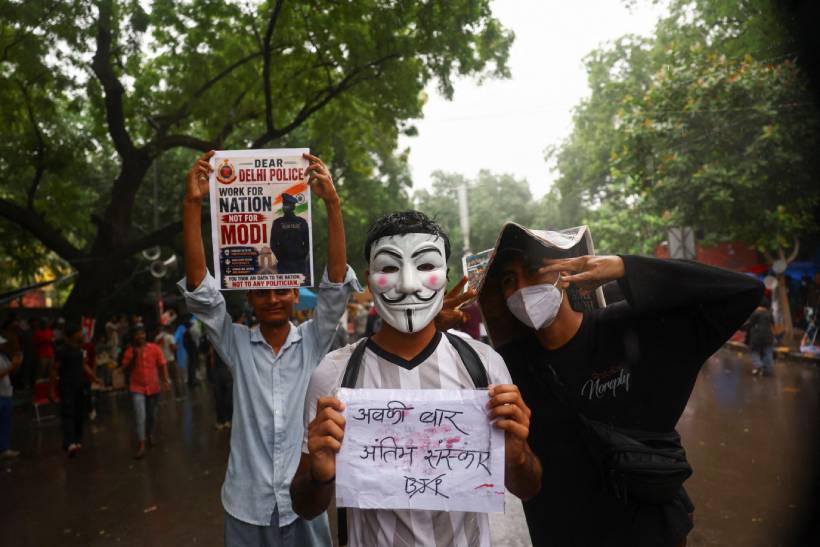
Thousands of young protesters have occupied central New Delhi in one of the largest demonstrations of Prime Minister Narendra Modi’s third term, demanding the resignation of Education Minister Dharmendra Pradhan after the cancellation of India’s most important medical entrance examination.
The movement, which calls itself the Cockroach Janta Party, has rapidly evolved from an online satirical campaign into a nationwide youth protest, reflecting broader frustrations over education, unemployment and government accountability.
What sparked the protests?
The immediate catalyst was the cancellation of the National Eligibility cum Entrance Test (NEET) after authorities confirmed that question papers had been leaked before the examination.
Around two million students sat for the exam in May, only to learn weeks later that it would be cancelled and conducted again. The decision plunged thousands of students into uncertainty after months or even years of preparation.
Stay ahead of the geopolitical week.
MD Briefing delivers expert analysis across five global fronts — the Indo-Pacific, energy, geoeconomics, European security, and the Middle East — every Monday morning. Free.
The controversy has also been linked to a series of student suicides, intensifying public anger and raising questions about the pressure India’s competitive education system places on young people.
Protesters argue that Education Minister Dharmendra Pradhan should resign for failing to safeguard the integrity of one of the country’s most consequential examinations.
Why is NEET so important?
NEET serves as the single national entrance examination for undergraduate medical education across India.
Every year, millions of aspiring doctors compete for fewer than 150,000 medical seats, making it among the world’s most competitive entrance exams.
For many families, preparation requires years of expensive coaching classes and significant financial sacrifice. When the exam was cancelled, many students felt those efforts had been wasted.
The episode has reignited debate about India’s higher education system, where limited university capacity and intense competition leave students under enormous psychological and financial pressure.
Why has this leak become such a major political issue?
India has experienced examination paper leaks before, including allegations surrounding NEET in previous years and recruitment examinations for teachers and police officers.
However, analysts say this year’s controversy resonated differently because it coincided with the emergence of the Cockroach Janta Party, a youth-led social media movement that quickly gained millions of followers.
Using humour, satire and viral online content, the movement transformed widespread frustration into organised political action, particularly among young Indians already concerned about unemployment, rising living costs and shrinking opportunities.
The protests therefore represent more than opposition to a single examination scandal. They have become a broader expression of dissatisfaction among India’s younger generation.
Government response
The government has acknowledged public anger while rejecting calls for the education minister’s resignation.
Pradhan has promised reforms aimed at preventing future examination leaks, while Prime Minister Narendra Modi has pledged to punish those responsible for compromising the exam.
Health Minister J.P. Nadda also met protest representatives and requested time to consider their demands.
Beyond Pradhan’s resignation, demonstrators are calling for compensation for families of students who died after the exam controversy and the release of activist Sonam Wangchuk, whose detention has become another rallying point for protesters.
What happens next?
Despite police using tear gas and batons to disperse demonstrators attempting to march toward parliament, thousands continue camping in New Delhi, vowing to remain until their demands are met.
India’s opposition parties, including the Congress Party, have embraced the protests, viewing them as an opportunity to challenge Modi’s government on an issue that directly affects millions of young voters.
Analysis: A test of Modi’s youth support
The NEET controversy has become far more than an education scandal. It has exposed deeper structural problems facing India’s rapidly growing youth population, including intense academic competition, limited higher education opportunities and persistent unemployment.
The emergence of the Cockroach Janta Party also highlights the growing political influence of digitally organised youth movements. Unlike traditional student organisations, the movement has relied heavily on social media, satire and decentralized activism to mobilize supporters across the country.
For Modi, the protests present a political challenge because young voters have been an important pillar of the Bharatiya Janata Party’s electoral success. While previous paper leaks generated temporary outrage, this controversy has evolved into a wider debate over governance, meritocracy and opportunities for India’s next generation.
Whether the demonstrations force policy changes or eventually lose momentum, they have already shown that education—and the aspirations of millions of young Indians can quickly become one of the most potent political issues confronting the government.
With information from Reuters.
