


Authors: Dr Madhukar Shyam and Kanika Rawal*
Introduction
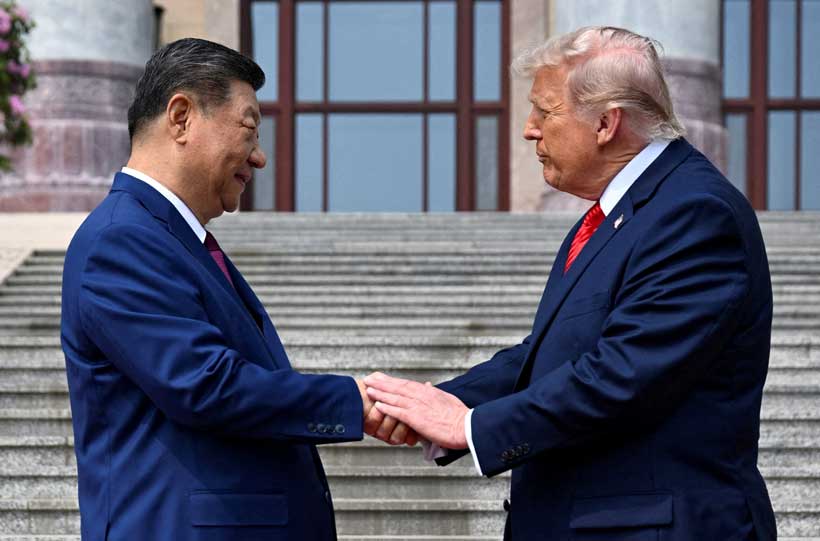
The relationship between China and the USA can be understood from the perspective of great power cooperation and competition. Does this relationship follow the principle of cooperation, or is it only based on the competition as defined by hegemonic stability theory? Let us understand through the recent visit by President Trump to China. What were the expectations other actors were having from this visit? For instance, this visit was viewed in the background of the Iran war, disruption in the global supply chain, how China plans on the reunification of Taiwan, how the USA’s support for Taiwan threats the sovereignty of China and what the future of QUAD will be in retaining the freedom of navigation in the South China Sea. In this background, the recent visit of the Trump administration becomes more relevant. So, let us deconstruct the USA president’s visit to China to understand the Taiwan issue, an important aspect that has grabbed global attention.
Why Did China Feel Compelled to Warn the United States Over Its Relations with Taiwan?
Stay ahead of the geopolitical week.
MD Briefing delivers expert analysis across five global fronts — the Indo-Pacific, energy, geoeconomics, European security, and the Middle East — every Monday morning. Free.
To really understand China’s warning, we need to grasp how Beijing views Taiwan.
Beijing views self-governed Taiwan as a separatist region that is ultimately meant to be integrated under its control, and it has maintained the possibility of employing military force to accomplish reunification and has explicitly refused to rule out the use of force to take the island, Xi Jinping made it clear. He emphasized that the Taiwan issue is an internal matter for China, and Beijing holds the right to take any action deemed necessary.
On the other hand, the US maintains a policy of strategic ambiguity, selling arms to Taiwan and pledging informal support; that is the reason why China strongly opposes the US presence. However, the USA is not giving any explicit defence support to Taiwan. This uncertainty runs deep. Moreover, since the 1950s, the U.S. has tried to navigate a tricky situation: it sent its Seventh Fleet to the Taiwan Strait during the crises in 1954 and 1958, then in 1979, it shifted diplomatic recognition to Beijing but also passed the Taiwan Relations Act to ensure Taiwan kept receiving defensive arms. The underlying message was clear America wouldn’t abandon Taiwan, yet it also wanted to avoid provoking China unnecessarily.
In addition, the third Taiwan Strait crisis occurred between 1995 and 1996, the year Taiwan conducted its first direct democratic elections. In response to Li Then-hui, the then-president of Taiwan, visiting the United States, China launched missiles into the surrounding waters. The US responded by sending two carrier groups and one carrier through the Taiwan Straits. It was followed by the visit by then-speaker Newt Gingrich (1997).
In the 21st century, things got more complicated. In 2017, the Trump administration greenlit a USD 1.4 billion arms deal with Taiwan, which stirred up anger in China. Then in 2018, Trump signed a law promoting high-level visits between the U.S. and Taiwan and approved another USD 330 million deal for F-16 parts.
Each of these moves set off stronger warnings from China, signaling that American support for Taiwan might be crossing a line, especially after the U.S. House Speaker Nancy Pelosi’s visit to Taiwan that same year. These drills were a clear message that ongoing U.S. support for Taiwan defence implications. However, the visit by then-speaker Newt Gingrich (1997) was very different from that of the House Speaker Nancy Pelosi for two reasons: a) the former visit was well publicised, and Beijing had maintained preconditions for Taiwan and the US followed the demand of PRC; in contrast, the visit by Nancy Pelosi was in which China was a sceptic and also warned not to visit Taiwan; and b) the relationship between China and the United States during that period was one of cooperation, whereas the situation now is of confrontation.
To this China’s response was not just diplomatic either. All this prompted China to conduct its largest military exercises around Taiwan in 2022. However, this raises a big question. If Xi has already said China will not bring Taiwan under its control through military force, then why is Beijing conducting war games? What makes Taiwan so crucial for China? The answer goes beyond politics. Taiwan is vital because it produces more than half of the world’s advanced semiconductor supply chain, contributing to over 60% of worldwide foundry revenue and over 90% of advanced chip manufacturing, making it essential for high-tech supply chains globally. Any conflict between China and the US over Taiwan would affect not only the region, but also have serious effects on the rest of the world.
That’s what made Xi’s warning at the summit stand out. It was delivered quite bluntly, not as a diplomatic nicety but as a clear message that Beijing’s patience with Taiwan is limited. Washington shouldn’t confuse this restraint with indifference. So, how did Trump react to all this? Interestingly, the White House didn’t mention Taiwan in its official statements, and Trump himself avoided questions on the subject.
To sum up, the summit in the wake of recent US-China tensions over Taiwan, one question demands an answer: Can China take control over Taiwan? Will the US stand by Taiwan? Does this scenario end in US-China cooperation or bring us closer to war? The future of Taiwan is clear when we look at its own people. A survey from the National Chengchi University showed that those identifying only as ‘Taiwanese’ grew rapidly 18% in 1992 to 63% in 2023. At the same time, people identifying as both Taiwanese and Chinese fell from 47% to 31%, while those identifying only as Chinese dropped sharply from 25% to just 2-3%.
This clearly shows that the majority of Taiwanese people strongly oppose Chinese dominance or unification. Taiwan’s resistance has also gained global attention and support. The Quad members in 2021 issued joint statements opposing any Chinese attempt to change the Taiwan Strait’s status quo by force and expanded maritime intelligence. The U.S. leads in massive arms sales with a record USD11.1 billion package in late 2025, with an overall backlog of nearly USD32 billion plus military training. Japan has also been more outspoken in its support of Taiwan’s security. However, the Quad still does not have real military cooperation, such as joint exercises or a shared command with Taiwan. But the US is not sitting on the sidelines. Days after Xi’s warning to Trump on Taiwan, in late May 2026, a large delegation of 41 senior US defense executives visited Taipei. The discussion on joint weapons production, drones and stronger military ties was led by retired General Charles Flynn. “Taiwan can’t afford to wait,” Flynn said explicitly. The situation points not to US-China cooperation over Taiwan, but to growing rivalry. The people of Taiwan continue to reject Chinese dominance, and the Quad countries are maintaining their support for Taiwan’s security. Because of this, it looks like China’s aim for reunification is going to be difficult to achieve
Author Bio: Kanika Rawal is a BA Economics and Political Science graduate from Christ University, Delhi NCR, currently serving as a Research Intern at the Centre for Social and Policy Research (CSPR).
