


Authors: Felipe Salles and Dr. Julian Spencer-Churchill
We are reaching the end of a procurement decision process started on July 23, 2019, when the Government of Canada formally opened a bid to select its future fighter force airframe. The January 2023 decision for 88 F-35s for Canada became uncertain with Mark Carney’s assumption of the position of Canadian Prime Minister and called for a “strategic review” of it in March 2025. Eighteen of these F-35s are already fully paid, and it remains possible that a new batch of stealth U.S. fighters could be procured for the RCAF (Royal Canadian Air Force). By October 2026, the first F-35 was delivered to Canada from Lockheed’s massive Fort Worth production site.
The final decision on the precise fighter procurement scenario is expected to be announced late in 2026, sometime after assessing the political relations with Washington after the November 2026 U.S. mid-term elections. This will determine whether the procurement will be composed of a mixed air fleet and the precise breakdown of either 60 or 72 Gripen Es, most of them to be built in Canada.
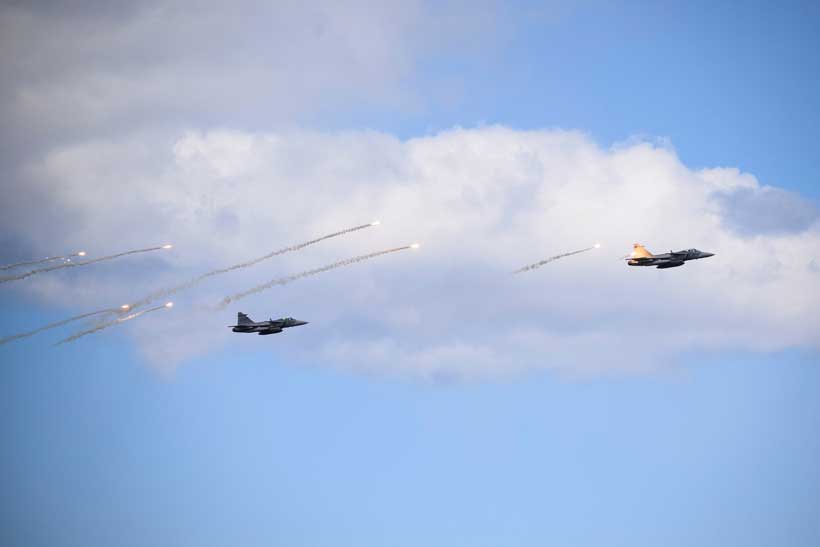
The Gripen E/F fighter offered to Canada is the latest advanced variant of the Gripen. It is only now entering service with the Air Forces of Sweden and Brazil. It is notably smaller than the F-35 but at the same time has a long range and is able to fire volleys of the powerful long-range European MBDA Meteor missile. This is the same weapon that the heavier and more expensive French Rafale and the four-nation Eurofighter fighters depend on to be able to credibly face the growing Russian fighter threat in Eastern Europe. The Gripen E has already proven itself to be cheaper to buy and cheaper to operate than the F-35. Despite the formal end of the bidding process, Saab has been allowed to offer an alternative proposal that would allow for a third Gripen E final production line to be set up in Canada. This idea was very attractive to the current administration and to those Canadians confronted by the Trump administration’s geopolitical and economic inconsistency. This is causing concern in Washington.
Stay ahead of the geopolitical week.
MD Briefing delivers expert analysis across five global fronts — the Indo-Pacific, energy, geoeconomics, European security, and the Middle East — every Monday morning. Free.
Organizing the Consortium
A newly identified opportunity sees Canada joining with Sweden, Brazil, and other users of the Gripen to fashion an industrial cooperative effort to further reduce costs through specialized co-production of parts, research for continuous technological upgrades, promotion of exports, and ultimately the recreation of Canada’s military aviation sector.
A brand new national final assembly line that comes with its own guaranteed export contract is something unheard of in aerospace history. This creates the possibility for Canada to return to exporting fighters.
Brazil was the first export client for the Gripen E/F. The Brazilian Air Force’s (FAB) command wholeheartedly embraced the concept of local manufacture, it being based on sovereignty, not on low costs. Swedish-built aircraft would always be cheaper to buy than Brazilian ones. Even though FAB brunt the full cost of creating a new assembly line at Gavião Peixoto, Embraer’s primary military aircraft facility. The sunken cost was seen as inevitable. Issues like supplier independence, the transfer of advanced technology to the Brazilian Embraer company, and, finally, a much greater difficulty of post-contract cancelations by Brazilian politicians being possibly the greatest benefit.
First and foremost, Sweden is by its very nature a country that has a well-established and stable international neutrality stance. Prior to the Gripen, Swedish fighters were exclusively exported to other neutral and/or Scandinavian air forces (Austria, Denmark, and Finland). The Gripen family debuted in 1988, with the initial A model entering into service eight years after that. Saab is a historic aeronautic engineering company established in 1937. The Gripen is the fifth in an uninterrupted line of Swedish fighters designed and built for the local Air Force since the introduction of the J29 Tunnan in 1948.
In Sweden there is Saab designing and building the base model, Saab Microwave for their advanced EW suite, and a large number of component subcontractors. Saab Dynamics (ex-Bofors) produces the Rb15 missiles and is a partner in the Iris-T and Meteor missile programs. The principal foreign suppliers and licensors include GE for the F414G engine, Leonardo Electronics (UK) for the Raven ES-05 radar, and the Skyward-G optical tracking system. BAE is also a key player in manufacturing the fighter’s active control sidesticks and many avionics, such as the main computer.
In Canada, which has more limited subcontractor suppliers for aircraft sufficient to fit into a Gripen production network, there are IMP, CAE, and Magellan. The Canadian industry minister indicated that the F-35 would not accrue sufficient industrial benefits to Canadian design and manufacturing. In Brazil there are Embraer and Saab Brasil Ltda., the latter of which encompasses separate operations such as Saab Aeronáutica Montagens—SAM and Saab Sensores e Serviços.
The Gripen is physically smaller than its predecessor Viggen in order to lower costs; it also has decided to tolerate less local Swedish content in the current product due to the exponential increase in the complexity of new fighters. Saab now studies many alternatives for the future but is seriously looking at manned unmanned cooperative operations as a way to control the spiraling of complexity and cost. Until then the Gripen E is quickly integrating items that are normally associated with “5th generation fighters,” like the F-35’s single wide-screen instrument panel, amongst other upgrades.
Industrialized countries with big militaries normally afford placing large multi-year orders as soon as their next-generation platforms are selected. This generates high production efficiency, very fast delivery of aircraft to operational units, low unit costs, and guaranteed long-running industrial operation. It also allows for the accommodation of export orders to allies as soon as the supply to the local air force is concluded. These foreign orders sustain the factories and the jobs since they are a “buffer” production until further orders from the home air forces are placed.
Smaller nations like Sweden, Brazil, and Canada, on the other hand, usually can’t afford these accelerated large initial production runs in high manufacturing tempos. Thus, they must be creative in deciding how fast an assembly line will run, which is key to reasonable product costs and economic viability. Embraer ran into this issue with the KC-390 tactical airlifter. It had to be built slow enough in the beginning as to not overwhelm the Brazilian Air Force’s financial disbursement capabilities and not too fast as to risk running out of local orders before the plane firmly established itself in the export market.
Another production line elsewhere helps share the Swedish investment burden as it is paid by the partner nation, minimizing the program risk for Sweden. If there was no Gripen production in Brazil, the company would have to fund the expansion of the Swedish plant and run it at a much faster pace to supply the Brazilian order from Sweden. However, that might be risky business. Two final production lines running in parallel in two separate countries dilute the risk for all parties. Three lines, even more.
Rebuilding Canada’s Combat Aeronautics Capability
It is not a well-known fact that Canada has built and even designed advanced fighters for decades but does not do it today. An extensive organization of aeronautic plants was set up in Canada as a backup case if the UK fell to the Nazis in WWII. The Cold War saw Canada manufacture the Canadair CT-133 jet trainers as well as more than 1800 North American F-86 Sabre (Montreal, 1950-58), over 340 CF-104, and 240 CF-5A/Bs. Avro Canada also managed to develop and manufacture 692 units of the CF-100 Canuck, an early indigenous jet fighter with straight wings.
The most recent Canadian push for operating a locally developed and manufactured fighter aircraft ended traumatically with the controversial cancelation of the AVRO Arrow program by Prime Minister John Diefenbaker on February 20, 1959. From the 1960s to the 1980s, the CF-101 Voodoo long-range fighters defended Canadian skies, while the RCAF F-104 Starfighters and CF-5A Freedom Fighters did the same job in Western Europe. These were also license-built in Canada. In the 1980s CF-18s bucked this historical trend where all were purchased from the U.S. In 2017 the Bombardier C Series aircraft debacle with Boeing in the U.S. was a major blow to the Canadian civil aviation industry. Due to a Boeing law suit the whole program had to be sold to Airbus in order to retain its commercial prospects in the crucial U.S. market.
The Ukraine Opportunity
On 30 June 2026, Ukrainian president Volodymyr Zelenskyy signed a memorandum of understanding in Sweden that would have the Ukrainian Air Force receive 16 new-build JAS39E/F. This happens alongside a previously announced transfer of 16 further ex-Royal Swedish Air Force Gripen JAS39 C/D. This agreement points to a desired total of at least 100 new-build Gripen E fighters in the following years. If Saab decides to build all these aircraft at its aircraft plant located in the city of Linköping, the schedule of deliveries to the Royal Swedish Air Force and to other current contracted clients such as Thailand and Colombia could be impacted. For this reason, Saab has allegedly offered Canada to assist in supplying the new Ukrainian fighters.
Canada will benefit from Luis Inácio Lula da Silva’s pro-BRICS foreign policy, which is reluctant to aid Ukraine against Russia, and this will certainly keep the Brazilian Gripen line off the Ukraine contract. Had his conservative rival Flavio Bolsionaro won, his close alignment with the U.S. would have created policies towards Ukraine that mimicked Trump’s administration and perhaps diffused Gripen production to Ukraine.
Tighter Political Strings on U.S. Weapons Sold Abroad
The U.S. government binds most of its arms transfers, with contracts that considerably limit the clients’ operational employment options. This includes controlling or restricting future upgrades and prohibiting selective operations, such as foreign exercises without prior authorization. The Foreign Military Sales (FMS) system is a powerful tool for the implementation of these policies. Turkey and the UAE, for example, both have robust national missile industries today that, due to US contractual restrictions, may not integrate their products into US F-16 aircraft. This is not really new: in the late 60s, Convair F-102 interceptors sold to feuding NATO neighbors Turkey and Greece had to sport on their fuselages the original USAF registration numbers throughout all their service life with these air forces.
The Imperfect F-35
There are already many articles discussing why the F-35A Lightning II may not be the ideal next fighter for Canada; the agreed-to-purchase sixteen might become a “silver bullet” unit for penetration attacks into high-risk, thoroughly missile-defended sites with its sensor suite linked to U.S. forces, and, if needed, for joining U.S. expeditionary forces around the world. Continued deindustrialization and internal culture wars in the U.S. have soured the American mainstream interest for the liberal international order it laboriously created from 1945. Washington’s new mercantilism is threatening to subordinate Ottawa, affronting Canada’s just interest in promoting closer alliances with other democracies. Nevertheless, the F-35’s sensor suite enables it to link its patrol data directly to NORAD monitoring.
Stealth fighters were designed as a “first day of war weapon.” A tool to quickly dispatch the enemy’s SAM missile batteries as well as its command and control (C²) infrastructure. From this point on, older, non-stealth aircraft would fly over enemy territory completely unscathed. Conversely, the NORAD system was created to identify as far as possible large numbers of incoming Soviet bombers overflying the Arctic Ocean on their way to targets in the U.S. The bomber threat is mostly over, having been substituted by very high-altitude and high-speed ballistic missiles that are completely untouchable by current fighter weapons, stealth or not. The F-35 is mostly a fighter-bomber and not cost-effective in an attritional engagement with stealthy Chinese J-20 air superiority fighters. If it is almost invisible to radars, to optical/IR sensors, it is completely conspicuous. If Canada’s possible wartime scenarios are essentially defensive ones, stealth doesn’t really bring much to the table.
The F-35A displays highly digitized and integrated avionics systems, like the initial ALIS system, that automatically reported NATO allies’ operational data, such as the amount of flight time and aircraft location, as soon as it landed (mostly these air forces did not really know much about these indiscrete functions). This reveal saw these allies compel Washington to remove this revealing datalink.
The F-35’s high cost ensures there are strong military and cost incentives for the RCAF to adopt the Gripen. Stealth aircraft are obviously very capable, but they unfortunately tend to be very expensive. Much more so to operate (when compared to the F-16s being replaced) than to buy. Many early European adopters of the F-35 bought into the idea that the Lightning II was so superior in combat to any previous generation opponent that their fighter fleets could be halved without compromising their technical lead above any contenders. But unfortunately, F-35 availability has been shown to be significantly less than what Lockheed’s salespeople originally promised.
Conclusion
The Gripen E as an alternative for Canadian defense is the one that leaves behind a great high-tech industrial legacy that jumpstarts both future civilian and military aerospace programs and industry and high-tech jobs. These are some things that, frankly, the F-35 has never really intended to deliver.
