


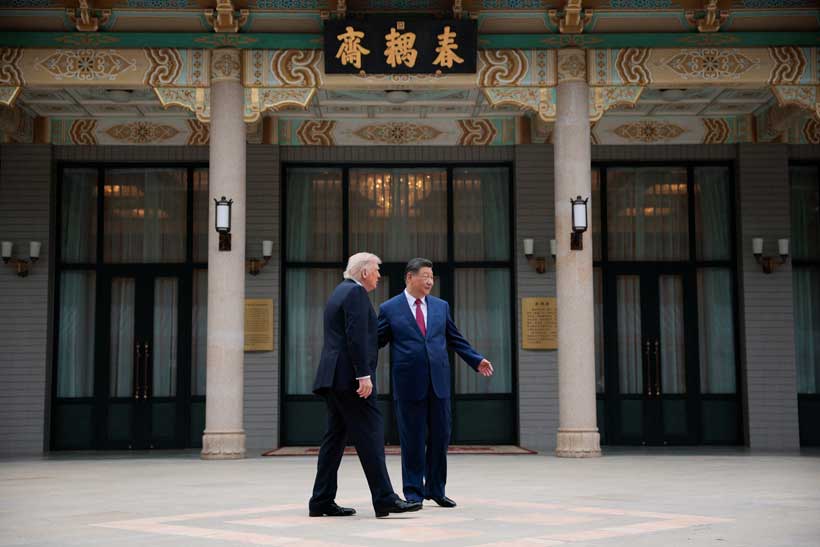
The points of contention and differing priorities between Beijing (President Xi Jinping), Donald Trump, and Vladimir Putin regarding the upcoming trilateral summit in Shenzhen, China, revolve around several key issues that complicate the arrangements and agenda. These points of contention and conflicting priorities between Beijing (led by Xi Jinping), Trump, and Putin concerning the anticipated trilateral summit in November 2026, on the sidelines of the APEC forum in Shenzhen, center around the following key issues:
– First: Disagreement over the format and rules of the meeting (structural disagreement)
1) Beijing’s vision: China is pushing for a meticulously written and pre-planned summit, where each leader reads a pre-prepared statement, thus restricting impromptu dialogue to avoid any surprises or unexpected negotiations that could harm its interests. Here, the summit is expected to be highly organized and strictly protocol-driven, with each leader reading a pre-prepared statement and very limited space for spontaneous, direct discussion in order to avoid any surprises or unforeseen commitments.
2) Trump’s Vision: The US administration insists on a more flexible and free format for exchanging views, preferring an open and direct strategic dialogue to address contentious issues without rigid protocol constraints. Here, the Trump administration is pushing for a more flexible and free format for dialogue, favoring direct and open discussion over pre-written statements.
Stay ahead of the geopolitical week.
MD Briefing delivers expert analysis across five global fronts — the Indo-Pacific, energy, geoeconomics, European security, and the Middle East — every Monday morning. Free.
– Second: The Balance of Power Dilemma and the Nature of Nuclear Weapons and Arms Control
1) Trump’s Vision: Trump places arms control and nuclear disarmament as a top priority for the United States at this meeting and believes it is essential to include Beijing in any future treaty to replace the recently expired New START agreement. Therefore, Trump considers this issue a top priority and a fundamental condition. Washington is seeking to involve Beijing in a new treaty and new controls to limit nuclear weapons, especially after the expiration of the New START treaty between the US and Russia in February 2026 without a replacement.
2) Beijing’s Perspective: China categorically rejects entering into trilateral arms negotiations. It believes that its nuclear arsenal—despite its rapid growth—remains significantly smaller than the combined US and Russian arsenals and fears that such negotiations would solidify the dominance of Washington and Moscow, leaving China in a subordinate position. Therefore, Beijing expresses strong reservations about this proposal, fearing that trilateral negotiations would reinforce US and Russian nuclear superiority, given that its arsenal is still smaller than those of the two powers.
– Third: The War in Ukraine and the Formula for a Political Settlement
1) For Putin: He is the primary motivator for the summit, aiming to leverage his relationship with Trump to push for a settlement to the Ukrainian war on terms that serve Moscow’s interests, while excluding Ukrainian President Zelensky from these direct negotiations. The Russian president seeks to use the summit to propose a settlement to the war in Ukraine on terms that serve Russia’s interests and European security from Moscow’s perspective, taking advantage of improved communication channels with Trump while attempting to impose arrangements without the participation or presence of Ukrainian President Volodymyr Zelensky.
2) Regarding Beijing: It is hesitant to be drawn into Moscow’s desire to impose a settlement that could put it in direct trade or political confrontation with the European Union and the West. It prefers to manage its relations with Washington and Moscow separately to extract concessions. China prefers managing its relations with Washington and Moscow bilaterally rather than entering into a single major political deal, fearing that a continuous trilateral meeting could damage its international image as a party that supports comprehensive multilateralism and direct negotiations between the conflicting parties.
3) Regarding Trump: He received warnings from his advisors about the necessity of avoiding making the Ukrainian war the central focus of discussions at a trilateral summit that does not include the directly involved parties, such as Kyiv and the Europeans.
– Fourth: Timing and Fragile Internal Calculations
1) The Trade Truce Between Washington and Beijing: The summit comes at a time when US-China economic relations are governed by a temporary truce that ends in January 2027, making China wary of offering Trump any concessions without receiving anything in return.
2) China’s Political Arrangements: The Chinese Communist Party is preparing for its National Congress in late 2027 to carry out comprehensive leadership changes. Therefore, President Xi Jinping sees engaging in impromptu discussions with Trump and Putin as a geopolitical risk with unpredictable consequences.
Consequently, the summit is currently teetering between the parties’ desire for symbolic gains and historic photo opportunities, and the possibility of its cancellation or replacement with separate bilateral meetings if an agenda cannot be agreed upon. Therefore, the current outcome is that these fundamental disagreements over the agenda and the format of the outcomes have cast doubt on the convening of the trilateral summit, with the possibility that the leaders will settle for separate bilateral meetings on the sidelines of the APEC summit if a common format cannot be agreed upon.
