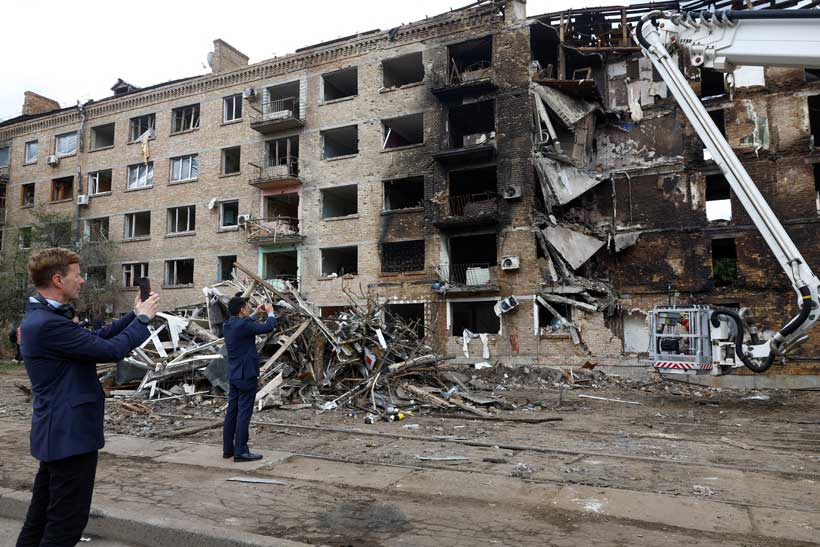
Wars can stop without being settled. That is the uncomfortable possibility behind Ukraine’s latest diplomatic opening. President Volodymyr Zelenskyy has indicated that Kyiv could accept a halt to fighting along the existing front line as a starting point for negotiations, while rejecting the surrender of Ukrainian territory. The proposal offers something Europe urgently needs: a chance to reduce the killing. But it also raises a question that is easier to postpone than to answer. If the guns fall silent on terms shaped mainly by Washington and Moscow, who will decide what keeps them silent?
The danger is not simply that Europe might miss a meeting. It is that Europe could inherit a security settlement whose most consequential assumptions it did not help write. A frozen front may halt territorial movement while leaving the political causes of the war, Russia’s military capacity and Ukraine’s future protection unresolved. In that scenario, a ceasefire would change the tempo of insecurity, not end it.
The distinction matters because a ceasefire and a peace settlement do different jobs. A ceasefire regulates violence; a settlement must remove the incentives to restart it. Freezing the current line could create breathing space for civilians, military recovery and diplomacy. Yet the same pause could allow both armies to replenish their forces, harden fortifications and prepare for another round. Whether the freeze becomes a bridge to peace or an interval before renewed fighting depends less on the line itself than on the guarantees built around it.
Zelenskyy’s position reflects this dilemma. In his 21 October interview with Fox News, he paired openness to a battlefield freeze with a demand for security guarantees from the United States and European partners. That is not a minor qualification. Kyiv can contemplate suspending combat without conceding that occupation confers sovereignty. A line of contact is a fact on the ground; an internationally recognized border is a legal and political judgment. Confusing the two would reward the very use of force that Europe’s postwar security order is meant to resist.
Stay ahead of the geopolitical week.
MD Briefing delivers expert analysis across five global fronts — the Indo-Pacific, energy, geoeconomics, European security, and the Middle East — every Monday morning. Free.
For European governments, the stakes are sharper still. Their economies, borders, defence budgets and political cohesion will bear the consequences of any agreement. A ceasefire without credible monitoring, rapid responses to violations and sustained support for Ukraine could simply convert an active war into an open-ended deterrence mission. The front might freeze, but Europe’s security bill would not.
This is why the argument about Europe’s empty chair needs precision. Europe has not been absent from every diplomatic conversation. Ukraine’s presidency reported that EU, NATO and several European national security advisers joined consultations in Oslo on 20 October. But participation in preparatory discussions is not the same as decisive influence over the final bargain. The Kremlin has since made clear that the next round of talks, planned for Abu Dhabi in the first half of November, will be trilateral — Russia, Ukraine and the United States — with any European role deferred to an unspecified later stage. The real issue, then, is not ceremonial representation. It is who gets to shape enforceable commitments.
Washington has obvious leverage. American diplomatic access, military assistance and intelligence capabilities can help bring adversaries to the table, and a US-led channel with fewer participants may make the initial bargaining easier. But diplomatic efficiency is not the same as strategic legitimacy. An agreement negotiated quickly can prove expensive if those expected to implement it are not committed to its terms. Europe cannot be treated merely as the guarantor of a bargain struck elsewhere.
Nor is Europe a single actor with a single risk calculation. States closer to Russia tend to judge an ambiguous ceasefire by the likelihood of renewed aggression; governments farther west may place more weight on immediate de-escalation and fiscal strain. These differences are not an argument for excluding Europe. They are precisely why an agreement needs European negotiation rather than European endorsement after the fact. A durable security architecture must accommodate the threat perceptions of the states that will live inside it.
There is also a basic problem of credibility. Security guarantees mean something only when the party tempted to violate them believes a response will follow. Broad promises of solidarity may reassure domestic audiences, but they do little to deter an opponent unless backed by capabilities, procedures and political resolve. Monitoring mechanisms need access and authority. Military assistance needs predictable funding. Any multinational presence needs a clear mandate and a realistic plan for what happens when a violation occurs. Deterrence cannot be improvised after the ceasefire breaks.
European leaders have already set out principles that point in this direction. In their 7 June joint statement, the leaders of France, Germany, the United Kingdom and Ukraine called for active US and European participation, insisted that borders must not be changed by force and demanded robust, legally binding guarantees, including a multinational force in Ukraine. Notably, the same statement accepted the current line of contact as the starting point for negotiations. Europe’s quarrel, in other words, is not with a freeze as such but with what is built around it. These principles should not be filed away as a diplomatic communiqué. They are the beginnings of a negotiating position, and they set a standard against which any eventual deal can be judged.
Yet Europe should avoid turning its demand for a seat into a substitute for strategy. Being in the room matters only if European governments know what they are prepared to provide and what they cannot accept. They need a common position on ceasefire verification, Ukraine’s long-term defence, sanctions conditionality and the relationship between a settlement and NATO or EU commitments. Otherwise, the complaint about exclusion risks sounding like a plea for status rather than a proposal for security.
A further danger lies in the politics of reconstruction. Investors and displaced families will not return on the strength of a press conference. They will ask whether power grids, housing and transport links can be rebuilt without being destroyed again. That confidence depends on insurance, financing and credible protection against renewed strikes. If the agreement leaves these questions vague, Europe may spend heavily on infrastructure that remains exposed to attack, and economic recovery will become hostage to the same unresolved military imbalance. A settlement that neglects deterrence can undermine the very reconstruction that is supposed to make peace worthwhile.
The most defensible approach is neither to reject a front-line freeze outright nor to celebrate it as peace. It is to treat the freeze as a conditional opening. Ukraine must remain a principal party to decisions about its territory and security. European governments must have a role wherever obligations fall on them. Any easing of pressure on Russia should be tied to verifiable conduct rather than diplomatic optimism. Above all, the arrangement should make renewed aggression more costly, not merely postpone the moment when Europe must confront it.
A silent battlefield would be a relief. It would not, by itself, be a new European security order. If Europe is asked to finance reconstruction, sustain deterrence and manage the consequences of another crisis, it must also help define the peace it is expected to defend. The decisive question is not whether Ukraine’s front line can be frozen. It is whether the political settlement around that line can stop the war from thawing again.