


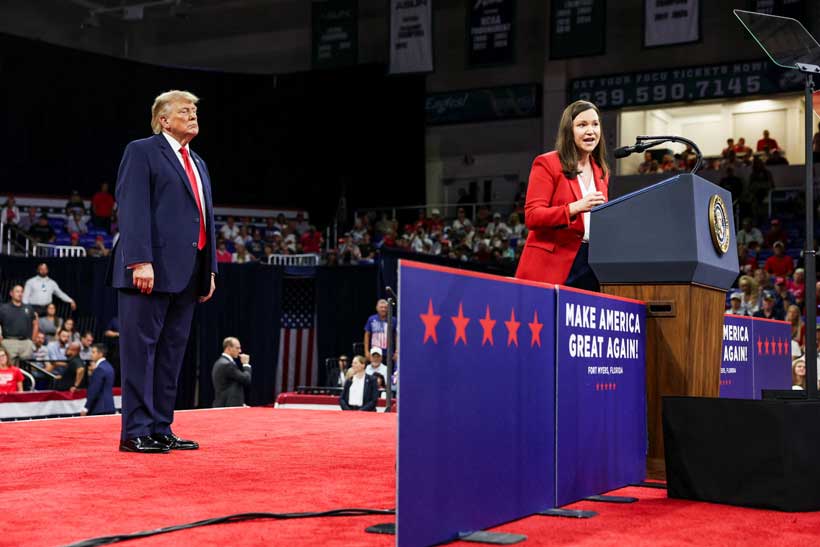
President Donald Trump’s influence over the Republican Party suffered a major setback in the 2026 midterm elections after several candidates he personally backed lost crucial Senate races, helping Democrats take control of the chamber.
Republican defeats in South Carolina, North Carolina and Texas exposed the limits of Trump’s ability to transfer his personal political support to candidates facing a broader electorate. His preferred candidate in Michigan was also trailing in an uncalled race, adding to concerns within the party about his influence over candidate selection.
For more than a decade, Trump has reshaped the Republican Party around his MAGA movement, using endorsements and primary interventions to elevate loyalists while sidelining established conservatives who challenged his political direction.
The latest results raise a difficult question for Republicans: has Trump’s dominance over the party’s internal politics become an electoral liability?
Stay ahead of the geopolitical week.
MD Briefing delivers expert analysis across five global fronts — the Indo-Pacific, energy, geoeconomics, European security, and the Middle East — every Monday morning. Free.
South Carolina, Texas and North Carolina Deliver Major Setbacks
South Carolina produced one of the most significant Republican defeats of the night. The state had not elected a Democratic senator since 1998, and Trump carried it by 18 percentage points in the 2024 presidential election.
Despite those advantages, Trump’s preferred candidate, Darline Graham, lost to Democrat Annie Andrews.
In North Carolina, former Republican national campaign official Michael Whatley was defeated by former Democratic Governor Roy Cooper. The result was another setback for Trump’s candidate-selection strategy in a state where Republicans had expected to remain competitive.
Texas delivered an equally significant reversal. Trump intervened in a contentious Republican primary to support state Attorney General Ken Paxton over incumbent Senator John Cornyn. Cornyn had been viewed by some Republicans as a safer candidate for the general election.
Democrat James Talarico subsequently defeated Paxton, giving Democrats a Senate victory in a state where they had not won a Senate election since 1988.
In Michigan, former US Representative Mike Rogers, Trump’s preferred candidate, was trailing Democrat Abdul El-Sayed in an uncalled race. If confirmed, El-Sayed’s victory would make him the first Muslim to serve in the US Senate.
Together, the results demonstrate that Trump’s endorsement was not enough to overcome the political weaknesses of several candidates in competitive general elections.
Trump’s Political Influence Faces a Test
The defeats are particularly significant because Trump’s control over Republican primaries has been one of his most important sources of political power.
Since entering presidential politics, he has repeatedly intervened in Republican contests, backing candidates who demonstrate loyalty to his movement and challenging established figures who oppose his priorities.
This approach helped reshape the party’s leadership and legislative agenda. However, the midterm results suggest that success in Republican primaries does not necessarily translate into broader electoral support.
Trump’s popularity was also weaker heading into the elections than it had been in the aftermath of the January 6, 2021, attack on the US Capitol, according to Reuters/Ipsos polling.
Economic dissatisfaction, particularly over high prices linked to tariffs and the war with Iran, further weakened the political environment for Republican candidates.
Republican strategist Doug Heye described the outcome as a “Trump Quake”, arguing that the president had focused on issues important to himself rather than the concerns of voters.
Trump rejected the suggestion that his influence had contributed to the losses, writing on social media that Republicans would have won by a landslide if he had personally been on the ballot.
Republican Critics Blame Trump’s Primary Interventions
Some Republican figures and independent analysts argue that Trump’s involvement directly weakened the party’s chances in several states.
Thomas Kahn, a professor at American University, said Trump’s intervention in Texas had cost Republicans a Senate seat that could have remained competitive under Cornyn’s candidacy.
North Carolina also illustrates how internal party divisions can affect general elections. Republican Senator Thom Tillis announced last year that he would not seek re-election following a public disagreement with Trump over the administration’s tax-and-spending legislation and proposed Medicaid cuts.
Kahn argued that Tillis might have remained in the race had Trump not threatened to support a primary challenger.
Former North Carolina Governor Pat McCrory similarly criticised Trump’s approach, saying his interventions had divided Republicans across multiple states.
In South Carolina, McCrory pointed to Trump’s disagreements with local Republican representatives as an example of how presidential involvement in primary contests can create divisions within the party.
The criticism reflects a wider concern among Republicans that loyalty-based candidate selection may weaken the party’s ability to compete in states where winning requires support beyond Trump’s core political base.
Economic Dissatisfaction Compounds Republican Losses
The candidate defeats also took place against a broader backdrop of voter frustration with the administration.
High living costs, tariffs and the economic consequences of the war with Iran became central campaign issues. These concerns weakened Trump’s ability to mobilise voters around his preferred candidates.
A White House official argued that Trump had done more to promote several Republican candidates than the candidates had done for themselves. Another senior administration official said internal polling had indicated weeks earlier that Republicans were likely to lose both chambers of Congress, prompting the president to undertake an extensive campaign effort.
The explanation suggests that the administration recognised the scale of the electoral challenge before voting concluded.
However, the results indicate that Trump’s campaign appearances and endorsements were unable to reverse the wider dissatisfaction affecting Republican candidates.
What Happens Next for the Republican Party?
The Republican Party now faces a debate over whether its electoral strategy should continue to revolve around Trump’s personal influence or give greater weight to candidates with established local support and broader appeal.
Democratic control of the Senate will also make Trump’s legislative agenda more difficult to advance during the final two years of his presidency.
For Republican lawmakers, the immediate challenge is to maintain party unity while responding to voters who have expressed dissatisfaction with the administration’s economic performance.
The results do not necessarily mean that Trump’s influence over Republican voters has disappeared. His political movement remains central to the party, but the midterms have exposed a distinction between his ability to shape Republican nominations and his ability to deliver victories in general elections.
The central question for Republicans is whether they can preserve the political coalition built by Trump while adapting their candidate-selection strategy to appeal to a wider electorate.
With information from Reuters.
