


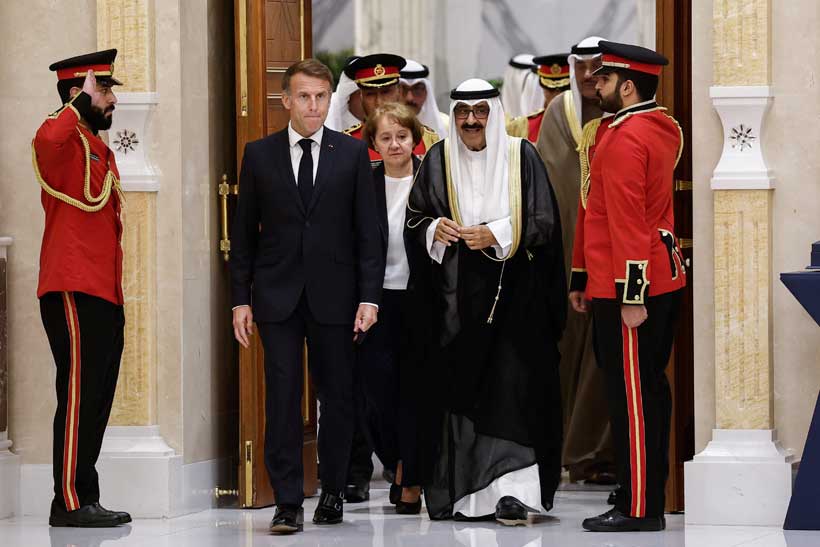
Emmanuel Macron spent Monday in Kuwait asking for diesel. Two days earlier, rioters had broken into the town hall in Limoges and set it on fire, and Laurent Nuñez was counting about 2,400 arrests from a single Saturday of protest. Before he left, Macron went on television and tied the fuel prices behind the anger to the war in the Persian Gulf, adding that France had not taken part in that war.
The second half of that claim has had less scrutiny than it deserves. The Charles de Gaulle has been in the region since spring with its Rafale wing. French soldiers guard the Saudi oil terminal at Yanbu. Paris and London have put together a demining mission for Hormuz. France has not fired on Iran. It has been paying for the war since the first month, and the 2027 budget shows exactly whom it sends the invoice to.
Start with what Macron’s address left out. The revolt did not begin at the petrol pump. It began in late September in the lycées, over teacher shortages, decaying buildings, and packed classrooms, and by October 2 the protests had reached a third of lycées. The Yellow Vests joined later, bringing fuel and austerity with them. By October 17, the government’s own count put 550,000 people on the streets, and about 1,000 police and gendarmes were injured.
Fuel deserves a fair hearing. In early October, diesel in France cost €2.355 a liter. Spain, which buys crude through the same blockaded strait, paid €1.918. A full tank in France takes 4.4 percent of the average net monthly wage, close to the EU average. Hormuz sets the crude price for everyone. Paris sets the rest.
Stay ahead of the geopolitical week.
MD Briefing delivers expert analysis across five global fronts — the Indo-Pacific, energy, geoeconomics, European security, and the Middle East — every Monday morning. Free.
Nor does Hormuz explain why teenagers were barricading schools before anyone in a yellow vest showed up.
Three lines in Prime Minister Sébastien Lecornu’s 2027 budget show where the bill actually lands.
First, the bondholders. The state will spend about €91 billion on interest next year, up from roughly €79 billion this year. Ten-year borrowing costs touched 4.94 percent in October, the highest since 2002, with public debt at 119 percent of GDP. Twelve billion euros of new interest is the price of a 5.4 percent deficit that no French government since 2024 has had the votes to close. No tanker in the Gulf ran up that bill.
Second, the military. The armed forces budget rises by €6.4 billion to more than €63.4 billion. Education gets €1.1 billion more. For every euro added to the schools where this revolt started, the state adds nearly six to the ministry whose carrier is sitting off the Arabian Peninsula. To be fair to Lecornu, most of that defense increase was planned before the war, under Macron’s 2025 pledge to accelerate military spending. That is the point. The war did not force the choice. It gave the choice cover.
Third, households. The back-to-school allowance loses €600 million. Family allowances are frozen, as is the civil service pay index. Pensions above €2,000 a month lose inflation indexing. VAT receipts, which fall hardest on people who spend everything they earn, rise by more than €7 billion. In the same document, the exceptional levy on large companies is cut by 30 percent.
A family that lost its school-supply money was told the Gulf was to blame. A large company’s shareholders got their relief on the same page.
Macron’s Gulf tour reads differently once those numbers are on the table. He took executives from TotalEnergies and Engie to Kuwait, the UAE, Bahrain, and Qatar to “secure our supplies,” and the Élysée also listed defense partnerships on the agenda. An energy specialist at the French Institute for International and Strategic Relations told reporters he did not expect the trip to move pump prices, since Gulf producers cannot make firm supply commitments until the region stabilizes. Paris already knows this. Lecornu’s own answer, announced a week before the riots, was to cut diesel by up to 18 cents a liter from November 1 to the end of January by selling 10 million barrels from the strategic reserve. He called it a response to “a crisis we did not choose.” The cut expires in winter, and the reserve it drains was built for the emergency the government says it is living through.
Then there is Washington. The war France says it stayed out of is an American war with Iran, now about eight months old. On Sunday, Donald Trump posted that “France is burning!” and blamed immigration, though French authorities had attributed the violence to far-left groups and looters, not migrants. The president who started the war now narrates its European fallout as a story about borders.
Macron blames the war. Trump blames migrants. Neither mentions the budget.
The budget itself undercuts the alibi. Lecornu’s numbers assume 1 percent growth next year, and France’s independent fiscal watchdog, the High Council of Public Finances, has called that scenario optimistic, since it counts on private investment picking up even as higher state borrowing costs push up credit for firms and households. A government that believed the Gulf War was driving its crisis would not write a budget that assumes the war barely touches growth. Paris treats the war as a cause when explaining riots and as a footnote when forecasting revenue.
None of this excuses what happened in Limoges. A town hall burned, police were hurt, and shops were looted, and Macron is right that people who did it should answer for it. But a government that answers a schools revolt with a fuel speech and a Gulf tour has misread its own crisis, and the opposition has noticed. Jordan Bardella called the address “cowardly.” His party’s leader, Marine Le Pen, leads the polls for next year’s presidential election.
There is a cheap test of good faith available before the National Assembly finishes with this bill. Restoring the €600 million back-to-school allowance would cost less than a tenth of the new defense money. It would not lower a single diesel price. It would show that the government can tell a war it did not choose from a budget it did.
Macron flies home on Wednesday. If the headline from his last stop is an arms contract rather than a diesel deal, French students will have their answer about which war this budget is paying for.
