


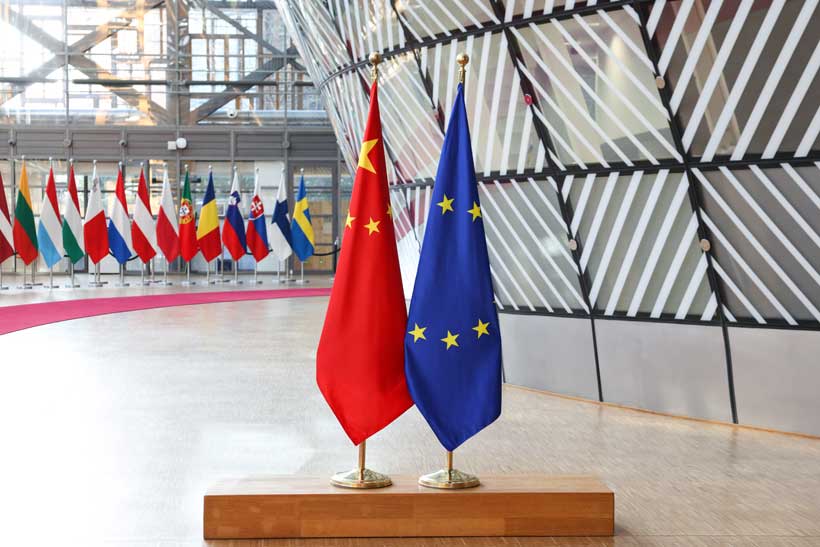
China has signalled its willingness to cooperate with the European Union on global economic imbalances, as both sides face growing tensions over trade, industrial competition and protectionism.
Chinese Finance Minister Lan Foan expressed Beijing’s readiness for dialogue during a meeting with senior European officials in Bangkok on Friday. The discussions focused on global economic governance and coordination of macroeconomic policies.
The meeting brought together Lan, European Commissioner for Economy and Productivity Valdis Dombrovskis, European Central Bank President Christine Lagarde and Eurogroup President Kyriakos Pierrakakis.
According to China’s Finance Ministry, Lan described global imbalances as a complex structural economic issue increasingly shaped by geopolitical tensions and protectionist policies.
Stay ahead of the geopolitical week.
MD Briefing delivers expert analysis across five global fronts — the Indo-Pacific, energy, geoeconomics, European security, and the Middle East — every Monday morning. Free.
He urged all parties to assess economic imbalances objectively and pursue greater cooperation and coordination in their macroeconomic policies.
Trade Tensions Complicate China-EU Relations
The diplomatic engagement comes just a week after China and the European Union reached an agreement to limit Chinese hybrid vehicle exports to the bloc, highlighting the economic disputes confronting both sides.
The EU is seeking to reduce its trade deficit with China, which reached €360 billion ($400 billion) in 2025. European policymakers have raised concerns about the competitiveness of domestic industries amid sustained imports from China.
Beijing’s call for dialogue therefore comes at a sensitive moment, as Brussels seeks to address trade disparities while protecting European manufacturers and maintaining access to the Chinese market.
The dispute over hybrid vehicles also illustrates how trade policy has become increasingly connected to broader concerns about industrial competitiveness, market access and strategic economic dependence.
Can Dialogue Address the Global Imbalance?
China’s willingness to discuss macroeconomic coordination could provide an opening for further engagement with European institutions. However, translating diplomatic statements into concrete changes will depend on how both sides address the structural factors behind their trade relationship.
For the EU, reducing the trade deficit remains an important economic priority. For China, resisting protectionist measures and maintaining access to European markets are central concerns.
The broader challenge is finding common ground between Beijing’s emphasis on cooperation and Brussels’ efforts to rebalance trade relations.
As geopolitical competition increasingly shapes economic policy, sustained dialogue could help prevent further escalation. However, the latest meeting does not establish that China and the EU have reached an agreement on the underlying causes of their economic imbalances.
Whether their renewed engagement produces meaningful progress will depend on their willingness to reconcile competing trade priorities and address longstanding economic differences.
With information from Reuters.
