


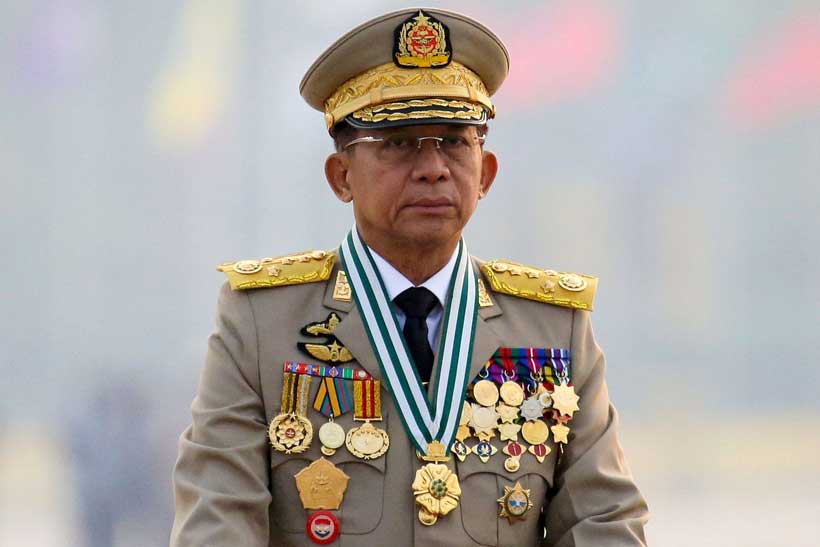
The United States and Myanmar’s military-backed government have held a second round of talks in a month, signalling a potential shift in Washington’s approach to the Southeast Asian country following the 2021 military coup.
The latest meeting took place in Tokyo last week, according to people familiar with the discussions. The talks follow a September meeting in Myanmar’s capital, Naypyitaw, where US officials discussed the release of an American businessman and efforts to shut down scam centres targeting US citizens.
Although the precise agenda of the Tokyo meeting remains unclear, the renewed diplomatic engagement could open the door to broader discussions on security, economic cooperation and access to Myanmar’s rare-earth mineral deposits.
The meetings mark a notable development in US policy toward Myanmar’s military leadership, which Washington has largely shunned since the overthrow of the elected government led by Aung San Suu Kyi.
Stay ahead of the geopolitical week.
MD Briefing delivers expert analysis across five global fronts — the Indo-Pacific, energy, geoeconomics, European security, and the Middle East — every Monday morning. Free.
Why Is Washington Re-engaging With Myanmar?
US Assistant Secretary of State for Intelligence and Research Michael Vance led the latest talks in Tokyo, accompanied by more than a dozen American officials, according to one person familiar with the meeting. The identities of Myanmar’s representatives have not been established.
The US State Department did not respond to a request for comment on the discussions. However, Washington has stated that it engages with groups across Myanmar on issues affecting American interests.
The September meeting between Vance and Min Aung Hlaing, Myanmar’s coup leader who subsequently became president, reportedly provided an opening for wider discussions. The quick return to negotiations suggests that both sides are interested in maintaining diplomatic contact.
A key priority for Washington is tackling scam operations that have defrauded Americans of billions of dollars through romance scams and other forms of online fraud.
Many of these operations are reportedly based in territories controlled by army-backed militias, with some proceeds allegedly flowing to the military. This raises questions about whether Myanmar’s authorities can or will take effective action against the networks.
Myanmar’s military-backed government has said it is participating in an international effort to combat scam centres.
Could Rare Earths Be Driving the US Strategy?
Beyond cybercrime and the release of detained Americans, access to Myanmar’s critical mineral resources could become a significant part of the renewed engagement.
Myanmar possesses substantial deposits of heavy rare earth elements, which are essential for manufacturing electric vehicles, wind turbines and other advanced technologies. Securing access to these materials could help Washington diversify supply chains and reduce its dependence on China, which remains the main buyer of Myanmar’s rare earths.
However, gaining access would be difficult. Many of the deposits are located in territories controlled by ethnic armed groups fighting Myanmar’s military. Any American effort to develop these resources would therefore face political, security and logistical obstacles.
China’s position presents another challenge. As the principal buyer of Myanmar’s rare earths, Beijing could resist an expanded US presence in a sector that has strategic importance for global technology and industrial supply chains.
Hunter Marston, Southeast Asia director at the Lowy Institute, said the Trump administration appeared to be approaching Myanmar through a transactional framework, with critical minerals and rare earths representing major strategic interests.
The potential importance of these resources suggests that Washington’s renewed engagement may extend beyond immediate concerns over fraud and detained Americans. Nevertheless, the precise role of mineral access in the latest talks remains unclear.
Sanctions Policy Signals a Possible Shift
Washington has also taken steps suggesting a reassessment of its approach to Myanmar.
Last week, the United States lifted sanctions on the daughter of a Myanmar businessman accused of supporting the military. The State Department described the decision as part of a new approach that emphasises dialogue with groups involved in the country’s civil war and a reassessment of the tools Washington has used to advance its interests.
However, the move does not amount to a wholesale normalisation of relations with Myanmar’s military leadership.
Min Aung Hlaing remains under US sanctions over human rights abuses, including his role in the 2021 coup and the subsequent suppression of popular opposition. Washington has also designated the mass killings and expulsions of Rohingya Muslims in 2016 and 2017 as genocide.
The United Nations has reported that Myanmar’s armed forces have killed thousands of people in airstrikes since the coup triggered widespread civil war.
These abuses continue to complicate any diplomatic opening. Engagement with the military-backed government could provide Washington with opportunities to pursue specific interests, but it also risks drawing criticism over the treatment of Myanmar’s opposition and ethnic communities.
What Role Is Japan Playing?
Japan’s involvement in hosting the discussions raises questions about whether Tokyo is simply facilitating American diplomacy or pursuing a broader effort to restore relations with Myanmar.
Japan’s Foreign Ministry said it had been communicating with both sides as necessary but declined to comment on specific diplomatic exchanges.
There are also signs of a separate Japanese effort to reopen channels with Myanmar’s military-backed authorities. Japan’s acting envoy to Myanmar met the government’s foreign minister earlier this month in their first known public engagement. Tokyo does not formally recognise the administration.
The meeting followed a September visit to Naypyitaw by Hiromichi Watanabe, a lawmaker from Japan’s ruling party. According to Myanmar’s state-run Global New Light of Myanmar newspaper, the visit was intended to explore renewed bilateral cooperation and the resumption of development assistance.
Watanabe told Reuters that his trip aimed to prepare the ground for normalising relations, although he acknowledged that significant barriers remained.
Japan condemned the 2021 military takeover but did not join the United States and several other Western governments in imposing sanctions on junta leaders and military-linked entities.
Tokyo has historically been a major investor in Myanmar, viewing the country as an important market and a means of balancing China’s regional influence. Many Japanese companies have continued operating there despite the political turmoil.
According to Japan’s trade promotion agency, JETRO, around 300 Japanese companies remain active in Myanmar, down from more than 400 in 2020.
What Happens Next?
The renewed US-Myanmar contacts could create opportunities for cooperation on online fraud, the release of detained Americans and critical mineral supply chains. However, the talks do not yet establish that Washington is preparing to restore full diplomatic or economic relations with the military-backed government.
The central question is whether limited negotiations over specific American interests will develop into a broader diplomatic strategy.
For Washington, Myanmar offers potential strategic and economic opportunities, particularly as competition with China intensifies over critical minerals. Yet the fragmented territorial situation, continuing civil war and record of military abuses could limit what any agreement can achieve.
Japan’s parallel outreach adds another dimension to the evolving situation. Whether Tokyo and Washington ultimately pursue coordinated engagement or separate approaches remains uncertain.
For now, the repeated meetings suggest that Myanmar is receiving renewed attention in US strategic calculations, even as the military-backed government continues to face international criticism over its seizure of power and conduct of the war.
With information from Reuters.
