


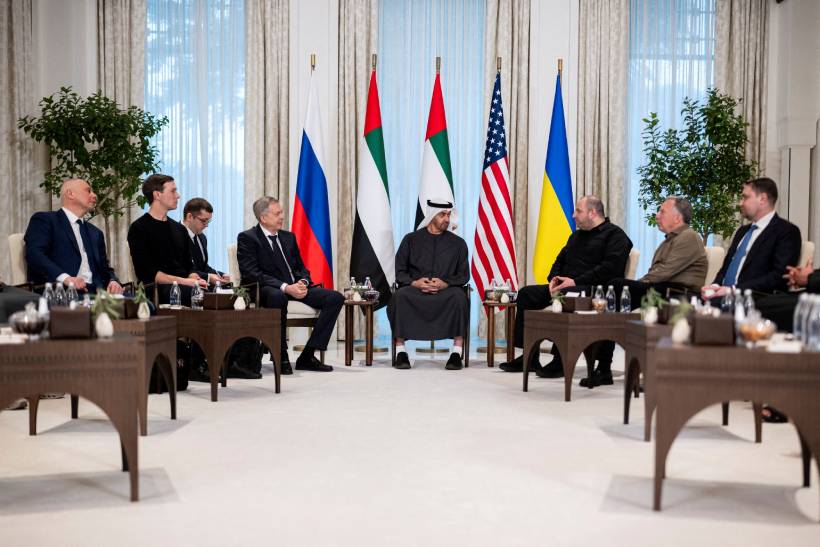
On 10 and 11 November, negotiators from Ukraine, Russia and the United States will meet in Abu Dhabi for a second round of US-mediated trilateral talks. The agenda, as Washington describes it, covers ending the war, de-escalation, humanitarian measures and post-war security arrangements. Europe will not be at the table. Asked whether European officials would take part, Kremlin aide Yuri Ushakov replied that they could get to Abu Dhabi if they bought tickets, but that no one intended to invite them. Moscow later clarified that Europeans may be present in the city and talk to the Americans and Ukrainians, but not negotiate. What Brussels has secured instead is a preparatory session with American negotiators in Brussels this week: a briefing room, not a negotiating table.
Most commentary will treat that exclusion as the story. It is not the whole of it. The more consequential development came a week earlier and drew far less attention. In remarks reported by the Financial Times, President Volodymyr Zelenskyy acknowledged for the first time that Russia’s demand for security guarantees would have to be addressed as part of a future settlement. Territory will dominate the coverage of Abu Dhabi, and Donetsk remains the main obstacle to any deal. But the acceptance of “security guarantees for Russia” as a legitimate category of negotiation is the concession with the longest reach into Europe’s own security order, and it is being normalised in a format Europe cannot shape.
From rejected demand to agenda item
Until recently this was not a position any Western capital entertained. Kyiv and its partners treated Moscow’s demands for guarantees from NATO as an attempt to restore a sphere of influence and hollow out its neighbours’ sovereignty. Zelenskyy himself dismissed the idea in August 2025, standing beside NATO Secretary General Mark Rutte and asking what guarantees an aggressor could possibly need. His position now is one of sequencing: end the war, meet Ukraine’s security needs first, and only then turn to the questions Russia raises.
Sequencing is not rejection. Once a category enters a negotiating framework, the debate moves from whether it belongs there to what it contains and when it is delivered. That is a meaningful shift, and it has taken place under visible American pressure rather than as the result of any change in Russian conduct.
Stay ahead of the geopolitical week.
MD Briefing delivers expert analysis across five global fronts — the Indo-Pacific, energy, geoeconomics, European security, and the Middle East — every Monday morning. Free.
What Moscow means by guarantees is not a mystery. Its December 2021 draft treaties demanded an end to NATO enlargement and the withdrawal of Allied forces and infrastructure from states that joined after 1997. According to UNITED24 Media, Russia may use Abu Dhabi to press for rolling NATO’s military presence in Eastern Europe back to 1997 levels. Zelenskyy has been explicit about the stakes: guarantees for Russia, as Russia understands them, would mean changing the security architecture of Europe and beyond.
This is the structural problem. Guarantees for Ukraine can be bilateral or coalition-based. Guarantees for Russia cannot be given by Ukraine alone, because they are by definition commitments about the behaviour of third parties: force posture in Poland and the Baltic states, rotational deployments, missile basing, the shape of NATO’s new northern flank after Finland’s accession. Those third parties are European. Their obligations would be discussed, at least conceptually, in a room they have been told they may only visit as tourists.
Why the format is the strategy
Moscow’s insistence on a trilateral format is not procedural pettiness. Excluding Europe allows Russia to frame European security as a matter to be settled between itself and Washington, which is the framing it has sought since the end of the Cold War. And Washington has shown it is willing to lean on Kyiv. The FT reports that relations soured in October after the White House pressed Ukraine to halt long-range drone strikes on Russian oil infrastructure, amid delays in air defence deliveries and a temporary suspension of intelligence sharing. Zelenskyy said the United States had supplied an average of just a dozen Patriot interceptors a month this year, and admitted Kyiv had grown more cautious about refinery strikes since Washington declared a unilateral energy ceasefire.
Zelenskyy also said he had heard signals of a possible reduction of American troops in Europe. A US drawdown decided on its own terms is one thing. A drawdown that becomes linked, even implicitly, to a Ukraine settlement is another. It would turn a sovereign American force-posture decision into something Moscow can later present as a promise, and treat any reversal as a breach. Europe would inherit the consequences without having consented to the bargain.
Europe’s own disorganisation compounds the problem. A Ukrainian source told Ukrainska Pravda that the main difficulty is the absence of a clearly empowered European representative able to take decisions in the room. The European Commission and Council are assembling a joint team of senior officials, and Kyiv has promised to brief Europeans in real time. But real-time briefings are what observers receive. Meanwhile, Moscow is cultivating bilateral channels instead, as with Putin’s calls with the leaders of Finland and Norway, which offer European capitals contact without collective standing.
The case for engaging
There is a defensible argument for Zelenskyy’s shift, and it deserves a fair hearing. A settlement that ignores Russia’s stated concerns entirely is unlikely to hold, and some arrangements could reduce the risk of renewed war without surrendering anyone’s sovereignty. Kyiv says it is ready to discuss an American proposal for a demilitarised zone on both sides of the front line. Incident-prevention mechanisms, notification of large exercises and limits on certain deployments near the contact line all have precedents in Cold War arms control, from the Helsinki Final Act to the Conventional Armed Forces in Europe Treaty. Mutual reassurance was the logic of that era, and it kept a far more heavily armed continent stable for decades.
The distinction that matters is between reciprocal, verifiable military transparency and unilateral limits on where NATO members may station forces on their own territory. The first is arms control. The second is a sphere of influence. The danger of the Abu Dhabi format is not that guarantees are being discussed, but that the line between those two things may be drawn by the parties with the least at stake in where it falls.
What Europe can still do
Europe cannot force its way into Abu Dhabi, but it is not without leverage, and it has days rather than weeks to use it. Three steps would matter.
First, European governments should state collectively which kinds of guarantees they could accept, such as reciprocal confidence-building and transparency measures, and which they will not, namely binding limits on Allied posture on Allied soil. A public line set in advance is harder to trade away in private.
Second, the EU and the leading European capitals need a single empowered negotiator. As long as Washington and Kyiv cannot say who speaks for Europe, Europe will be briefed rather than consulted.
Third, Europe should make plain to Washington that any commitment touching European force posture requires European consent and will not be implemented otherwise. The troops, bases and infrastructure in question are European or hosted by Europeans. So are many of the instruments Moscow ultimately wants: sanctions relief that requires EU unanimity, frozen sovereign assets, and the reconstruction money any settlement will need. Those are not tickets to Abu Dhabi, but they are reasons for every party there to keep Europe’s position in mind.
Ushakov’s remark about buying tickets was meant as a taunt. It also describes, with some accuracy, how Europe risks entering the post-war order: present, informed and bound by terms written elsewhere. The cameras in Abu Dhabi will follow the map of Ukraine. The map that matters more for Europe, showing where NATO may stand and on whose terms, is being sketched in the margins.
