Two Bridges and a Warning
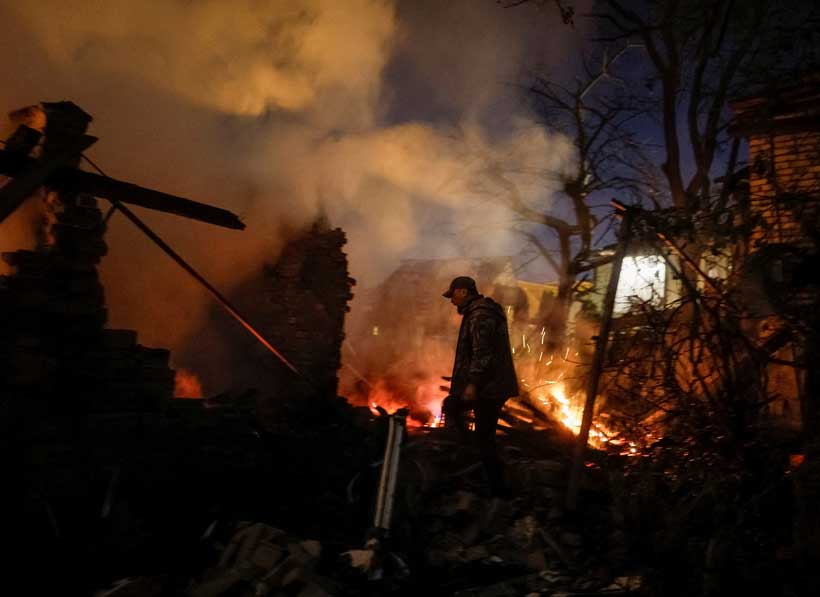
At about 11:30 on 1 October, a Russian jet drone struck Kyiv’s Southern Bridge while a metro train was crossing it. Two days later drones hit the Northern Bridge, wounding two people and cutting trolleybus power. By Saturday, three of the city’s six road bridges over the Dnipro were fully or partly closed, snarling a river crossing used by roughly 500,000 commuters a day. The same day, Russia’s foreign ministry warned foreign nationals, “including diplomatic mission staff,” against staying in Ukraine, adding that “responsibility for any adverse consequences lies entirely with those who ignore this warning.” Read together, the bridges and the warning point at one target. Moscow is not trying to take Kyiv. It wants other governments to stop treating it as a safe place to govern from.
Third Time Asking
Moscow has tried this twice before. In November 2024, after Russian threats of retaliation, the US, Italian and Greek embassies closed for a day over a “potential significant air attack.” In May 2026, a day after one of the heaviest strikes on Kyiv of the war, Russia’s foreign ministry announced “systematic strikes” on “decision-making centres” and urged diplomats and international-organisation staff to leave “as soon as possible”; Sergei Lavrov repeated the message to Marco Rubio by phone. No embassy left. Nearly 50 countries condemned the threat at the UN. The United States did not sign, though the State Department said there were “no changes to embassy operations.”
Stay ahead of the geopolitical week.
MD Briefing delivers expert analysis across five global fronts — the Indo-Pacific, energy, geoeconomics, European security, and the Middle East — every Monday morning. Free.
Behind all of this is a memory both sides share. In February 2022 Washington moved its embassy to Lviv, others followed, and the picture of an emptying diplomatic quarter fed Moscow’s belief that Kyiv would fall within days. Today the 1,250-km front line has been virtually deadlocked for months. The capital is where Russia sees room to move.
A Capital Is Something Other Governments Agree On
Start with the bridges, because the military case for hitting them is weak. Russia’s defence ministry says they carry troops and military cargo. Ukrainian engineers point out that drones alone cannot bring down structures of this size; at most they close lanes for hours. What closures do produce is visible misery: gridlocked commuters, a metro line suspended, a city of three million cut in two by its own river as the heating season starts. Ukrainian officials say they have obtained Russian plans for a winter campaign against electricity, heating, water and transport, on top of the escalating strikes on the grid of the past weeks. Volodymyr Zelensky put the logic bluntly: “They want Ukrainians to leave the capital … and show that if you don’t have the capital you don’t have the country.”
The warning to diplomats is the other half of the same operation. A capital is not only a city with ministries in it; it is the place other governments agree to treat as the seat of a state, and embassies are how that agreement is expressed. Embassy postures are not set by foreign ministers’ speeches. They are set by security officers applying duty-of-care rules and by threat assessments that react to exactly the kind of formal, public warning Moscow issued on Saturday. Russia is not addressing Ukraine’s army. It is addressing the risk managers in foreign ministries.
The prize is a cascade, not an exodus. Moscow does not need 25 European embassies to leave. It needs one large mission to order non-essential staff out, or to move to Lviv “temporarily.” Travel advisories follow embassy postures; insurers, lenders, aid agencies and companies follow travel advisories. Kyiv would then look less like a capital under fire and more like a front-line city, which is how Moscow wants it described at any negotiating table. That takes no ground gained, just the right photographs.
So far the line has held, and held loudly. On Sunday all 25 EU member states with embassies in Kyiv, plus the EU delegation, posted matching messages: “We are staying in Kyiv.” The EU ambassador, Katarína Mathernová, said Moscow “wants to scare Europe into reducing its support for Ukraine”. Friedrich Merz arrived the same day by train, pledging 1,000 interceptors against jet-powered Shahed drones. But there are two weak points. The first is Washington, which stayed out of May’s UN statement and has kept its public line to a minimum. The second is in the fine print of the European plans. An unnamed diplomat told the Guardian that missions have contingency plans to move to Lviv or eastern Poland, but only if Russia deliberately targets foreign missions. That condition hands Moscow a switch. In August 2025 two missiles landed 80–90 metres from the EU delegation. A strike that close, presented as an accident, would test whether “deliberate” is a line anyone can draw in practice.
The strongest objection is that governments owe their staff a duty of care, and keeping diplomats in a city under bombardment for the sake of a symbol is reckless. Embassies do not stop missiles. True, but the attack is itself aimed at a symbol, so the symbol is the defence. Nor is the choice between staying and leaving. Missions have spent three winters in Kyiv managing risk with shelters, staff rotation and remote work during alerts. The risk is real and manageable. The strategic cost of leaving is just as real, and it appears nowhere in a duty-of-care spreadsheet.
Denying Moscow the result takes four things. First, a collective commitment: G7 and EU governments should say jointly that no mission will relocate in response to Russian warnings, and that any change in posture will be coordinated, not unilateral. Second, separate contingency triggers from Russian announcements, so that departures follow observed threats rather than Moscow’s press office. Third, treat air defence for Kyiv as protection for the diplomatic community as well as for Ukrainians; interceptors over the capital are the cheapest way to keep embassies open. Fourth, keep the traffic flowing: ministerial visits, investment conferences and export-credit cover that tell business Kyiv is open. On the first point, a US signature matters more than any other.
How the Winter Could Go
Base case: embassies hold, Kyiv has a hard winter (about 55%). Russia keeps hitting bridges, substations and heating plants, and Moscow promises more of the same. Disruptions are frequent but short. A few smaller missions quietly thin their staff and work partly from Lviv or Warsaw without announcing it, but no major Western embassy relocates. Ministerial visits continue, and “we are staying” hardens from a slogan into routine. Moscow gets misery, not the picture it wants. The key assumption: no strike seriously damages a Western mission.
Downside: one mission blinks (about 30%). A strike damages a Western embassy or kills foreign staff. A major mission orders non-essential staff out or moves to Lviv “temporarily.” The most likely candidate is the US, whose posture already sits apart from the European line. Smaller embassies, UN agencies and lenders follow their own advisories. Moscow presents it as proof that Kyiv is a war zone, and in any talks pushes for terms that treat the capital’s status as negotiable. Within days, insurance and travel cover for Kyiv tighten, and the business case for being there weakens with them.
Upside: threats become free to ignore (about 15%). The EU and G7 formally commit to stay. An air-defence surge, combining German interceptors and European purchases, measurably cuts drone hits on the capital, and Washington publicly aligns with the Europeans. With no visible payoff, Russia shifts strike priorities back to the front and to energy targets outside Kyiv. The condition: Washington decides that a Kyiv that keeps functioning strengthens its own hand in any negotiation.
Make Leaving the Harder Decision
Russia’s Kyiv campaign is aimed less at Ukraine’s army than at foreign capitals. It asks them to say, through their actions, that Kyiv is no longer a safe seat of government. Every embassy that stays refuses. Every one that leaves, however briefly, hands Moscow a result it cannot win on the front line.
Watch the European Council on 15–16 October. If the leaders’ conclusions include a collective commitment to keep missions in Kyiv and a specific air-defence pledge for the capital, Europe will have turned a weekend of social-media posts into policy. If the text is silent, the decision falls back to each mission’s security officer, one air-raid alert at a time. That is exactly where Moscow wants it.