


A year after US President Donald Trump unveiled his plan to end the Gaza war, the conflict remains far from the political settlement Washington envisioned. Although the plan helped produce a ceasefire in October 2025 and secured the release of the remaining Israeli hostages held in Gaza, its broader objectives have proved much harder to achieve.
Israeli military strikes continue, Israel retains control over roughly two-thirds of the Gaza Strip and Palestinians remain concentrated in an increasingly restricted coastal area. Hamas has not disarmed, an international stabilization force has yet to be deployed and reconstruction remains largely out of reach.
The result is a plan that delivered a major first step but has struggled to translate that breakthrough into a durable post-war order.
What Did Trump’s Plan Promise?
Trump’s 20-point plan was designed as a phased framework for ending the conflict and establishing a new political and security structure in Gaza.
Stay ahead of the geopolitical week.
MD Briefing delivers expert analysis across five global fronts — the Indo-Pacific, energy, geoeconomics, European security, and the Middle East — every Monday morning. Free.
Its first phase called for a suspension of military operations, the release of Israeli hostages and Palestinian prisoners, an Israeli withdrawal from part of Gaza and a major increase in humanitarian assistance.
The later phases were more ambitious. Hamas was expected to surrender its weapons, while Gaza would eventually be governed by a Palestinian technocratic administration overseen by the Trump-led Board of Peace. An International Stabilization Force would assume responsibility for security as Israeli forces gradually withdrew.
The plan also promised the reconstruction of Gaza and presented the territory’s redevelopment as being intended for the benefit of its population.
The difficulty has been moving from the relatively achievable first phase to the questions at the heart of the conflict: who controls Gaza, who provides its security and what happens to Hamas.
A Ceasefire That Has Not Produced an End to Violence
The October 2025 ceasefire prevented a return to the kind of full-scale military campaign seen during the earlier stages of the war. But it has not stopped Israeli military action.
Gaza’s health ministry says at least 1,400 Palestinians have been killed since the ceasefire, including women and children. Israel says its attacks have targeted Hamas militants and accuses the group of attempting to carry out attacks and rebuild its military capabilities. Hamas denies those allegations.
Five Israeli soldiers have also been killed by Palestinian militants or in combat since the ceasefire, according to the Israeli military.
That continued violence exposes one of the central weaknesses of the arrangement: the ceasefire has reduced the intensity of the war without resolving the security dispute between Israel and Hamas.
Israel’s Control Has Expanded
The territorial reality also looks increasingly different from the original plan.
Trump’s first-phase framework envisaged an Israeli withdrawal to a designated “yellow line”, leaving Israel in control of about 53% of Gaza. Since then, Israeli forces have expanded their effective control to roughly two-thirds of the territory.
The advancing line has pushed more Palestinians into an increasingly compressed coastal zone. About two million people remain concentrated in an area where many are living in tents or damaged buildings.
The territorial shift matters because Israeli withdrawal was supposed to be linked to the wider transition toward an international security arrangement. Instead, Israel’s continued presence has become one of the main obstacles to that transition.
Israeli-backed Palestinian militias opposed to Hamas have also used areas under Israeli control to launch attacks into Hamas-controlled territory, adding another layer to Gaza’s fragmented security landscape.
Aid Has Increased, but the Humanitarian Crisis Remains
Humanitarian assistance has improved since the ceasefire, but aid agencies say the increase remains insufficient.
The Integrated Food Security Phase Classification has reported that more than 1.2 million people in Gaza continue to face acute hunger. Between the ceasefire and the end of May, an average of 227 trucks carrying humanitarian and commercial supplies entered Gaza each day, according to data cited by the organization.
That was less than half the 600 trucks per day stipulated in Trump’s Gaza plan.
Israel disputes the characterization of the aid situation, saying roughly 600 trucks carrying humanitarian and commercial goods are entering Gaza each day and that sufficient supplies are available.
Aid organizations, however, say restrictions remain on items such as metal tent poles, engine oil and spare parts because of Israeli concerns that Hamas could use them for military purposes.
The dispute illustrates a broader problem with the plan: even where there is agreement on the need for humanitarian assistance, the parties remain divided over what constitutes sufficient access and what security restrictions are justified.
Hamas Has Moved Closer to Giving Up Its Weapons, but Not Disarmed
Perhaps the most significant political question is whether Hamas will surrender its weapons.
In July, Trump said Hamas and other Palestinian armed groups had accepted a 15-point roadmap developed by the Board of Peace. Under the proposal, Hamas would hand over its weapons for storage under the control of a US-backed Palestinian technocratic government. Israeli forces would then withdraw as Hamas disarmed.
Hamas rejected the term “disarmament” but indicated that its weapons could be placed under the authority of the proposed Palestinian administration. That represented a significant shift from its previous position.
Israel, however, has remained deeply skeptical that Hamas will actually surrender its military capabilities. Israeli officials have said there will be no meaningful withdrawal until Hamas is fully disarmed.
The disagreement has therefore produced a circular problem. Israel wants Hamas disarmed before completing its withdrawal, while the proposed framework links Hamas’s disarmament to an Israeli withdrawal.
Without agreement on sequencing, the second phase of Trump’s plan remains largely stalled.
The International Stabilization Force Exists on Paper
The proposed International Stabilization Force was supposed to become the bridge between Israeli withdrawal and a new Palestinian security structure.
There has been some progress. US Major General Jasper Jeffers has been appointed commander, while Indonesia, Morocco, Kazakhstan, Albania, Kosovo and Uganda have committed personnel. The long-term proposal envisages a force of around 20,000 troops alongside the training of approximately 12,000 Palestinian police officers.
But the force has not yet been fully assembled or deployed.
A separate Palestinian technocratic body, the National Committee for the Administration of Gaza, was appointed in January under Ali Shaath, a former deputy minister in the Palestinian Authority. It has yet to establish itself inside Gaza.
That leaves a major gap between the proposed political architecture and the reality on the ground.
Reconstruction Is Still a Distant Prospect
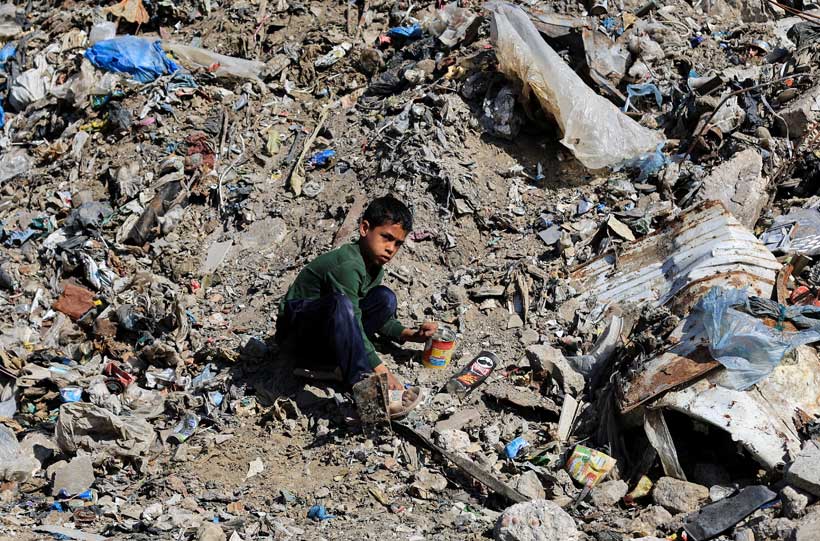
The physical devastation of Gaza remains another reminder of how far the plan is from its ultimate objectives.
Palestinians continue to live among destroyed buildings and use materials recovered from the rubble to reinforce temporary shelters.
The Board of Peace announced a $2.45 billion reconstruction plan in September. But the figure is far below the estimated $71.4 billion needed for recovery and reconstruction over the next decade, according to an assessment by the United Nations and European Union released in April.
The financing gap is therefore enormous. Even if the political and security obstacles were resolved, rebuilding Gaza would require sustained international funding and a functioning administration capable of delivering it.
Gaza’s Future Remains Politically Contested
Perhaps the biggest uncertainty concerns what Israel and the United States ultimately envision for Gaza’s political future.
Trump’s plan formally envisages Palestinians remaining in Gaza and rebuilding the territory. But influential Israeli right-wing politicians have continued to advocate what they describe as the “voluntary emigration” of Palestinians.
Israeli Defence Minister Israel Katz recently argued that there was no real long-term solution for Gaza without such migration. Israel established an office in 2025 tasked with overseeing what it called voluntary emigration from the territory.
Trump himself previously suggested that Palestinians could be permanently displaced from Gaza, although he later moved away from the proposal following strong opposition from Arab governments and widespread international rejection.
Israeli officials have maintained that there are no plans to forcibly remove Gaza’s population.
The contradiction between these competing visions has not disappeared, however. It raises fundamental questions about whether the future Gaza envisaged by Trump’s plan will actually be one in which its current population remains, governs itself and participates in reconstruction.
What Happens Next?
Israel’s upcoming general election on October 27 could add another layer of uncertainty.
The election will be the country’s first since the October 7, 2023, Hamas attack, and the political contest is expected to influence the debate over Gaza’s future. Some leading opposition figures have backed Trump’s plan, while polling indicates a closely contested race between pro- and anti-Netanyahu blocs.
For Trump, the challenge is no longer simply stopping the war. It is turning a ceasefire into a sustainable political settlement.
The first year of the plan shows that securing agreement on hostages, prisoners and an initial pause in fighting was possible. The far more difficult questions remain unresolved: whether Hamas will disarm, whether Israel will withdraw, who will govern Gaza, who will provide security and whether enough money can be mobilized to rebuild the territory.
Until those questions are answered, Trump’s Gaza plan risks becoming a framework that successfully interrupted the war without actually resolving it.
With information from Reuters. [
