A Runway Next Door to Wing 23
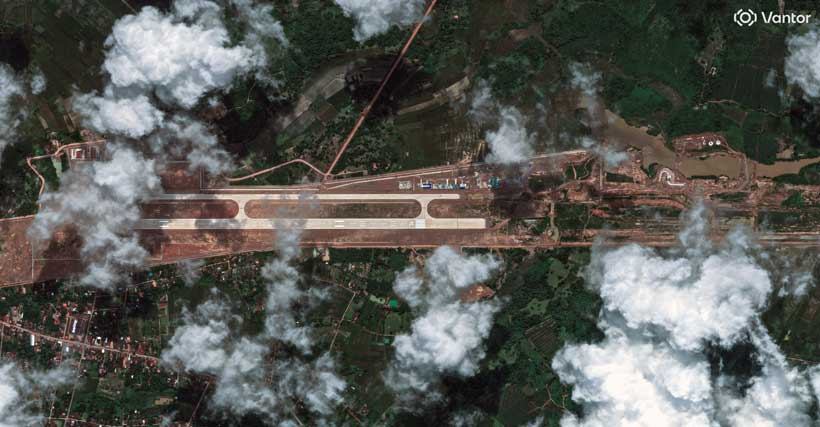
In August, Chinese J-10C and J-11 fighters and an airborne early-warning aircraft spent eleven days flying out of Wing 23, the Royal Thai Air Force base at Udon Thani, for the Falcon Strike 2026 exercise. On 29 September, seven weeks after they went home, the People’s Liberation Army opened an airfield of its own less than 170 km to the north. The China–Laos Joint Support and Training Center at Ban Keun, in Vientiane Province, has a 2,000-metre runway, taxiways, aprons and hangars, and a Chinese defence ministry assurance that it is “not directed against any third party.” This week’s attention will be on the Taiwan Strait, where Beijing has used President Lai Ching-te’s National Day speech as a pretext for drills before. The more lasting shift is happening some 2,000 km to the southwest, and it runs on runways, not piers.
From Djibouti to Ream to a Rice Field
Ban Keun is China’s third overseas military installation. The first, in Djibouti, opened in 2017 at the mouth of the Red Sea. The second, a joint support and training center at Cambodia’s Ream Naval Base on the Gulf of Thailand, opened in April 2025. Both are maritime. Ban Keun, built from late 2025 on farmland beside an old American airstrip from the Indochina wars, is the first organised around air power. It pairs the joint centre with a China–Laos Friendship Aviation Academy that will train Lao pilots and ground crews.
Stay ahead of the geopolitical week.
MD Briefing delivers expert analysis across five global fronts — the Indo-Pacific, energy, geoeconomics, European security, and the Middle East — every Monday morning. Free.
Laos is an easy host. Its air force is tiny, with about 30 aircraft, mostly helicopters plus a handful of Chinese K-8 and Russian Yak-130 trainers. Its finances are bound to Beijing: China holds roughly half of Laos’s $10.5 billion external public debt, and the $6 billion China–Laos Railway, opened in 2021, runs from Kunming to Vientiane. The Pentagon’s most recent list of countries where China was weighing military facilities did not include Laos at all.
Why Airfields, and Why Laos
Most coverage has treated Ban Keun as one more dot on a map of Chinese bases. That misses what is new. Djibouti and Ream follow a navy’s logic: protect sea lanes, resupply ships, sit near chokepoints. Each depends on supply routes through waters the US Navy can still contest. Ban Keun breaks the pattern twice. It is an airfield, and it can be supplied over land. It sits on the China–Laos Railway corridor, so fuel, spares and people can move from Kunming by rail without touching a sea lane anyone else controls.
Airfields do things ports cannot. A runway in central Laos brings northeastern Thailand, Vietnam’s western flank, northern Cambodia and eastern Myanmar within easy range of aircraft that would otherwise have to fly from Yunnan. Chinese commentators put major mainland Southeast Asian cities 500–700 km away; by our own measurement, both Bangkok and Hanoi fall within about 600 km. A 2,000-metre strip handles trainers, fighters, medium transports and surveillance aircraft — the platforms that build presence and situational awareness — even if heavy airlift at full load would struggle.
Chinese military commentators have been unusually frank about the purpose. One widely read account, Junwu Ciweimian, listed three functions: committing the Lao air force to Chinese equipment for good, giving Chinese aircraft a secondary base for exercises “closer to actual combat” rather than routing them through Thailand, and building influence across the Indochina Peninsula. Another, Ronping, argued that Cambodia’s hedging (Phnom Penh welcomed the USS Cincinnati to Ream in January) makes Laos the “more loyal partner.” That is the testing-ground logic in plain words: pick the most dependent host on the most permissive terrain, and see how far the model stretches.
The second of those functions is the one Bangkok should read twice. Falcon Strike has made Thailand, a US treaty ally, the PLA Air Force’s indispensable partner on the mainland. That gave Bangkok leverage in Beijing and a quiet hedge against Washington. Ban Keun erodes both: China no longer needs Thai airspace to practise operating abroad, and Thailand’s main northeastern air base now has a Chinese-run runway just across the Mekong. Bangkok’s public line, from Rear Admiral Surasant Kongsiri, is that Thailand “will continue to closely monitor developments” while respecting Laos’s sovereign choice. That is about all it can say. Thailand already buys roughly twice as much weaponry from China as from the US and is acquiring a Chinese submarine; Washington turned down its F-35 request in 2023. Protesting loudly would expose how thin the alliance has worn. Saying nothing invites the question of whose side its airspace is on.
For Vietnam the problem is geography. Laos shares a border of more than 2,100 km with Vietnam and has been Hanoi’s closest partner since their 1977 friendship treaty, a “special relationship” in which Vietnam trains Lao officers and treats Laos as strategic depth. Ban Keun sits under 300 km from the Vietnamese border. A country that fought China in 1979, and contests its claims at sea, now faces a Chinese military runway on its landward side too. Hanoi has said nothing publicly, in keeping with its careful balancing between the great powers, but no capital has more reason to worry.
The strongest objection is that this is a small flight school in a poor country, and that alarm repeats the overreaction to Ream, where no permanent Chinese garrison has been confirmed. China’s overseas network is still dwarfed by America’s several hundred bases. All true, and beside the point. The model being tested is not a garrison but access: PLA personnel rotating in as instructors and technicians, aircraft arriving for “training,” logistics stocks building up, all under a host-nation flag. Cambodia showed a host can dilute that by inviting others in. Laos, which owes Beijing roughly $5 billion, is in a far weaker position to try. As the Council on Foreign Relations’ Joshua Kurlantzick put it, “China is not building one base in Laos and stopping.”
Three Ways Ban Keun Grows
Base case — quiet rotation (about 60%). Chinese instructors and technicians rotate through, Chinese trainers replace older types in the Lao inventory over three to five years, and PLA Air Force transport and training flights become routine but unannounced. Thailand keeps Falcon Strike going and privately asks Beijing for notification of deployments. Vietnam deepens training and infrastructure ties with Vientiane without public protest. The key assumption: Beijing keeps Ban Keun below the threshold of visible combat deployment, as it has at Ream.
Downside — an operational test (about 25%). During a Taiwan crisis or a flare-up on the Thai–Cambodian border, commercial satellite imagery shows PLA surveillance aircraft or long-range drones on the Ban Keun apron. That would turn a training site into a forward intelligence node overlooking Thai bases and Vietnam’s interior. Washington would press Bangkok over US access to U-Tapao, its key logistics airfield in Thailand; Thai opposition parties would make it a sovereignty issue; Hanoi would raise it directly with Vientiane and push for transparency inside ASEAN. For governments and investors, mainland Southeast Asia would shift from economic corridor to contested military space.
Alternative — Laos internationalises the academy (about 15%). Prodded by Hanoi, Vientiane opens the aviation academy to Vietnamese or Thai trainees, or invites ASEAN observers, much as Cambodia blunted criticism of Ream by welcoming foreign warships. That would dilute Chinese exclusivity and give Bangkok political cover. The condition: Vietnam would need to put economic offers on the table large enough to matter to a debt-stressed Lao government.
The Base That Doesn’t Need the Sea
China’s overseas footprint is changing shape. The ports protected its trade; the airfields are about influence over its neighbours. Mainland Southeast Asia, with a dependent Laos, an accommodating Thailand and a railway from Kunming, is where Beijing is testing how much of that it can do without provoking a response. Ban Keun is not a crisis. It is a precedent.
Watch Saturday, 10 October, and the days after. If Lai’s National Day speech draws PLA drills, as it did four days after his 2024 address, look at commercial satellite imagery of Ban Keun while they run. Chinese military aircraft on that apron during a Taiwan exercise would show the training centre is already on the PLA’s operational map. An empty apron buys Bangkok and Hanoi time, though not much.