


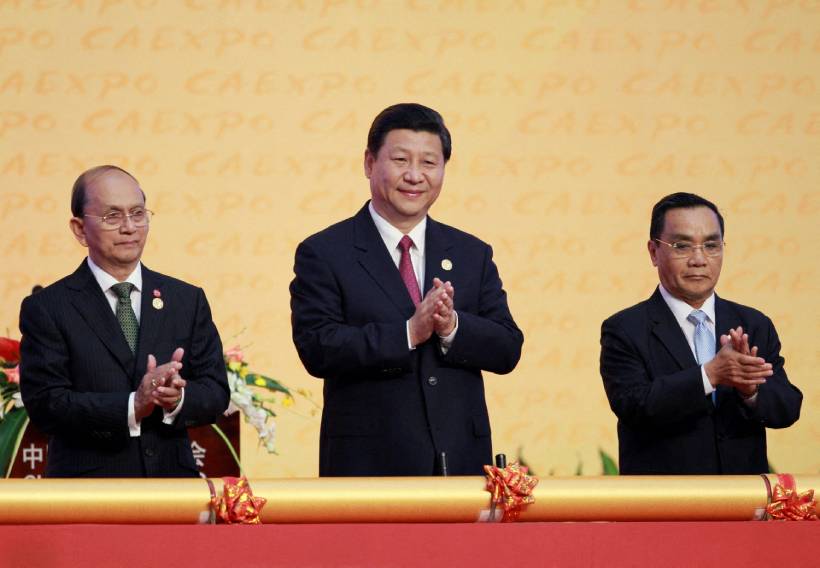
Wang Yi just completed his third multi-country tour of Southeast Asia in twelve months. Xi Jinping has visited the region twice since April 2025. When Trump arrived in Beijing this week, the last time a senior American official had been in Southeast Asia was Hegseth, in 2025, doing a single tour that covered four countries and has not been repeated since.
That gap tells you most of what you need to know.
Southeast Asian governments notice who shows up and who does not. Presence in this region is not a diplomatic nicety. It is the substance of the relationship. When Washington stops sending senior officials regularly, governments do not wait around hoping things will change. They start building other options. They have been doing exactly that, and the results are showing up in ways that should concern anyone paying attention to where this region is heading.
The ISEAS-Yusof Ishak Institute published its 2026 State of Southeast Asia Survey in April. When asked to choose between China and the United States, 52% of respondents leaned toward China. A year ago, the top regional concern was Chinese aggression in the South China Sea. In 2026, it is anxiety about US leadership under Trump. The region has not fallen in love with Beijing. It has lost confidence in Washington, and that is a different problem with different implications.
Stay ahead of the geopolitical week.
MD Briefing delivers expert analysis across five global fronts — the Indo-Pacific, energy, geoeconomics, European security, and the Middle East — every Monday morning. Free.
Washington’s Presence Problem in Southeast Asia
Trump has visited one Southeast Asian country since taking office. Malaysia, for the ASEAN summit. Rubio has been to Malaysia twice. Hegseth did a regional tour in 2025 and has not returned. Meanwhile Wang Yi just wrapped up his third Southeast Asian swing in a year. Xi has visited twice.
The numbers are not complicated. China is showing up, America is not.
In Southeast Asia this matters more than almost anywhere else. The region’s governments make foreign policy decisions based heavily on who takes them seriously enough to visit, negotiate directly, and maintain relationships through the inevitable friction points. When that engagement disappears, governments do not put their foreign policy on hold. They find other partners who are willing to do the work. That process has been underway for several years and the Iran war accelerated it considerably. The Strait of Hormuz closure hit Asian energy markets hard. Southeast Asian governments that were already frustrated with American unpredictability watched the United States start a war that drove up their fuel costs, disrupted their food supply chains, and forced them to explore Russian oil as an emergency alternative. Thailand’s prime minister said the war should never have happened. Singapore’s foreign minister called America a revisionist power. These are not minor complaints from minor partners. They are serious signals from governments that have historically been among Washington’s most reliable friends in the region.
The 52% Number and What It Actually Means
Read carefully, the 52% figure is not a story about China winning. It is a story about America losing.
The same survey that shows 52% leaning toward China also shows deep and persistent concern about Chinese behavior in the South China Sea, about Beijing’s growing economic dominance, about the risks of depending too heavily on a neighbor that has been steadily expanding its territorial claims. Southeast Asian governments do not trust China. They are not choosing Beijing out of admiration or ideological sympathy. They are drifting toward it because Washington has given them fewer reasons to stay anchored to the American connection.
That matters because the two things require completely different responses. If the region genuinely preferred China, the problem would be structural and probably irreversible at this point. Since the region is drifting reluctantly, because American behavior has been erratic and American engagement has been thin, a different approach from Washington could actually reverse it. The window has not closed. But it is narrowing, and the Beijing summit this week did nothing to stop that narrowing.
China’s Advantage Is Consistency, Not Charm
Nobody in Southeast Asia is particularly charmed by China. Beijing’s South China Sea behavior generates genuine fear and resentment across the region. Chinese economic dominance worries governments that have watched smaller neighbors become heavily dependent on Chinese financing and Chinese markets. The Lancang-Mekong mechanism, which connects China with five mainland Southeast Asian states on water governance and development finance, looks cooperative on paper and functions partly as a vehicle for Chinese leverage over countries downstream.
What China offers that Washington currently does not is consistency. Beijing shows up on a predictable schedule. Its trade agreements run on formal planning cycles that survive changes in leadership. The ASEAN-China Free Trade Area 3.0, implemented this year, reflects a calculation that Chinese goods, platforms, and logistics networks are already so deeply embedded in regional economies that resisting further integration would cost more than managing it. So ASEAN negotiated terms rather than fought the tide. That is not enthusiasm for China. It is pragmatism about a reality that Washington helped create by being absent during the years when it mattered most.
The technology dimension deepens all of this. Chinese AI systems, digital infrastructure, and technical standards are being installed across the region through Belt and Road projects. Once that infrastructure is in place, switching to American alternatives becomes enormously expensive. The region is being locked into Chinese-built systems gradually, investment by investment, agreement by agreement, and the process is far enough along that reversing it would require sustained American engagement that has simply not been forthcoming.
The Double Bind of the Trump-Xi Summit
Here is the part that does not get enough attention. Southeast Asian governments are not simply hoping the US-China relationship stabilizes. They are worried about what stabilization might cost them.
A Trump-Xi deal that produces genuine accommodation between the two powers could easily come at Southeast Asia’s expense. Washington needs Beijing’s cooperation on Iran. It needs Chinese minerals for its defense supply chains. It wants a trade arrangement that reduces domestic economic pain before the midterms. All of those needs point toward concessions, and the concessions most available are ones that matter enormously to Southeast Asia: reduced American pressure on Chinese South China Sea behavior, relaxed technology export controls, and an implicit acknowledgment that Beijing has primacy in its immediate neighborhood.
The Philippines is watching this summit with particular anxiety. As ASEAN chair in 2026, and as the country that has been most willing to contest Chinese territorial claims in the South China Sea, Manila has the most to lose from a Washington that decides Chinese cooperation is worth more than Philippine security. The Thailand-Cambodia ceasefire in 2025 was a preview of how US-China accommodation plays out regionally. Both Trump and Xi mediated on the sidelines of the ASEAN Foreign Ministers’ meeting. The ceasefire held, but ASEAN’s institutional role was bypassed entirely. The two great powers managed the situation bilaterally and the regional organization watched from the outside. If that becomes the template, Southeast Asian governments have less agency over their own neighborhood than they have had at any point in the past thirty years.
The Hedging Strategy and Its Limits
The region’s response to all of this has been to build as many relationships as possible. The Philippines signed a reciprocal access agreement with Japan and expanded military cooperation with Australia. Vietnam deepened ties with South Korea and India. Indonesia joined BRICS while keeping its American security arrangements intact. Singapore is developing a new trade partnership framework that deliberately spreads its commercial relationships across multiple partners.
This approach has worked reasonably well so far. It keeps options open, prevents either great power from claiming exclusive influence, and gives smaller states bargaining leverage they would not have through exclusive alignment. But the Iran war exposed a real weakness in it. When the Strait of Hormuz disrupted energy supplies across Asia, ASEAN governments had to respond individually. Vietnam told companies to work from home to save electricity. The Philippines recommended four-day work weeks. Countries tapped their strategic reserves independently. No coordinated regional response emerged. Hedging as individual countries works less well than hedging collectively, and ASEAN’s capacity for collective action has been declining for years. More than a third of survey respondents now describe the organization as slow and unable to respond to fast-moving events. Some analysts have started calling it a zombie institution. That is harsh, but it captures something real about an organization whose consensus rules have allowed China to veto meaningful South China Sea discussions for years.
What Washington Is Getting Wrong
The path back is actually not that complicated. Show up. Send senior officials to Southeast Asian capitals on a regular schedule, not just when there is a summit to attend. Revisit the tariff policies that punished Indonesia, Malaysia, Thailand, and Vietnam on Liberation Day, because economic pain is not a foundation for partnership. Hold a consistent line on South China Sea freedom of navigation even when it creates friction with Beijing. And find a way to make American commitments more durable across administrations, which is the hardest part because it requires institutional consistency that the current moment is actively working against.
None of that is happening. The visits are not happening. The tariffs are still in place. The South China Sea posture is softening as Washington needs Beijing’s help with Iran. And the region has no particular reason to believe that the next administration will be more consistent than this one or the one before it.
Southeast Asia does not want to choose China. That point is worth making clearly because the survey data is sometimes read as though the region has already made its decision. It has not. It is watching, recalibrating, building insurance policies in every direction, and waiting to see whether America eventually remembers that this is one of the most strategically important regions in the world. The Beijing summit this week suggested Washington is more focused on what China can give it than on what Southeast Asia needs from it. Until that calculus changes, the drift will continue.
