Chinese Missiles, Pakistani Crews, Saudi Oil
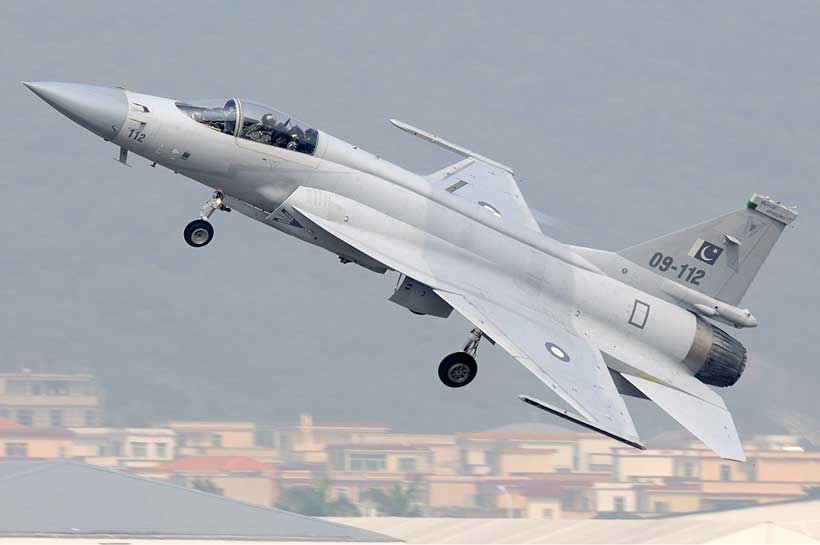
At King Abdulaziz Air Base in Saudi Arabia’s Eastern Province, the air defences guarding the kingdom against Houthi and Iranian missiles now include a Chinese HQ-9/P system operated by Pakistanis. Alongside it sit 16 Pakistani JF-17 Thunder fighters, a jet Pakistan builds with China, and some 8,000 Pakistani troops. They arrived in May. In August, Pakistan, Saudi Arabia and Turkey signed the Mecca Joint Defence Agreement, under which an attack on one is treated as an attack on all.
As the Houthis seized Yemen’s coast and fired on Mecca, Yanbu and Riyadh, Crown Prince Mohammed bin Salman asked Washington to resume airstrikes. Washington declined. Pakistan’s defence minister, by contrast, said that “the Makkah Agreement applies to us, and we will fulfil our duty.” Riyadh asked its oldest guarantor for help and got intelligence. It asked Islamabad and got crews.
From Riyadh 2025 to Mecca 2026
This did not start with the Iran war. In September 2025, a week after Israel struck Hamas officials in Doha and shook Gulf confidence in American protection, Saudi Arabia and Pakistan signed a Strategic Mutual Defence Agreement declaring that aggression against either would be treated as aggression against both. The Mecca agreement of 7 August 2026 widened that bilateral pledge into a trilateral one with Turkey, complete with a ministerial committee and a permanent secretariat in Saudi Arabia.
Stay ahead of the geopolitical week.
MD Briefing delivers expert analysis across five global fronts — the Indo-Pacific, energy, geoeconomics, European security, and the Middle East — every Monday morning. Free.
The war has turned paper into deployment. The kingdom now faces missiles and drones from Yemen, Iran-backed strikes on its East-West oil pipeline and attacks on its Red Sea port of Yanbu. Its defenders are a coalition of the willing: Greek Patriot batteries, French radars at Yanbu, British tanker aircraft and US intelligence — an arrangement Modern Diplomacy has questioned as a way to contain the Houthi threat. Pakistan is the only partner that has sent fighters, air defences and thousands of soldiers at once.
Who Supplies the Gulf’s Security Now
The standard reading is that Saudi Arabia is hedging: adding partners while the United States remains the real guarantor. That understates what has changed. The Gulf is moving from a single security provider to a division of labour, and Pakistan has taken the role that is hardest to buy — people willing to stand in the line of fire.
Start with what each partner is actually doing. The US provides intelligence, targeting support and advisers, but has refused a renewed air campaign. Europeans provide high-end systems for specific sites; President Macron said French forces were at Yanbu “to protect this site – not to get us involved in any conflicts.” Turkey has offered F-16s and short-range air defences, and its parliament has yet to ratify the pact. Only Pakistan has committed a combined air and ground force, and its defence minister has said Pakistan will defend the kingdom “to any extent.” For a country with a large army, combat experience and nuclear weapons, that is a meaningful offer, even if the nuclear dimension remains deliberately vague.
Now look at the hardware. Pakistan is the main customer of China’s arms industry: China supplied about four-fifths of Pakistan’s major arms imports between 2020 and 2024, according to SIPRI. When Pakistan defends Saudi Arabia, it does so largely with Chinese equipment. China is also the world’s biggest buyer of Saudi oil. The result is striking. Chinese-made missiles, operated by Pakistanis, are protecting oil that largely flows to China, without a single Chinese soldier deployed. Beijing gains reach in the Gulf, combat data on its air-defence systems against Iranian-designed missiles and a demonstration for future buyers, while carrying none of the risk. As an analysis for the Lowy Institute put it, Pakistan’s contribution cannot be separated from Chinese weapons and technology.
That raises a question Washington has not answered. Saudi Arabia’s air-defence network is built largely on American systems, such as the Patriot. Integrating a Chinese HQ-9 into it, or keeping it apart, exposes either American or Chinese technology to the other side. The longer Pakistani batteries stay, the more the US must decide whether to accept a mixed network in the kingdom it has protected since 1945 — one of the questions Modern Diplomacy raised in examining what the pact means for China and the US.
For India, the implications are the most uncomfortable. New Delhi has spent a decade building a strategic partnership with Riyadh, built on energy, investment and millions of Indian workers in the kingdom. When the 2025 pact was signed, India’s foreign ministry said it expected Saudi Arabia to pursue the partnership “keeping in mind mutual interests and sensitivities.” Now its rival’s army is embedded in Saudi air defence, under a treaty that also binds Turkey, a vocal Pakistani ally. India’s leverage in Riyadh rests on economics. Pakistan’s now rests on security. In a war, the second carries more weight.
The strongest objection is that Pakistan is less a provider than a contractor. It depends on Saudi money: some $8 billion in Saudi deposits help keep its foreign-exchange reserves afloat. Sixteen jets and one air-defence system will not stop a determined Iranian salvo. And Riyadh did not invoke the Mecca pact even when the Houthis struck two days after it was signed, as CFR’s Steven Cook noted. All true. But a security provider paid by its client is how the Gulf has always worked; the US was paid in arms purchases and oil pricing. What has changed is who is on the payroll, whose weapons they carry and whether the guarantee is in writing. On all three counts, the answer is no longer only American.
Three Directions From Here
Base case (around 55%) — a quiet deepening. Pakistan rotates forces, adds air-defence batteries and trains Saudi crews, while the pact stays formally uninvoked. The US remains the intelligence and targeting backbone without returning to offensive operations. India hedges quietly: it protects its energy and investment ties with Riyadh while deepening links with the UAE and Israel. China says little and benefits.
Downside case (around 25%) — Pakistan’s two fronts collide. A Houthi or Iranian strike kills Pakistani personnel in the kingdom, drawing Islamabad into direct confrontation with Tehran on its own Baluchistan border. Or a new India-Pakistan crisis erupts while Pakistani forces are tied down in Saudi Arabia, forcing Riyadh to say what “an attack on one” means when the other side is one of its biggest oil customers. Either way, the pact’s ambiguity, which is useful in peacetime, becomes a liability.
Upside case (around 20%) — a managed division of labour. A US-Iran ceasefire eases Houthi pressure. Washington openly endorses regional burden-sharing, agrees rules for separating American and Chinese systems on Saudi soil, and Riyadh reassures New Delhi that the pact is not aimed at India. The Pakistani presence becomes a normal, limited feature of Gulf defence.
The Guarantor Has Changed Shape
Pakistan is becoming the Gulf’s security provider, not by replacing the United States but by filling the role Washington will no longer play: putting troops on the line. China gains reach without deploying a soldier. India finds its rival embedded in its most important Gulf partnership. And the United States finds that “indispensable” now means intelligence and spare parts rather than airstrikes.
Watch whether Riyadh formally invokes the Mecca pact’s collective-defence clause. So far it has preferred bilateral help to triggering the treaty. The first invocation will show whether this is a real alliance or a framework of convenience — and whose army answers first. For decades, the Gulf’s security was made in America. It is now assembled in Pakistan, powered by China and paid for in Riyadh.