


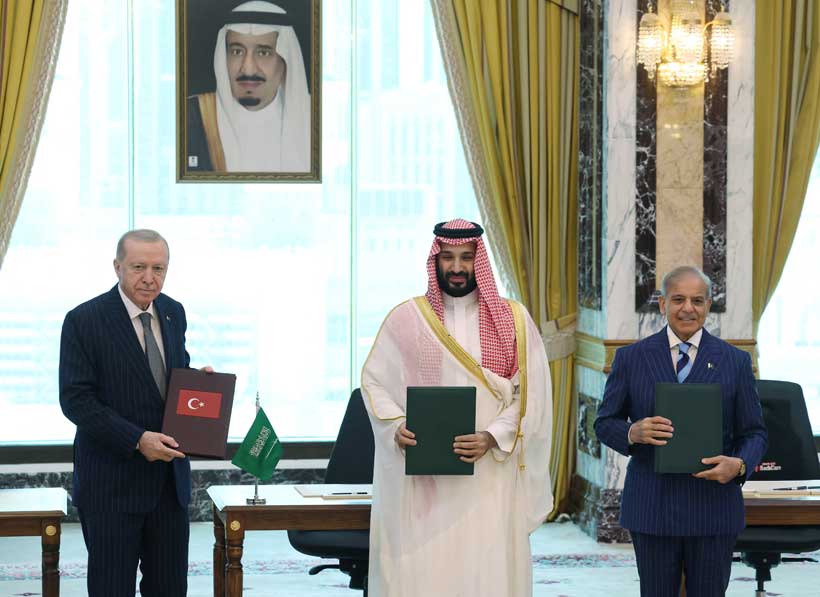
The Mecca Joint Defence Agreement, signed on August 7, 2026, by Saudi Arabia, Türkiye and Pakistan, marks an important development in the evolving security architecture of the Middle East. The agreement commits the three countries to treating an armed attack against one member as an attack against all, establishing a framework for collective deterrence.
Although the three governments have presented the arrangement as defensive and not directed against any particular country, its implications extend well beyond the three signatories. The agreement raises questions about the future role of the United States in regional security, the strategic calculations of Iran and other regional actors, and the extent to which countries traditionally connected to Washington are seeking greater room for independent action.
For China, the development is particularly significant. Beijing has spent years expanding its economic, diplomatic and strategic presence across the Middle East while avoiding direct competition with the United States in the provision of regional security. A regional defence arrangement involving Saudi Arabia, Pakistan and Türkiye could therefore offer China both opportunities and challenges.
The central question is not whether the Mecca agreement represents a direct break with Washington. It does not necessarily do so. Rather, it may signal the emergence of an additional layer of regional security in which states that have traditionally relied on external guarantees are seeking to strengthen their own collective deterrence.
Stay ahead of the geopolitical week.
MD Briefing delivers expert analysis across five global fronts — the Indo-Pacific, energy, geoeconomics, European security, and the Middle East — every Monday morning. Free.
A new layer of regional deterrence
The three members bring very different strategic assets to the agreement.
Saudi Arabia contributes substantial financial resources, energy importance and political influence in the Arab and Muslim worlds. Türkiye brings a sizeable and experienced military, a growing defence industry and significant capabilities in areas such as drones and other advanced military technologies. Pakistan contributes extensive military experience, a large armed force and a nuclear deterrent.
Taken together, these capabilities give the agreement considerable potential weight. The three countries also occupy strategically important positions connecting the Gulf, the Middle East, South Asia and the wider Mediterranean region.
The significance of the agreement, however, will ultimately depend on how far the political commitment to collective defence is translated into practical military cooperation. Joint planning, intelligence sharing, exercises, logistics and clearly defined mechanisms for responding to an attack will be necessary if the agreement is to become more than a political declaration.
The agreement’s declared purpose is defensive. Its members have not identified Iran, Israel, the Houthis or any other actor as its specific target. Nevertheless, the existence of a collective defence commitment inevitably affects the calculations of potential adversaries. By increasing the potential cost of military action against one member, the arrangement could strengthen deterrence across a region already marked by overlapping conflicts and security tensions.
This is particularly relevant given the continuing confrontation between Iran and several Gulf states. Even if Tehran is not the formal target of the agreement, Iranian policymakers will have to consider how the new arrangement could affect the regional balance of power.
The same applies to other actors. The agreement potentially creates a broader security umbrella around three countries whose interests do not always coincide but which share an interest in preventing their territory, infrastructure and strategic assets from becoming vulnerable to external military pressure.
What does the agreement mean for Washington?
The Mecca agreement should not automatically be interpreted as a rejection of the United States.
Türkiye remains a NATO member, while Saudi Arabia and Pakistan have longstanding military and security relationships with Washington. None of these relationships disappears because of the new agreement.
The more significant development may therefore be the growing willingness of regional powers to diversify their security partnerships.
For years, the United States has occupied the central position in the Middle Eastern security architecture. Regional states have nevertheless increasingly sought to develop relationships with other major powers while strengthening their own capabilities. The Mecca agreement fits into this broader trend.
From Washington’s perspective, a stronger regional capacity for collective defence could have advantages. If regional states can assume a greater share of the burden of deterrence, the United States could potentially face less pressure to respond directly to every regional crisis.
At the same time, a proliferation of independent security arrangements could make the regional security environment more complicated. Washington would have less control over how its partners respond to crises, particularly if a conflict involving one member of the Mecca agreement develops rapidly.
This makes the agreement less a question of whether Saudi Arabia, Türkiye or Pakistan are abandoning the United States and more a question of whether Washington remains the indispensable security provider in the region.
The distinction is important. The three countries may be hedging rather than choosing sides.
Why the agreement matters to China
For Beijing, the development has several important dimensions.
First, a stronger regional security architecture that is not entirely dependent on Washington could create additional space for China’s diplomatic engagement. China has consistently sought a greater role in the Middle East without becoming directly responsible for the region’s security.
That approach was illustrated by Beijing’s role in facilitating the Saudi-Iranian rapprochement in 2023. China’s preference has generally been to promote stability and maintain relationships with competing regional powers rather than establish exclusive alliances.
The Mecca agreement could fit into that environment.
Second, Pakistan’s participation gives the agreement an additional Chinese dimension. Pakistan is one of China’s closest strategic partners, and Beijing has extensive economic and infrastructure interests in the country. Pakistan’s involvement in a new regional defence framework could therefore provide China with another indirect connection to a changing Middle Eastern security environment.
Third, Saudi Arabia’s participation is significant because of the depth of the developing Saudi-Chinese relationship. Energy remains at the centre of that relationship, but cooperation has expanded into investment, infrastructure, technology and diplomacy.
A Saudi Arabia that seeks greater strategic autonomy does not necessarily become aligned with China. However, a more diversified Saudi foreign policy can create additional opportunities for Beijing.
For China, the ideal outcome would not necessarily be the displacement of the United States. A more stable region in which Washington is no longer the sole security provider could provide Beijing with greater diplomatic and economic flexibility without requiring it to assume the enormous military responsibilities traditionally carried by the United States.
The Iran question
One of the most important unanswered questions concerns Iran.
The three members insist that the agreement is defensive and not directed against any particular country. That position should be taken seriously. At the same time, the agreement is emerging against the backdrop of serious tensions between Iran and several Gulf states, as well as wider instability across the Middle East.
It would therefore be difficult for Tehran to ignore the strategic implications.
The agreement could make potential military action against any of the three members more complicated by introducing the possibility of a coordinated response. Its deterrent effect may consequently be broader than its formal language suggests.
Yet there is also a danger in assuming that the agreement automatically creates a unified anti-Iranian bloc.
Saudi Arabia, Türkiye and Pakistan have different relationships with Tehran and different regional priorities. Türkiye, for example, has historically maintained channels of communication with Iran despite substantial disagreements. Pakistan also has its own complicated relationship with its western neighbour.
The effectiveness of the agreement will therefore depend on whether the three governments can maintain a common position when their national interests diverge.
Why Egypt matters
Egypt’s absence from the initial agreement is another important element of the emerging picture.
Cairo has participated in previous regional discussions about defence coordination, but it was not among the three signatories to the final agreement. Its strategic priorities are also different from those of the three founding members.
Egypt faces security challenges on several fronts, including instability in Libya and Sudan, the Gaza conflict, Red Sea security and the protection of the Suez Canal. Cairo has traditionally sought to preserve strategic flexibility by maintaining relationships with multiple external powers, including the United States, European states, China and Russia.
A binding collective-defence arrangement could therefore impose obligations that Egypt would prefer to consider on a case-by-case basis.
At the same time, Egypt should not be regarded as permanently outside the project. Turkish officials have indicated that Cairo could potentially become involved in the future, subject to further discussions and conditions.
Egypt’s eventual decision could become an important test of whether the Mecca framework develops into a broader regional security organisation or remains a limited arrangement among its three founding members.
For Cairo, one of the central concerns would likely be maintaining control over decisions that could potentially draw the Egyptian military into conflicts unrelated to its immediate national security interests.
A regional security architecture in transition
The significance of the Mecca Defence Agreement ultimately lies less in the creation of another formal alliance than in what it says about the direction of regional politics.
Saudi Arabia, Türkiye and Pakistan are not abandoning their existing international relationships. Instead, they appear to be adding another layer to their strategic options.
This is part of a wider pattern in which middle and regional powers are attempting to avoid excessive dependence on any single major power. They are building relationships with the United States while simultaneously expanding ties with China, Russia, Europe and one another.
For Washington, this means that traditional alliances and security partnerships can no longer automatically be assumed to translate into exclusive strategic dependence.
For China, the development offers opportunities, particularly if regional states continue to pursue greater strategic autonomy. Beijing can benefit from deeper economic and diplomatic engagement without necessarily becoming responsible for the region’s military security.
For Iran, meanwhile, the agreement introduces another factor into an already complicated regional balance.
The Mecca framework should therefore not be viewed simply as an anti-American or anti-Iranian alliance. Its deeper significance may lie in the emergence of a more fragmented but also more autonomous Middle Eastern security environment.
Whether this eventually produces greater stability will depend on what happens next. If the three members develop genuine military interoperability, intelligence cooperation and credible mechanisms for collective action, the agreement could become a meaningful regional deterrent. If political differences prevent such cooperation, it may remain primarily symbolic.
Either way, the agreement reflects an important reality: regional powers are increasingly unwilling to leave their security entirely in the hands of external powers.
For China, that trend is strategically important. For the United States, it is a warning that influence in the Middle East increasingly depends not only on military presence, but also on the ability to adapt to a region where its partners are becoming more autonomous.
