


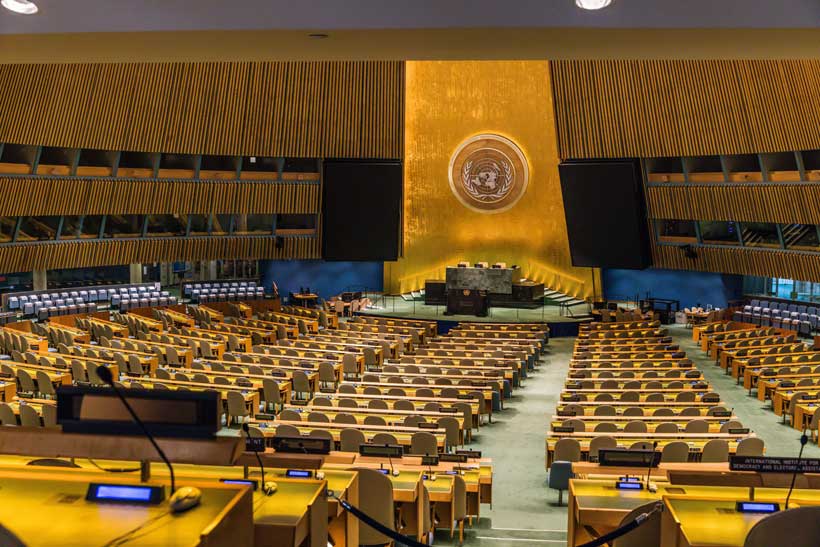
On the sidelines of the 81st UNGA, Foreign Minister Sergey Lavrov has intensified Russia’s coordination with African leaders, re-emphasizing the importance of reforms while undertaking the strategic steps in transforming and reshaping Africa’s architecture to ensure economic sovereignty within the framework of the emerging multipolarity.
Foreign Minister Lavrov maintains that countries of the Global South and East are asserting themselves as sovereign centres of growth and are assuming responsibility for ensuring security in their respective regions. Russia’s foreign policy is intended to support Africa’s growth and future prosperity. With adequate preparations and strategically selected African leaders and regional heads and individuals for interaction at the 81st UNGA, in New York.
Geopolitics: Is BRICS Challenging the West?
Perhaps Lavrov prioritizes BRICS (Brazil, Russia, India, China, and South Africa) and African partnering states. BRICS, which is described as a non-political association, guides its members in structuring the emerging new global order. Egypt, Ethiopia, and South Africa are staunch members. Nigeria and Uganda are partner states. Lavrov shared thoughts with the Vice President of the Republic of Uganda, Jessica Alupo, and the Nigerian Vice President, Kashim Shettima.
Stay ahead of the geopolitical week.
MD Briefing delivers expert analysis across five global fronts — the Indo-Pacific, energy, geoeconomics, European security, and the Middle East — every Monday morning. Free.
Lavrov held separate discussions with Egypt, Ethiopia, and South Africa, who are BRICS members. He also met with Nigeria and Uganda, who are partner states of BRICS. For multiple reasons, Egypt seemingly has the most strategic relations with Russia. In practical terms, the collective decision to pursue the development projects, including the $28 billion Russian-backed nuclear plants, which is already in progress, in Egypt. Beyond that, Moscow and Cairo reviewed matters on the multi-faceted bilateral cooperation with a focus on maintaining active momentum in the political dialogue between Russia and Egypt, while also stepping up trade and economic cooperation and carrying out large-scale bilateral infrastructure projects. They went on to reaffirm the imperative need to ensure and coordinate their positions on foreign policy matters, including at the United Nations and other international platforms.
As an association, it has played advocacy these past years. BRICS has emphasized collective support for a multipolar world order and reforms to the United Nations, including its Security Council, as well as global financial institutions such as the World Bank (WB) and the International Monetary Fund (IMF). Furthermore, as BRICS-African members, South Africa, Egypt, and Ethiopia have indicated high aspirations to build an alternative order to the West, wielding power to challenge Western hegemony.
Therefore, in close collaboration in pursuing its task with these African delegations who visited UNGA in New York, the officials discussed issues related to the further development of multifaceted ties, with a focus on maintaining active political dialogue and expanding cooperation in trade, the economy, humanitarian affairs, and other areas. They also exchanged views on current international and regional issues while considering other emerging questions relating to BRICS, geopolitical developments, and its future.
Founded in 2006 by Brazil, Russia, India, and China, today BRICS has expanded to 11 members representing about half the world’s population and a significant share of global economic output. It has sought greater representation for developing countries in global institutions and promoted alternatives to Western-dominated financial systems.
Russia’s Relations with ECOWAS, Maghreb, and the Arab League
Minister of Foreign Affairs, African Cooperation, and Moroccan Expatriates of the Kingdom of Morocco, Nasser Bourita; Minister of State, Minister of Foreign Affairs, the National Community Abroad, and African Affairs of the People’s Democratic Republic of Algeria, Ahmed Attaf; Minister of Foreign Affairs, International Cooperation, and Egyptian Expatriates of the Arab Republic of Egypt, Badr Abdelatty; and delegation from the Arab League.
With the Secretary-General of the League of Arab States, Nabil Fahmy, for strengthening cooperation between Russia and the Arab League, particular emphasis on revitalizing existing bilateral mechanisms, including the Russian-Arab Cooperation Forum. They also held a substantive exchange of views on current developments in the Middle East, focusing on the volatile situation in the Gulf region resulting from US-Israeli aggression against Iran. The discussion also covered the crises surrounding the Palestinian-Israeli conflict, as well as the developments in Lebanon and Syria.
The North African ministers reaffirmed their collective commitment to maintaining effective foreign policy coordination on current regional issues, including with a view to resolving the Western Sahara issue and other ongoing conflicts through political and diplomatic means, based on the universally recognized principles of international law and the UN Charter.
ECOWAS Chairmanship: Senegalese President Bassirou Diomaye Faye. In considering the key topics of the world and regional politics, including in the context of the current Senegal chairmanship of the Economic Community of West African States (ECOWAS), the parties reaffirmed the proximity of Moscow’s and Dakar’s principled approaches to most contemporary problems.
Russian Tourism and Recreation: Seychelles and Maldives
Lavrov’s meeting with the Republic of Maldives Foreign Minister, Iruthisham Adam, and Patrick Herminie of the Republic of Seychelles. Traditional discussions centered on prospects for further developing multifaceted relations between Russia on one side and the Maldives and Seychelles on the other. But the common ground is to sustain the conditions already set for promoting Russia’s tourism to the Islands. Both sides have expressed interest in maintaining regular political dialogue and expanding practical cooperation in a range of areas, including tourism. Reports confirm that both the Maldives and Seychelles are large-scale mass destinations. Statistics show that Russian citizens in 2025 increased by 16% year-on-year to reach 20.1 million in the Maldives. The tourist traffic from Russia to Seychelles is steadily growing, as much as 15% more than the previous year, reaching an estimated 1.5 million in 2025.
Reviewing Peace and Security Outlook with African Representatives
Lavrov underlines Russia’s contributions toward establishing peace and stability, generally, in Sahel States with the Minister of Foreign Affairs and International Cooperation of the Republic of Mali Abdoulaye Diop, while stressing traditionally Russian-Malian relations, with a specific focus on expanding trade, economic, and investment ties in the context of the decisions adopted following the second meeting of the Intergovernmental Commission on Bilateral Cooperation held in Kazan in May 2026.
Further to that, on September 25, Lavrov also held a broader meeting with the three foreign ministers of the Alliance of Sahel States (AES): Minister of Foreign Affairs of Burkina Faso Karamoko Traoré, Minister of Foreign Affairs and International Cooperation of the Republic of Mali Abdoulaye Diop, and Minister of Foreign Affairs, Cooperation, and Nigeriens Abroad of the Republic of the Niger Bakary Yaou Sangaré.
The meeting focused on a wide range of issues concerning priority areas of cooperation within the Russia–AES dialogue—political, economic, financial, transport and logistics, and information—with particular emphasis on preparations for the third Russia–Africa Summit, due to be held in Moscow on October 28–29. A candid exchange of views took place regarding the situation in the Sahara–Sahel region. The parties reaffirmed their commitment to strengthening foreign policy coordination at the UN and other international platforms.
Lavrov’s Common Language with António Guterres
During the meeting between Lavrov and UN’s head, António Guterres, both reviewed the continental situation in terms of peace and security development and suggested strategic coordination and multilateral support while complementing and harmonizing the existing mechanisms in the spirit of geopolitical realism and Africa’s expectations. Libya, Sudan, South Sudan, and Somalia are still in conflict. Both Sudan and the French-speaking West African countries, especially Mali and Niger, experience consistent ethnic fighting in the region.
Renewed fighting in northern Ethiopia is drawing in the country’s disputes with Egypt, Sudan, and Eritrea, raising fears that its internal conflict could spread across the region. Ethiopia’s army chief has accused Egypt and Sudan of supporting a new alliance of armed groups trying to remove Prime Minister Abiy Ahmed, saying the groups could not succeed unless they were “pushed, supported, and supplied” from abroad. The alliance brings together seven groups, including the Tigray People’s Liberation Front, the Oromo Liberation Army, and the Amhara Fano National Movement. Its members say they want to remove Abiy’s government and establish a transitional administration.
At the General Assembly, Lavrov underlined the fact that in African countries such as Libya, Sudan, South Sudan, and Somalia, ethnic conflicts continue to rage. And that the UNSC, together with the African Union and regional blocs, must take urgent and unconventional steps to reverse these trends in the continent. “Our principled approach is that a reform of the Security Council cannot provide any extra seats to the Western countries—especially Germany and Japan—that have taken the path of militarization and revanchism. We advocate solely for the expansion of representation by Asia, Africa, and Latin America and support candidates of Brazil and India for permanent seats while the interests of the African continent shall be met with due account for the Ezulwini Consensus and the Sirte Declaration,” Lavrov pointed out in his speech at the session on the peace and security architecture and Africa.
Still whistling on reforms and the UN’s restructuring
The Security Council has 15 members: five permanent members, China, France, Russia, the United Kingdom, and the United States, and 10 members elected by the General Assembly for two-year terms. The five permanent members hold veto power, allowing any one of them to block a substantive Council resolution.
Ultimately, the reform process has stalled. The General Assembly launched the intergovernmental negotiations process on Security Council reform since 2008. Currently, there is no African country that has a permanent seat. This remains work-in-progress. Nigeria wanted his seat, so also Egypt and South Africa.
Yet, Africa remains central to much of the Council’s work. In 2025, the Council adopted 44 resolutions, including 24 under Chapter VII of the UN Charter, which covers measures such as sanctions and authorizations for the use of force. Eighteen of those 24 Chapter VII resolutions concerned Africa.
For Professor Ibrahim Gambari, a former Nigerian foreign minister and former Nigerian permanent representative to the UN, the issue is not simply one of geography. “The status quo is not really interested in change,” he told Al Jazeera. “In the appointment of the Secretary-General, you cannot be a candidate unless each of the five permanent members agrees. Therefore, we have the privilege of the unelected P5, which they don’t want to relinquish.”
The General Assembly launched the intergovernmental negotiations process on Security Council reform in 2008. The talks cover the Council’s size, membership categories, regional representation, and the veto and have continued through successive General Assembly sessions without agreement on the core questions. Changing the Council’s permanent membership would also require an amendment to the UN Charter. Under Article 108, that requires approval by two-thirds of the General Assembly and ratification by two-thirds of UN members, including all five permanent members.
UN Secretary-General António Guterres used his final address to the General Assembly to renew his call for Security Council reform, saying it must become more representative and better reflect today’s geopolitical realities. The renewed calls highlight the scale of Africa’s demand. But translating them into an agreement that changes the Council’s structure remains a far more difficult task. Ghana’s President John Mahama made a similar appeal: “Security Council reform is not a favor to Africa; it is an imperative for the legitimacy, credibility, and survival of the United Nations.”
Nigeria’s Vice President Kashim Shettima, delivering President Bola Tinubu’s national statement, called for at least two permanent seats for Africa, with veto powers for as long as the veto exists, as well as five non-permanent seats for the continent.
