A Promise Meets a Midterm
On 22 September, Donald Trump said he might support a ban or quantitative limit on US diesel exports. Soon afterwards his energy secretary, Chris Wright, softened this to “restrictions” that would be “voluntary.” Brussels was not reassured. “We believe this is a bad idea,” said Commission spokesman Olof Gill, adding that Europe expects “close partners to consult each other” before acting.
The reason for the alarm is one number. In August, the United States supplied about half of all diesel the EU imported. A year ago it was a secondary supplier. Now it is the supplier. On Monday, Texas governor Greg Abbott declared a statewide disaster over diesel prices. Europe’s energy security now depends on how that plays in Texas.
How Europe Got Here
Europe runs on diesel, and it does not refine enough of its own. Since February 2023, the EU has banned Russian refined products. Since early 2026, it has also banned products refined from Russian crude in third countries such as India. Then the Iran war hit the other big source. Middle Eastern diesel exports fell by about half between March and August. In July, Russia restricted its own diesel exports after Ukrainian drone strikes on its refineries. India, the only other large exporter, has cut shipments from 582,000 to 352,000 barrels a day.
Stay ahead of the geopolitical week.
MD Briefing delivers expert analysis across five global fronts — the Indo-Pacific, energy, geoeconomics, European security, and the Middle East — every Monday morning. Free.
Into that gap stepped the US Gulf Coast. American diesel now makes up 32% of the EU’s imports from outside the bloc, up from 17% in 2025. In north-west Europe it is about 57%. France gets 36% of its imported diesel from the US, and Britain 26%. Modern Diplomacy warned in April that Europe was trading one dependence for another. The diesel-ban threat shows what that means in practice.
Paying Twice for Someone Else’s War
The obvious reading is that this is a price problem: diesel is expensive everywhere, and Europe is one more buyer squeezed by the Strait of Hormuz. That misses what is distinctive about Europe’s position. Europe is paying for the Iran war twice, and the second bill is political.
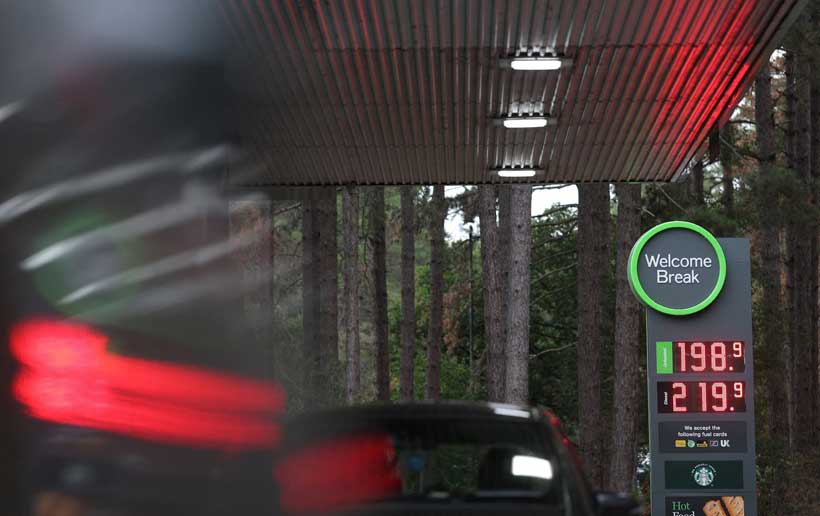
The first bill is money. EU diesel hit a record €2.23 a litre last week; in France it was €2.40. Energy Commissioner Dan Jørgensen says the EU has spent more than €100 billion extra on energy imports since the war began and “received not one extra molecule of gas or oil.” Europe did not start the war, has no seat at the US-Iran talks, and cannot reopen Hormuz. It pays the war’s costs without having a say in it.
The second bill is dependence on an ally’s electoral calendar. In July 2025, at Turnberry, the EU promised to buy $750 billion of American energy by 2028. The pitch was mutual: Europe gets a reliable, friendly supplier, and America gets a guaranteed customer. By Brussels’ count, 2025 purchases and signed deals already exceeded $250 billion. But the pledge ran in one direction only. Europe committed to buy. Washington did not commit to keep selling in a crisis. US petrol now averages $4.47 a gallon, Texas diesel costs $5.86 against $3.30 in February, and the House is on the ballot in five weeks. A president facing that arithmetic will look at the tankers leaving Houston for Rotterdam.
This is a different kind of vulnerability from the one Europe spent 2022 escaping. Russia used gas as a weapon, deliberately and against Europe. America would be cutting supply by accident of its politics, as a side effect of managing prices at home. That is harder to plan for. Europe can sanction an adversary or diversify away from it. It cannot sanction its main security guarantor, and it has, for now, nowhere else to diversify to. There is no second Gulf Coast. Every other large exporter is shut in by war, sanctions or the Hormuz closure.
Even the threat changes behaviour. Wright’s “voluntary restrictions” are not a ban. But refiners who are asked by the administration to put domestic supply first will not stretch to sign long winter contracts with French or British buyers. European traders will pay a political risk premium on US cargoes that did not exist in August. And France, the most exposed large economy, has already moved. Emmanuel Macron is calling a G7 meeting on emergency stocks and “greater cooperation on exports” between allies.
The strongest objection is that a ban will not happen. The oil industry opposes it, with the upstream producers’ council calling it “short-sighted,” and a ban would fill Gulf Coast tanks and cut margins without clearly lowering prices at the pump. In 2022 the Biden administration floated export curbs and backed away for exactly those reasons. All true, and a formal 90-day ban is not our base case. But the argument does not depend on a ban. It depends on the fact that Europe’s most important fuel supplier has publicly weighed one. That uncertainty is itself a cost, and Europe will pay it all winter.
Three Ways This Plays Out
Base case: no ban, but a jawboned winter (50%). The White House avoids a formal ban but leans on refiners to favour the US market until the midterms. US exports to Europe dip and a risk premium sticks to American cargoes. The IEA, which says 80% of its members’ emergency stocks remain, coordinates another release of refined products, the step Modern Diplomacy has argued is Europe’s most effective winter tool. Europe gets through the winter, but at record prices. The key assumption is that the president treats the threat as enough and avoids an open fight with the EU during the campaign.
Downside case: quotas before the vote (30%). Pump prices keep rising into October, and the administration imposes quantitative export limits for 90 days, covering both the midterms and the start of winter. North-west Europe loses a large share of its supply at short notice. France and the UK draw down stocks and bring in demand-cutting measures. Brussels links the move to the Turnberry energy pledge, and the fuel dispute becomes a trade dispute. For hauliers, airlines and farmers, this is the scenario that turns high prices into physical shortages.
Alternative case: Europe turns the scare into rules (20%). Macron’s G7 meeting produces a commitment among allies not to restrict fuel exports to each other in a crisis, backed by coordinated product stocks. Brussels makes further Turnberry purchases conditional on reliability. Few are pricing this in, but it would turn a one-sided purchase pledge into a two-sided supply deal, the kind of insurance Europe thought it had bought.
The Supplier Nobody Can Sanction
Europe fixed its Russia problem by trading dependence on an adversary for dependence on an ally. The Iran war has shown the flaw in that trade: an ally’s domestic politics can cut supply as surely as an adversary’s malice, and there is no sanction for it. Europe is paying for a war it did not choose, and the most important decision about its winter will be made with American voters in mind.
Watch two things. First, any White House move on diesel exports before 3 November, whether a formal restriction or an announced “voluntary” arrangement with refiners. Second, French and UK diesel stock levels as winter approaches, and what Macron’s G7 stocks meeting produces. If stocks fall while Washington keeps the option open, Europe will learn how little its $750 billion bought.