A Departure, and a Drone Launcher
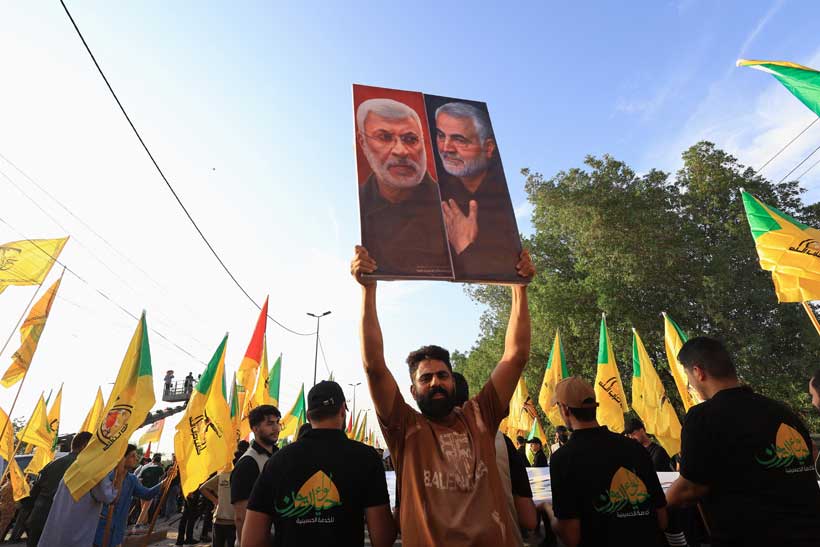
On 30 September the last American troops left an air base in the Erbil region, ending the US military presence in Iraq after twelve years. Kataib Hezbollah, the most powerful Iran-aligned militia, called it “the beginning of full sovereignty” and added a veiled warning to the Iraqi government. The Kurdish regional government said it had been left without air defences after more than 1,000 drone and missile attacks since the Iran war began.
Seventeen days earlier, Iraqi security forces had seized a drone launcher in Maysan province, near the Iranian border. It had been used to strike Saudi Arabia’s East-West pipeline, the kingdom’s main route for sending oil around the Strait of Hormuz. That is the right lens for this week. The question is not whether Iraq falls into a vacuum. It is whether Iraq has already become a launchpad, and who can now stop it.
How Iraq Got Here
The withdrawal followed a timetable agreed in 2024, but the Iran war that began in February changed what it means. Iran-aligned groups attacked US sites in Baghdad throughout March, and NATO pulled its mission out. Iraq’s own oil economy was hit hard. With Hormuz largely shut, exports fell from 3.5 million to about 2.5 million barrels a day, costing roughly $60 billion in lost revenue. Oil funds about 90% of the federal budget.
Stay ahead of the geopolitical week.
MD Briefing delivers expert analysis across five global fronts — the Indo-Pacific, energy, geoeconomics, European security, and the Middle East — every Monday morning. Free.
Prime Minister Ali al-Zaidi has given the militias until June 2027 to hand over their weapons. The first step is a 90-day truce. Some factions have agreed to disarm. Kataib Hezbollah and Harakat al-Nujaba have refused. These groups sit partly inside the state, through the Popular Mobilisation Forces, the government-funded umbrella for Shia militias. That is why Baghdad cannot simply order them to disarm.
From Buffer to Launchpad
Most coverage of the withdrawal asks the old question: will Iran fill the vacuum, and will Islamic State come back? That frames Iraq as a prize to be won. The more urgent point is that Iraq is already being used as a weapon, and the target is the Gulf.
Look at the pattern of launches. In May, Saudi Arabia and the UAE said drone attacks on them had been launched from Iraq. In late July, more than 30 drones hit Saudi oil infrastructure in 72 hours. Washington and Riyadh responded with the first joint US-Saudi airstrikes on Popular Mobilisation Forces bases, killing at least 20 militia members and four Iranian Revolutionary Guard officers. In September, drones from Maysan knocked out the East-West pipeline for eleven days, at the moment Riyadh most needed it. Houthi forces were at that moment seizing Yemen’s side of the Bab el-Mandeb, the Red Sea strait at the pipeline’s other end.
Iraqi soil gives Tehran deniability. A strike from Iran is an act of war. A strike from Maysan is a “rogue faction” that Baghdad promises to investigate. The Islamic Resistance in Iraq, the umbrella for the hardline militias, called Saudi accusations “fabrications.” Baghdad’s pipeline investigation reportedly even included Iranian participation. That deniability matters most now, as Tehran negotiates. Iran’s peace road map, presented to US envoys on 23 September, offers to halt its attacks on Arab neighbours. It says nothing about launches from Iraq. Iran can promise restraint and still keep a way to hurt the Gulf.
The troops’ departure matters, but not the way it is usually told. American soldiers did not stop the launches; most of the attacks above happened while they were still there. What the troops provided was a tripwire and a stake. US forces on Iraqi soil gave Washington a direct interest in policing the militias, and gave Riyadh a partner for the July strikes. They also made Baghdad cautious: al-Zaidi’s government seized the Maysan launcher within days, sacked the provincial police chief and dismissed the regional operations commander. Without the troops, a militia launch at Saudi Arabia is no longer a problem for Washington. It is a problem for Saudi Arabia. And Kataib Hezbollah has reportedly threatened to bring down al-Zaidi’s government and fire on “hostile” aircraft after 30 September.
What restraint remains is financial, not military. Washington still controls Iraq’s access to dollars. Iraq’s oil revenues sit in an account at the New York Federal Reserve, and the US envoy has used restrictions on dollar flows to push for action against the militias. That is a powerful lever, but a blunt one. It punishes the Iraqi state for what factions inside it do. And it works only as long as Washington is willing to risk destabilising a government it wants to survive.
The strongest objection is that Iraq’s own interests pull the other way. The Iraqi state is one of the biggest victims of Iran’s Hormuz strategy. It has lost $60 billion, and al-Zaidi told the UN on 25 September that he was watching the strait “with concern.” Baghdad needs Gulf goodwill, Turkish pipelines and new export routes. It does not need a war with Saudi Arabia. That is true, and it is the best argument for cautious optimism. But it describes the government, not the groups doing the launching. Kataib Hezbollah does not answer to Iraq’s budget. Iraq’s tragedy is that the state bears the cost of the launchpad and the factions keep the benefit.
Three Ways This Plays Out
Base case: managed deniability (50%). Most factions observe al-Zaidi’s 90-day truce. Occasional drones still fly at Saudi or Kuwaiti targets when Tehran wants leverage, most likely around each round of US-Iran talks in Oman. Baghdad seizes launchers after the fact and sacks local commanders. Disarmament slips towards the end of 2027. Riyadh absorbs the attacks rather than strike alone. The key assumption is that US-Iran talks stay alive, so Tehran keeps the Iraqi lever in reserve rather than using it in full.
Downside case: Riyadh strikes alone (30%). US-Iran talks collapse and launches from southern Iraq resume at the July tempo against Saudi energy sites. With no US partner on the ground, Saudi Arabia strikes Popular Mobilisation Forces bases by itself. Kataib Hezbollah treats Baghdad’s inaction as complicity and moves against al-Zaidi. Iraq becomes a second front in a Saudi war that already runs through Yemen. Energy traders would see Gulf supply threatened from the north as well as the south.
Alternative case: Baghdad sells the border (20%). Iraq’s export crisis forces a bargain. Gulf states and Turkey help Baghdad find routes around Hormuz. In return, the government accepts verified policing of the Maysan and Basra border districts, possibly with Gulf-funded surveillance. Washington backs the deal with its dollar leverage. Few are pricing this in, because it requires Baghdad to treat its militias as a threat to its own revenue rather than a political constituency.
Iraq’s Choice, Riyadh’s Patience
The withdrawal does not create a vacuum. It exposes one that already existed. Iraq has spent seven months as a launchpad for strikes on the Gulf, and the troops that left this week were the last outside actor with a direct stake in shutting it down. What happens next depends on how long Riyadh will tolerate attacks from Iraqi soil, and how hard Washington is willing to use Iraq’s dollars. American soldiers no longer come into it.
Watch two things. First, the next drone launch traced to Iraqi territory, and whether Saudi Arabia responds alone. Second, whether al-Zaidi’s government names Kataib Hezbollah in its formal disarmament announcement, or quietly exempts it. The first will show whether the Gulf will enforce its own red lines. The second will show whether Baghdad has decided whose side its state is on.