The Man Not on the Ballot
On Sunday, Željka Cvijanović of the Alliance of Independent Social Democrats (SNSD), the ruling Bosnian Serb party, defends the Serb seat in Bosnia’s three-member national presidency. Her challenger is Marinko Božović, the joint candidate of an opposition led by the Serb Democratic Party (SDS). The race for president of Republika Srpska, the Serb-majority entity, is a rerun of the same contest: SNSD’s Savo Minić against SDS leader Branko Blanuša.
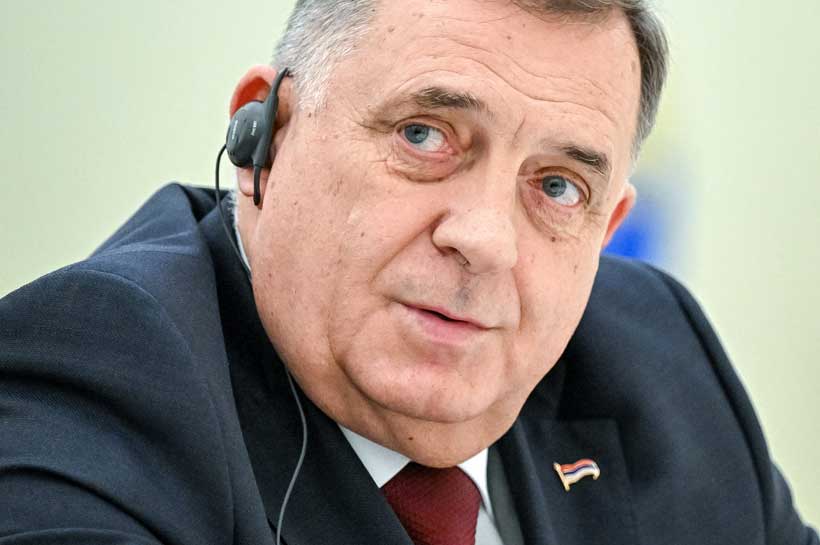
The man who will actually decide what happens next is not on the ballot. SNSD has registered its list as “SNSD – Milorad Dodik”. Dodik, convicted and barred from office, is not standing. His name is on every SNSD ballot paper anyway, and his son Igor is running in Banja Luka. Bosnia’s courts removed Dodik from office. They did not remove him from power. And for the first time since 1995, nobody outside the country seems inclined to try.
A Conviction That Changed Nothing
In February 2025, the Court of Bosnia and Herzegovina sentenced Dodik to a year in prison and a six-year ban from office for defying the High Representative, the international official who oversees the 1995 Dayton peace agreement and can overrule Bosnian officials. The verdict was upheld in August. Dodik converted the prison term into a fine, and his mandate as Republika Srpska president was revoked.
Stay ahead of the geopolitical week.
MD Briefing delivers expert analysis across five global fronts — the Indo-Pacific, energy, geoeconomics, European security, and the Middle East — every Monday morning. Free.
He stayed on as SNSD chairman. He had already installed Minić as the entity’s prime minister in defiance of a state-level ban. He then picked Siniša Karan to run in the snap presidential election. Karan won by 10,870 votes after a partial rerun in February 2026. At the time, headlines spoke of a “post-Dodik era”. Ten months on, that era has not begun.
From Punishment to Playbook
The standard reading of the Dodik case is that the law worked. A defiant leader was convicted, lost his job, and saw his secessionist laws annulled. That reading mistakes the penalty for the outcome.
What the case produced is a template, and it is easy to copy. Accept the legal penalty, pay the fine, step aside from the formal post, and run everything through the party. Nothing in Bosnia’s system stops a party chairman from choosing the entity president, the entity prime minister and the presidency candidate. Nothing stops him from putting his own name on the ballot as a party brand. The court punished the office-holder. It had no answer to the party boss. Any leader in Bosnia facing a judgment, in either entity or at state level, can now see exactly how to absorb one.
A template like this works only if nobody outside enforces a higher standard. That enforcement has fallen away on four fronts at once.
Washington has walked away. In October 2025 the US Treasury lifted sanctions on Dodik, his children, Cvijanović and Karan. Dodik thanked President Trump for “correcting the great injustice.” The administration has since declared that the “US-led nation-building era has passed”. A September report by House Foreign Affairs Democrats, “Pay for Play in the Balkans”, links that shift to a more-than-$1-billion gas pipeline concession given to a company tied to associates of both Dodik and Trump. Whatever the motive, Washington’s attention is now taken up by its war with Iran. Bosnia gets policy by neglect.
The High Representative’s office is running on inertia. Under US pressure, Christian Schmidt resigned in May and left on 1 July. The Peace Implementation Council, the group of states that oversees Dayton, missed its own 14 July deadline to appoint a successor. Washington backed an Italian candidate who reportedly promised restraint. France, Britain and Germany backed a French diplomat. An American deputy, Louis Crishock, now serves as acting High Representative. Formally, he holds the office’s “Bonn powers” to impose laws and remove officials. In practice, no acting envoy caught in a transatlantic dispute will use them. Compare 2022, when Schmidt imposed election-law changes on election night. Nobody expects that on Sunday.
The EU has carrots, but no stick. Brussels has withheld €108.5 million in Growth Plan funds over missed reforms, and Bosnia has until 31 December before its grace period ends. Ursula von der Leyen has dropped Sarajevo from her Balkan tour to avoid influencing the vote. Withholding money rewards good behaviour, but it cannot compel it. EU-wide sanctions on Dodik need unanimity, and Hungary has sided with him throughout. Germany and Austria imposed their own entry bans in 2025. That is the limit of what Europe has shown it will do.
The Croat question is still open. HDZ BiH, the main Bosnian Croat party, has long demanded that the Croat member of the presidency be elected by a majority of Croat voters. Twice, in 2018 and 2022, Željko Komšić won the seat largely on Bosniak votes. The election law has not changed. If HDZ’s Darijana Filipović loses on Sunday, the party has both the motive and the precedent to stall government formation. The only outside actor that ever broke such deadlocks was the High Representative.
Put together, this is the first Bosnian election in which no outside power is really enforcing Dayton. The US has left the job. The High Representative is acting in name only. The EU can pay but not punish. The one dispute likely to paralyse the result has no referee.
The strongest objection is that Dodik’s grip is visibly weakening. Karan won by 2.4 points on a turnout of 36%, and the opposition is now united behind one candidate. That is true, and it matters. But it points the same way. The only remaining check on the Dodik model is Republika Srpska’s own voters. If SNSD holds on Sunday, however narrowly, nobody in Sarajevo, Brussels or Washington is positioned to contest what it does next. A peace settlement enforced only by the people it constrains is not being enforced.
Three Ways This Plays Out
Base case: a hollow continuity (55%). SNSD wins the Serb presidency seat and the Republika Srpska presidency with reduced margins. HDZ disputes the Croat seat if Filipović loses, and state-level government formation drags into 2027. The Peace Implementation Council still cannot agree on a permanent High Representative, and Crishock does not use the Bonn powers. Nothing breaks. Dayton becomes a set of rules that every party quotes and none obeys. The key assumption is that Dodik has more to gain from quiet control than from open defiance while US sanctions are off.
Downside case: deadlock plus defiance (30%). HDZ refuses to form a government until the election law changes. SNSD, emboldened by the result, revives laws challenging state jurisdiction over courts or property. With no High Representative willing to annul them and Hungary blocking EU action, the Constitutional Court’s rulings are simply ignored. For investors and EU planners, that means a frozen state-level government through 2027, with the rest of the Growth Plan money lost.
Alternative case: Europe fills the gap (15%). The opposition wins the Republika Srpska presidency, which the February margin suggests is possible. Paris, Berlin and London then use the result to push through a European High Representative backed openly by the EU. Europe would be holding Dayton together without Washington for the first time. Few are pricing this in, but it depends on a Serb electorate that has elected SNSD’s candidate seven times in a row.
Europe’s Test, Not Bosnia’s
Dodik was supposed to show that Bosnia’s rules still bind. What his case actually shows is that a conviction without enforcement is only a formality, and that anyone can get around one by running things through the party. The United States wrote Dayton and is now walking away from it. Whether it survives is a test for Europe, and Sunday is the first exam.
Watch two things. First, SNSD’s share of the vote in Republika Srpska: below the 50.5% Karan scraped last winter, the model is cracking from inside. Second, whether HDZ BiH refuses to join a state government until the election law changes. If it does, Bosnia will face its first post-election deadlock with nobody left to break it.