Seven Days, Again
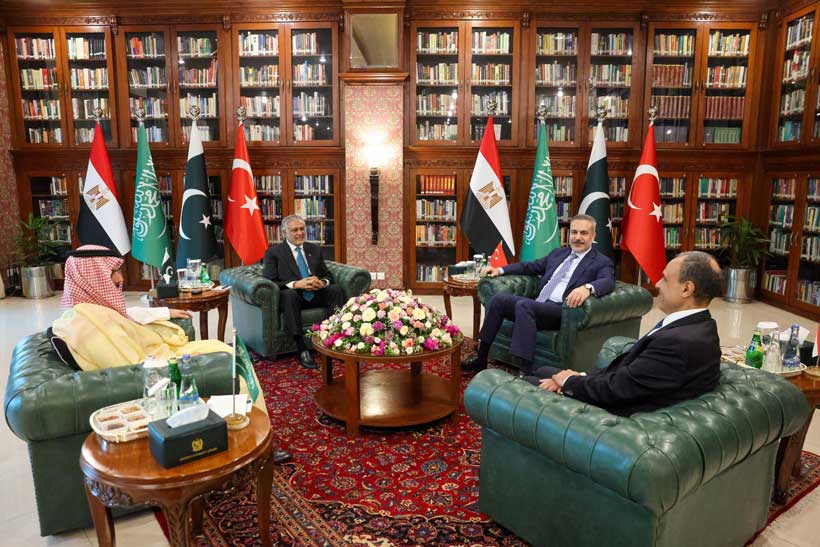
On 23 September, in a meeting room at the United Nations, Iran’s foreign minister, Abbas Araghchi, sat down with Steve Witkoff and Jared Kushner. Qatar, Pakistan and Egypt were in the room as mediators. Within 48 hours Tehran had offered to reopen the Strait of Hormuz and restart nuclear talks within seven days, in return for an end to the US blockade, waivers on its oil sales and a ceasefire that included Lebanon. On 26 September Trump rejected it: “that deal would not be acceptable.”
The offer looked familiar because it was: it closely repeated the June memorandum. That text was agreed through the same mediators and signed with great fanfare, and it had collapsed within three weeks.
From Muscat and Geneva to Islamabad, Doha and Cairo
Stay ahead of the geopolitical week.
MD Briefing delivers expert analysis across five global fronts — the Indo-Pacific, energy, geoeconomics, European security, and the Middle East — every Monday morning. Free.
Before this war, the US–Iran relationship ran through quiet, slow channels. Oman hosted the 2025 nuclear rounds, and Switzerland has long represented US interests in Tehran. Both acted as neutral hosts with no stake in the outcome. Since the US and Israel struck Iran on 28 February, the work has moved elsewhere. Pakistan brokered the April ceasefire and hosted the Islamabad talks. The Islamabad Memorandum of 17 June was mediated mainly by Pakistan, with Qatar, Egypt, Saudi Arabia and Turkey also involved. It was supposed to be signed at Switzerland’s Bürgenstock resort, but Trump signed it early at Versailles during the G7 summit, and Tehran signed separately.
It set a 60-day ceasefire, lifted the blockade within 30 days, made Hormuz passage free for 60 days, and promised a $300 billion reconstruction fund for Iran. On 25 June a ship was struck; on 27 June the US hit Iran’s coast; on 7 July Trump declared the memorandum “over.”
Three Mediators, Three Clocks
The usual explanation is that the belligerents are not ready. MD argued this month that mediators cannot change what the two sides still believe they can win. That is true, but it leaves out something important: the mediators have interests of their own. Each has a reason to want a deal soon, and none has a strong reason to insist on one that lasts.
Qatar is losing money every week the war continues. Iran’s March strike on Ras Laffan took out 17% of Qatar’s LNG capacity for up to five years. With Hormuz closed, Qatar shipped just 18 LNG cargoes in the war’s first six months, against 509 a year earlier, losing about $24 billion in sales. All of its gas must pass through the strait, because there is no pipeline around it. For Doha, any agreement that gets tankers moving has immediate value, whatever it leaves unresolved.
Pakistan’s stake is influence in Washington. Its army chief, Asim Munir, has become the go-between trusted by both Trump and Iran’s generals, and returned to Tehran in August to restart talks. In a year, mediation has turned Pakistan from a country Washington kept at arm’s length into a valued intermediary. But Pakistan is not neutral. It imports about 90% of its oil through the Gulf, it signed a defence pact with Saudi Arabia in 2025, and in April it sent fighter jets to the kingdom under that pact. With the Houthis now attacking Saudi Arabia, MD has asked whether Islamabad can stay a mediator at all. The value it gets from mediating comes from signing ceremonies. Keeping a ceasefire in place over months is Washington and Tehran’s job, not Pakistan’s.
Egypt is losing revenue on the Suez Canal. President Sisi puts Egypt’s lost canal revenue at around $10 billion. The Houthis’ capture of Yemen’s whole Red Sea coast this month, including the Bab el-Mandeb, threatens a new drop in traffic. Cairo needs calm on the Red Sea, and that requires a deal Tehran can sell to the Houthis. Such a deal will be broad and vague, because precise terms would give the Houthis more to object to.
Put these three incentives together and you get the June memorandum. The experts Al Jazeera interviewed point to the same weaknesses. The Hormuz article set out two incompatible shipping routes, one backed by Oman for US traffic and one hugging Iran’s coast. The ceasefire clause did not mention Israel, so strikes in Lebanon continued. The $300 billion fund did not say who would pay. One former State Department official said the text was “doomed to fail”. Hard questions were left vague because answering them would have taken months, and none of the mediators could afford to wait that long. A signed document was what each of them needed.
The Hormuz route shows what happened to the one neutral party that remained. Oman used to be the patient, disinterested host. It now has its own negotiations with Tehran over a new route through the strait, as the other country bordering it. Oman has become a party to the dispute, so the one neutral mediator has lost its neutrality too.
The strongest objection is that mediators with a stake in the outcome often achieve more than neutral ones, because they bring leverage. That is often true, but only when the mediator can guarantee that the deal is carried out, as the US did at Camp David. Qatar, Pakistan and Egypt cannot stop Israeli strikes in Lebanon, police a shipping route or fund a reconstruction package. Their leverage affects only the timing of a deal, not whether it holds.
The Next Memorandum
Base case (around 50%): another short-lived text before the midterms. A round in Oman, possibly at Salalah, produces a phased reopening of Hormuz and a partial easing of the blockade before 3 November. President Pezeshkian has said he wants a deal before the midterms, and all three mediators want one too. Like the June text, it leaves the route, Lebanon and the money vague. It holds for weeks, not months, and oil prices fall briefly before rising again. The key assumption is that Washington accepts a vague text because it helps before the election.
Downside (around 25%): the mediators start making separate deals. Mediation gives way to bilateral transit arrangements. Qatari LNG tankers are already moving through Hormuz in small numbers, and more deals like that follow. Iran lets through ships from favoured countries while the US blockade stays in place. Pakistan’s defence pact draws it into the Saudi–Houthi conflict, and it stops being a credible mediator. The strait reopens for some countries only. For readers, this means shipping, insurance and energy contracts that depend on the flag a vessel flies.
Upside (around 25%): Oman shapes the route. The Salalah round turns Oman from a sidelined host into a guarantor of the shipping route. A detailed agreement on navigation, drafted by the two countries that border the strait, is signed before the political memorandum rather than after it. Settling the most practical question first would give any political deal a much better chance of holding.
Mediators on a Deadline
The US–Iran talks keep failing partly because of the mediators themselves. Qatar needs its tankers moving, Pakistan needs its seat in Washington and Egypt needs traffic back on the canal. Each gains from a signature and pays little if the deal later collapses. That is why the talks produce memorandums, and why those memorandums fail on the questions the mediators could not afford to wait on.
Watch for whether the Oman round convenes, and above all whether any new text sets out the shipping route through Hormuz with precise coordinates. The June memorandum failed on that clause. If the next text is just as vague, expect it to collapse in the same way within weeks.
Neutral mediators used to delay agreements until the terms could hold. This year’s mediators want a signature quickly, and the talks are moving at their speed.