


Pakistan is facing a difficult diplomatic test as escalating fighting between Saudi Arabia and Iran backed Houthi forces in Yemen threatens to undermine Islamabad’s attempt to maintain close ties with Riyadh while preserving its role as a channel to Tehran.
For much of the past year, Pakistan has positioned itself simultaneously as a defence partner of Saudi Arabia and an intermediary between Washington and Tehran. But the latest escalation is putting increasing pressure on that balancing strategy.
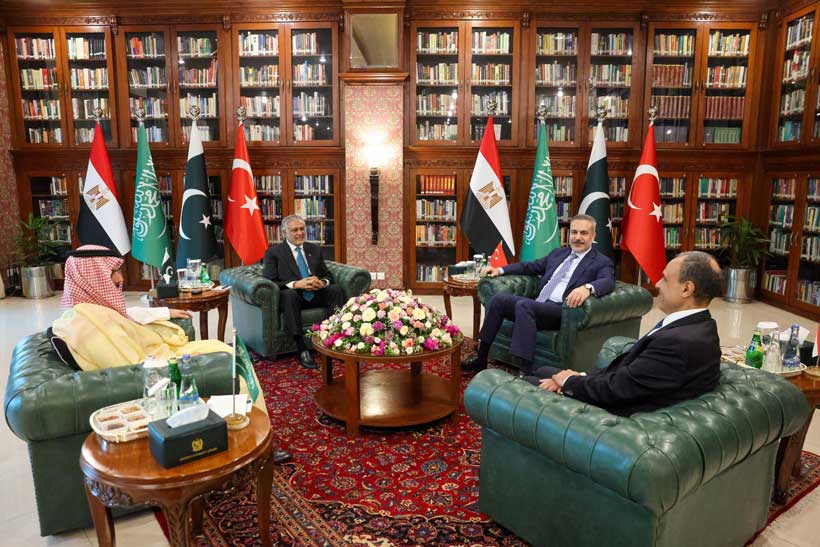
The challenge is particularly sensitive because Pakistan recently strengthened its defence relationship with Saudi Arabia and Turkey through a trilateral agreement under which an armed attack against one member would be treated as an attack against all three.
At the same time, Pakistan remains dependent on energy supplies and trade routes vulnerable to disruption by Iran and the Houthis, giving Islamabad strong incentives to prevent the conflict from expanding.
Stay ahead of the geopolitical week.
MD Briefing delivers expert analysis across five global fronts — the Indo-Pacific, energy, geoeconomics, European security, and the Middle East — every Monday morning. Free.
A New Test for Pakistan’s Defence Commitments
The latest fighting represents an important test of Pakistan’s expanding security relationship with Saudi Arabia.
Pakistani troops are already deployed near the Saudi border with Yemen, while Islamabad has previously provided military support to Riyadh under bilateral defence arrangements.
The new confrontation therefore presents a more complicated scenario than earlier Iranian attacks on Saudi energy infrastructure.
If fighting intensifies and Riyadh requests additional military assistance, Pakistan could face pressure to fulfil its security commitments. Any direct involvement, however, could undermine Islamabad’s efforts to maintain working relations with Tehran.
Pakistan’s military is already managing significant demands elsewhere, including tensions along its border with India and security challenges in its western provinces.
Expanding its commitments in the Gulf could therefore create both diplomatic and operational difficulties.
Islamabad Warns Iran While Calling for Diplomacy
Pakistan appears to be trying to contain the crisis before it reaches the point where neutrality becomes impossible.
Islamabad has conveyed a Saudi warning to Iran urging Tehran to restrain its Houthi allies. At the same time, Pakistan’s military leadership has maintained direct communication with Iranian officials in an effort to revive diplomatic channels.
The approach reflects Pakistan’s broader position that escalation serves neither regional stability nor its own interests.
Islamabad does not want to alienate Riyadh, particularly as Saudi Arabia and other Gulf states have become increasingly important to Pakistan’s economic and investment ambitions.
But Pakistan also has a direct interest in maintaining stable relations with Iran.
The two countries share a border, and tensions have previously escalated into military exchanges. A wider regional conflict could create additional pressure along Pakistan’s western frontier while disrupting trade and energy supplies.
Why Iran Matters to Pakistan
Pakistan’s relationship with Iran is structurally different from its relationship with Saudi Arabia.
Saudi Arabia is an important economic and defence partner, while Iran is Pakistan’s immediate western neighbour.
That geography limits how far Islamabad can align itself with Riyadh.
Pakistan also depends on energy flows through the wider Gulf and Red Sea region. Any prolonged disruption involving the Strait of Hormuz or Red Sea shipping routes could increase energy costs and place additional pressure on Pakistan’s already vulnerable economy.
A direct military role in the Saudi-Houthi conflict could therefore expose Pakistan to economic consequences extending well beyond the battlefield.
It could also make Pakistan a target for retaliation or deepen tensions along its border with Iran.
The Limits of Pakistan’s Mediator Role
Pakistan’s growing diplomatic role has raised expectations that Islamabad can help bridge divides between competing regional powers.
But mediation requires credibility with both sides.
Iran has publicly welcomed Pakistan’s diplomatic efforts, yet Tehran may have reservations about Islamabad’s increasingly close military relationship with Riyadh and Washington.
That creates an inherent contradiction.
Pakistan’s value to Saudi Arabia and the United States partly comes from its relationships with the Gulf and its security ties with Washington. But those same relationships can make Tehran question Islamabad’s neutrality.
Pakistan therefore may be most useful as a mediator precisely because it is not completely neutral.
Its ability to communicate with Riyadh and Washington while maintaining channels with Tehran gives Islamabad access that a purely neutral actor might not possess.
The danger is that this advantage disappears if Pakistan becomes directly involved in military operations.
From Stakeholder to Combatant
The distinction between diplomatic support and military involvement could become crucial.
Pakistan can relay messages, encourage negotiations and support de-escalation without fundamentally changing its position in the conflict.
Military intelligence, air defence or direct operational assistance would be different.
Such involvement could transform Pakistan from a stakeholder attempting to mediate into an active participant in the conflict.
That would make it considerably harder for Islamabad to maintain channels with Tehran and could expose Pakistani interests to retaliation.
The same calculation appears to have influenced Pakistan’s cautious approach to expanding its defence arrangements with other Gulf states.
Islamabad has reportedly resisted broader military commitments that could deepen its exposure to conflicts involving Iran.
What Comes Next?
Pakistan is likely to continue pursuing a middle position for as long as the conflict allows.
That means maintaining its defence relationship with Saudi Arabia while avoiding direct participation in offensive operations against the Houthis or Iran.
Diplomatic engagement with Tehran will also remain important, particularly if Islamabad believes it can use its relationship with Riyadh to encourage restraint.
However, the space for manoeuvre will narrow if the conflict expands.
A direct attack on Saudi territory, damage to major energy infrastructure or a request for substantial military assistance could place Pakistan under significantly greater pressure to act.
At that point, Islamabad would have to decide whether the strategic benefits of its Saudi partnership outweigh the diplomatic and security costs of confronting Iran and its allies.
Implications and Analysis
Pakistan’s current predicament demonstrates the difficulty of pursuing strategic relationships with competing powers in an increasingly polarised Middle East.
Islamabad has attempted to turn its position between Saudi Arabia, Iran and the United States into a diplomatic advantage. Its military relationship with Riyadh gives it access to the Saudi leadership, while its geographic proximity and longstanding relationship with Tehran provide a channel that Gulf states and Washington can use.
But the same relationships are now creating competing expectations.
The central issue is therefore not whether Pakistan supports Saudi Arabia or Iran. It is whether Islamabad can preserve enough strategic autonomy to remain useful to both sides.
For now, the answer may be yes, but only if Pakistan keeps its military role limited and prioritises diplomacy.
A direct Pakistani combat role would fundamentally alter the equation. It could weaken Islamabad’s credibility as a mediator, expose its forces to additional risks and create new security problems along its western border.
Pakistan’s best strategic option may therefore be to use its defence partnership with Riyadh as leverage for diplomacy rather than as a reason for military escalation.
The deeper lesson is that Pakistan’s growing role in Middle Eastern security comes with a cost. The more security commitments Islamabad accepts from Gulf partners, the less room it has to maintain an independent position when those partners come into direct confrontation with Iran.
The current crisis will therefore test not only Pakistan’s military commitments, but the sustainability of its broader strategy of balancing competing regional powers.
With information from Reuters.
