


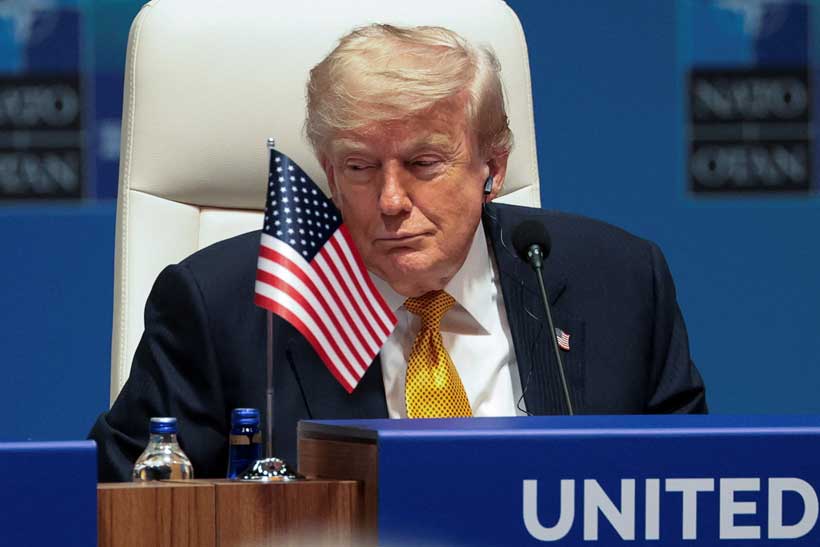
President Donald Trump is making himself the centre of the Republican Party’s campaign for the 2026 midterm elections, but growing concerns within his own party are raising questions about whether a Trump focused strategy can attract the independent voters Republicans need to retain control of Congress.
At the Republican Party’s first ever midterm convention in Dallas this week, Trump urged voters to “pretend that I’m on the ballot” as he sought to recreate the enthusiasm and turnout that helped him win the presidency in 2016 and 2024.
The strategy is designed to energise Trump’s loyal supporters, but it comes with significant risks. Trump’s approval ratings have fallen sharply among independents, while inflation and the war with Iran have created vulnerabilities for Republicans seeking to defend their congressional majorities.
Trump Puts Himself at the Centre
Trump’s message at the convention was straightforward: the midterms should be treated as a referendum on his presidency.
Stay ahead of the geopolitical week.
MD Briefing delivers expert analysis across five global fronts — the Indo-Pacific, energy, geoeconomics, European security, and the Middle East — every Monday morning. Free.
Rather than allowing individual Republican candidates to campaign primarily on local issues, the party is seeking to nationalise the election around Trump’s agenda and political brand.
The approach reflects Trump’s continued dominance within the Republican Party. His most committed supporters remain highly loyal, and party activists believe his presence can motivate voters who might otherwise stay home during a midterm election.
But the strategy also exposes Republicans to Trump’s weaknesses.
A president who is popular among Republican voters but significantly less popular with independents could become an obstacle for candidates fighting in competitive districts and states.
The Independent Voter Problem
The divide between Republican voters and independents is particularly important.
A Reuters/Ipsos poll conducted in late August found Trump’s overall approval rating at 33%, the lowest level of his presidency. His approval among Republicans stood at 82%, while among independents it had fallen to 22%.
That creates a difficult electoral calculation.
Republicans need Trump’s supporters to turn out, but they also need to persuade voters who are not firmly aligned with either party.
Five of the 15 Republicans interviewed at the convention expressed doubts about whether Trump was the party’s strongest messenger for reaching independents.
Even those who supported putting Trump at the centre of the campaign acknowledged that the strategy carried risks.
The Economy Could Be Trump’s Biggest Vulnerability
The convention also highlighted a gap between Trump’s political messaging and voters’ economic concerns.
The high cost of living remains one of the most important issues facing American voters, but Trump devoted relatively little attention in his convention speeches to addressing those concerns.
He instead claimed that food prices were rapidly declining, despite government data indicating otherwise.
Trump also promised a $5,000 “Trump dividend” for every American adult if Republicans retain control of Congress, without explaining how the payments would be financed.
The economic issue presents a particular challenge because Republicans cannot rely solely on Trump’s popularity with their base if voters are dissatisfied with their personal financial circumstances.
Republicans Still See Trump as Their Best Option
Despite the concerns, most Republicans at the convention supported the strategy.
Ten of the 15 Republicans interviewed said putting Trump front and centre was the party’s best approach. They argued that his ability to energise Republican voters outweighed the risks created by his lower support among the broader electorate.
For many Republicans, the alternative may appear even less attractive.
Trump remains the party’s most powerful political figure, and his supporters are among the most engaged parts of the Republican electorate.
The question is whether that enthusiasm can be converted into the broader coalition required to win competitive races.
Democrats Welcome the Strategy
Democrats have little incentive to discourage Republicans from making the election a referendum on Trump.
The Democratic Party can use the president’s economic record, approval ratings and handling of foreign policy to argue that voters should reject Republican candidates as a way of rejecting Trump’s agenda.
Republicans are attempting to counter that strategy by portraying Democrats as increasingly radical and warning that a Democratic victory would threaten American values and way of life.
For Republican activists, the argument is that concerns about the Democratic Party could ultimately outweigh dissatisfaction with Trump.
But that calculation may be more difficult in closely contested districts where voters are less ideologically committed.
Vulnerable Republicans Keep Their Distance
The tension between Trump’s national strategy and individual candidates’ electoral needs was visible at the convention itself.
Some of the Republican Party’s most vulnerable candidates did not attend the Dallas gathering, instead remaining focused on their own districts.
For candidates representing competitive areas, distancing themselves from the national political environment could allow them to emphasise local concerns and avoid becoming entirely associated with Trump’s approval ratings.
That creates a potential contradiction within the Republican campaign.
The party leadership wants Trump at the centre of the election, while some candidates may have more to gain by keeping their own campaigns focused on local voters.
What Comes Next?
Trump is likely to remain heavily involved in the Republican campaign as the midterms approach.
His political organisation can provide candidates with fundraising, publicity and access to a highly motivated voter base.
But Republican candidates will have to decide how closely they want to associate themselves with him, particularly in competitive districts.
The party’s success may ultimately depend on whether it can combine Trump’s ability to mobilise his core supporters with messages that address the economic concerns of independent and moderate voters.
Implications and Analysis
The Republican Party’s dilemma is fundamentally about the difference between mobilising voters and persuading voters.
Trump is highly effective at the first. His political brand can generate enthusiasm among Republicans and give supporters a reason to participate in an election in which he himself is not on the ballot.
The harder question is whether he can do the second.
Midterm elections are not presidential elections, and congressional candidates often need to build broader coalitions than those required to win a party’s presidential nomination. If Republican candidates make the election entirely about Trump, they may benefit from stronger turnout among his supporters but also inherit his weaknesses among independents.
The Dallas convention therefore represents a calculated gamble.
Republicans appear to believe that Trump’s ability to energise their base is more valuable than the potential cost of alienating voters outside it. Democrats, meanwhile, are likely to welcome any strategy that allows them to make the election a referendum on a president whose approval among independents has fallen sharply.
The Republican Party’s challenge will be to ensure that Trump remains an electoral asset rather than becoming the only issue voters are asked to consider.
If his political machinery succeeds in bringing disengaged Republicans back to the polls, the strategy could strengthen the party’s position.
But if economic dissatisfaction and concerns about Trump’s broader record dominate among independents, putting him at the centre of the campaign could give Democrats exactly what they want: a national election in which every Republican candidate is forced to defend a president who is not actually on the ballot.
With information from Reuters.
