By offering Saudi Arabia intelligence and targeting help but declining direct military protection after the East-West pipeline strike, Washington has quietly redefined the 80-year security-for-oil bargain from a guarantee into a menu — and Riyadh’s own hedging over the past year shows it had already priced in that downgrade before it arrived.
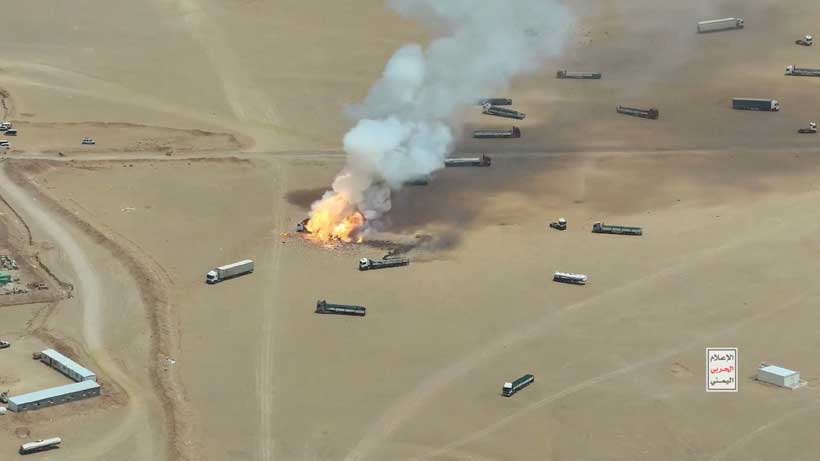
Ten months ago, Mohammed bin Salman sat in the Oval Office and left with a “major non-NATO ally” designation and the promise of an expanded arms package. Last week he asked Washington for something smaller and more basic: direct military help against Houthi threats to Red Sea shipping, days after drones launched from Iraq hit the pump stations on Saudi Arabia’s East-West pipeline, shutting the kingdom’s only oil export route that doesn’t run through a Strait of Hormuz Iran has effectively closed. The answer came back from a senior administration official: no US strikes, but Washington would “help with intelligence sharing and targeting” while “empowering our regional partners to take the lead.” The upgrade was symbolic. The downgrade, when it actually mattered, was substantive.
The Context
The bargain being tested dates to February 1945, when Franklin Roosevelt met King Abdulaziz Ibn Saud aboard the USS Quincy and traded American security guarantees for reliable oil access — the arrangement that has anchored US-Gulf policy ever since, through the Carter Doctrine and the 1991 Gulf War. It first visibly cracked in 2019, when Trump declined to retaliate after drone strikes knocked out half of Saudi Aramco’s output at Abqaiq. Riyadh drew its own conclusion: in September 2025 it signed a Strategic Mutual Defence Agreement with Pakistan, expanded in August 2026 into a trilateral pact with Turkey. When Saudi Arabia invoked it during the current US-Iran war, Pakistan sent 8,000 troops, sixteen jets and one air-defense battery — a token, not a shield. The East-West pipeline attack, which cut a 4–5 million barrel-a-day artery and helped push oil above $100, landed on top of all of it — and this time the drones came not from Yemen but from Iraqi territory, widening the circle of fronts Riyadh has to watch.
Stay ahead of the geopolitical week.
MD Briefing delivers expert analysis across five global fronts — the Indo-Pacific, energy, geoeconomics, European security, and the Middle East — every Monday morning. Free.
The Argument
Start with what was actually offered, because the wording is the story. “Intelligence sharing and targeting” while Saudi forces do the fighting is the cheapest form of support the United States can provide: no American pilots at risk, no US casualties, no escalation that Washington itself would have to own. “Empowering our regional partners to take the lead” is the language of a patron redefining a client as a peer — responsible now for its own wars, entitled only to advice. That is a precise, deliberate downgrade from what “ally” has meant in this relationship for eight decades, delivered in the driest possible bureaucratic prose so that no one has to say it out loud.
The strongest objection is that this is not new and therefore not a story: Trump declined to act after Abqaiq in 2019 too, there was never a NATO-style mutual defense treaty to tear up, and burden-shifting rhetoric is standard for any administration managing an expensive commitment. On this reading, Washington is not downgrading anything — it never signed anything more specific than an informal understanding, and informal understandings flex with every president. Riyadh knew the rules going in.
That objection misses what makes September 2026 different from 2019, and it is not the wording — it is the stakes and the counterfactual. In 2019 Saudi Arabia had no alternative security architecture and was not living inside an active regional war. In September 2026 it has both: a trilateral defense pact it has already invoked once, a live war next door that has closed its primary export route, and now a second, backup export route also disabled by drones fired from a third country. This is the highest-pressure test the informal bargain has faced in its modern history, and Washington met it with the same answer it gave when the pressure was a fraction of this. An ally discovers what a guarantee is worth not in the quiet years but in the crisis, and Riyadh just found out.
The more telling evidence is not what Washington said but what Riyadh has been doing for a year before it said it. A confident treaty partner does not sign a mutual defense pact with Pakistan and Turkey, invoke it for a symbolic deployment, and simultaneously open a back channel to Israel through US Central Command for help against the same Houthi threat — all while still formally under the American umbrella — unless it has already concluded that the American answer to “will you fight for us” is conditional. Riyadh did not start hedging last week. It started in September 2025, a full year before Washington’s answer arrived, which means the answer did not create the hedge. It confirmed that the hedge had been the correct call all along.
There is a complicating wrinkle worth taking seriously, because it cuts against a clean story: when Houthis hit a Saudi refinery just 48 hours after the Mecca pact was signed, Riyadh did not invoke it. That suggests Saudi Arabia’s own confidence in its alternatives is as thin as its confidence in Washington — it is not trading one reliable guarantor for another, it is diversifying between several partial and unproven ones. The kingdom is not choosing a new patron. It is discovering it may not have a full one anywhere.
The Scenarios
Base case (55%): Washington continues the intelligence-not-intervention posture indefinitely, and Riyadh continues building its patchwork of partial alternatives — Pakistan, Turkey, quiet Israeli contacts — without formally declaring independence from Washington, because it still needs American targeting data, spare parts and future weapons deals too much to break cleanly. Nobody announces a rupture. The relationship simply becomes thinner in substance while identical in name.
Downside case: A strike on a bigger target than a pump station — Abqaiq itself, or Ras Tanura, the kind of facility that moves global benchmarks in hours — forces a binary choice with oil markets watching. If Trump again declines direct US action, Riyadh has two paths: invoke the Mecca pact for real rather than symbolically, testing whether Pakistan and Turkey show up when it counts, or deepen the CENTCOM-brokered channel to Israel into open coordination. Either path is a bigger admission than anything said this month — and given that the pact went uninvoked after the refinery strike, there is a real chance it is tested and found wanting a second time, leaving Riyadh more exposed rather than less.
Upside case: Sustained oil prices above $100 start feeding into US inflation and the Fed’s own rate calculus — the same dynamic already straining Washington’s politics this autumn — and Trump, who has already shown a willingness to strike Iran directly in this war unlike his 2019 self, authorizes direct action once the threat to Red Sea shipping is framed as an American interest rather than a Saudi one. This does not restore the old bargain; it narrows it, from “we protect Saudi Arabia” to “we protect the commodity flows that protect us,” which is a meaningfully smaller promise than the one Riyadh thought it had.
The Takeaway
The pipeline strike was the trigger. The story is the shape of the answer Riyadh got when it asked for something more than sympathy: intelligence, not protection, “regional partners” instead of a protected client, delivered ten months after Washington handed Mohammed bin Salman a ceremonial upgrade in status. Watch for: whether Riyadh formally invokes the Mecca pact — not a token deployment, but a real one — the next time it is attacked, or whether the CENTCOM-brokered Israeli channel hardens into open security coordination. Either would confirm that the bargain struck aboard the USS Quincy in 1945 has not ended, but it has been quietly re-priced, and Riyadh is the one paying the difference.