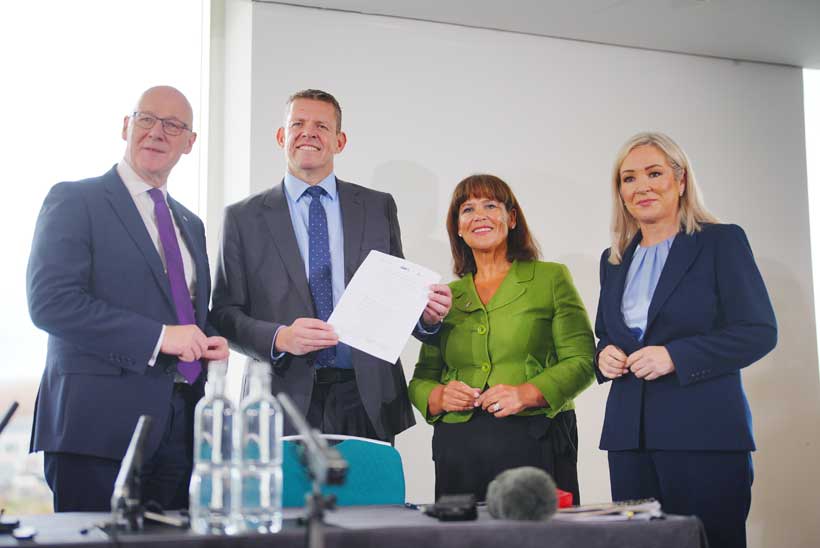
The September 14 Cardiff memorandum is a coordinated pressure campaign timed to a uniquely weak moment for the union’s defenders — a fragile, freshly installed Downing Street and a fragmented pro-union vote — not a genuine step toward any referendum. Andy Burnham’s already-wobbly “off the table” line shows Westminster’s political will is far shakier than its legal veto, which remains completely intact.
On Saturday, standing beside Ireland’s Taoiseach in Dublin, Donald Trump said reunifying Ireland “is going to happen eventually, so it may as well happen now.” Two days later, in Cardiff, the First Ministers of Scotland, Wales and Northern Ireland signed a joint memorandum declaring that “constitutional change is coming” and that no Westminster government has the right to block it. Downing Street’s response came within hours: a border poll and any independence referendum remain “off the table.” But not from Andy Burnham himself. Britain’s prime minister, two months into an accidental premiership, had cancelled his public schedule after his father’s death. Even his government’s firmest line on the union’s future was, for the moment, being delivered by someone else.
THE CONTEXT
Getting here took an unusual run of events. Andy Burnham was not even an MP in June; he won a by-election, forced Keir Starmer’s resignation four days later, and became prime minister on July 20 without ever leading Labour into a general election. In May, Scotland and Wales held devolved elections on the same day. The SNP won a fifth term but fell to a minority government, and pro-independence parties’ combined vote share actually dropped to its second-lowest level since 2007 — they won more seats only because Reform UK’s entry split the pro-union vote. In Wales, Plaid Cymru won its first ever election, also short of a majority, with Reform UK right behind it as the second-largest party. Northern Ireland has been led by Sinn Féin’s Michelle O’Neill since 2022. Legally, Scotland needs a Westminster-granted Section 30 order to hold a binding referendum, Wales’s devolution settlement contains no referendum mechanism at all, and a Northern Ireland border poll depends entirely on the UK-appointed Secretary of State’s judgment, which courts have ruled is deliberately undefined.
Stay ahead of the geopolitical week.
MD Briefing delivers expert analysis across five global fronts — the Indo-Pacific, energy, geoeconomics, European security, and the Middle East — every Monday morning. Free.
THE ARGUMENT
Most coverage of the Cardiff memorandum treats it as a step toward constitutional rupture. That gets the sequencing backwards. The more useful question is not what the memorandum says — it commits nobody to anything — but why three nationalist parties chose this exact fortnight to sign it, and the answer is about arithmetic and timing, not momentum toward departure.
Start with the arithmetic. Scotland’s pro-independence parties won their most seats ever in May while winning a smaller share of the vote than in 2016 or 2021, because Reform UK’s arrival split what used to be a more unified pro-union bloc across Conservatives, Labour, Liberal Democrats and Reform itself. Plaid Cymru’s historic win in Wales came with barely a third of the vote, and needs a coalition to govern at all. Neither result reflects a surge in public appetite for leaving the union; both reflect fragmentation on the other side. A memorandum built on that kind of mandate is a stronger case for governing leverage than for a referendum campaign.
Now the timing. Burnham’s path to Downing Street was accidental by any standard: a by-election win, an ousted predecessor, a leadership contest with no other candidate, and a premiership that began without a general election behind it. He has already shown how unsteady his position on the union is — in late August, he called a border poll “off the table” so bluntly that Sinn Féin called it anti-democratic and Downing Street had to walk it back within hours, reaffirming “every part” of the Good Friday Agreement, consent principle included. Three nationalist first ministers watching that climbdown, then watching Donald Trump tell reporters in Dublin that Irish unity “is going to happen eventually,” had every reason to conclude that this was the moment to raise the pressure — not because the legal path had opened, but because the man guarding it had never looked less sure of his ground.
None of that changes what Westminster can actually do. Scotland’s route to a legal referendum still runs through a Section 30 order that only Westminster can grant — the mechanism the UK Supreme Court confirmed in 2022 when it ruled Holyrood cannot legislate for one alone. Wales has no equivalent provision in its devolution settlement whatsoever; Plaid Cymru’s signature on the Cardiff memorandum is a statement of solidarity, not a legal lever. Northern Ireland’s border poll depends solely on the Secretary of State’s judgment about future majority support for unity, a trigger the courts have explicitly declined to define, leaving it entirely a political call for whoever holds that office. Three governments signed a document about self-determination; not one of them altered who controls the actual switch.
The obvious objection is that political pressure has moved that switch before: David Cameron granted Scotland’s 2012 Section 30 order despite no obligation to do so. But Cameron did it from strength — freshly re-elected, confident of winning the vote, and wanting to settle the question for a generation. Burnham is negotiating from the opposite position: newly installed, mandate-less, and by his own office’s account, uninterested in reopening constitutional debates while managing a cost-of-living crisis. A leader who is strong can afford to grant a referendum in order to close a question down. A leader who is weak has every incentive to refuse one, because refusal costs him nothing today and reopening it could cost him everything. That asymmetry, not the strength of the nationalist case, is what is actually holding the line.
THE SCENARIOS
Base case (roughly 60%): Burnham holds the position through this parliament. No Section 30 order, no border poll trigger, and the Cardiff pact settles into a recurring symbolic alliance that resurfaces around set-piece moments — a King’s Speech, a UK-Ireland summit — without producing legal movement, similar to the pattern of post-2017 Catalan declarations that changed rhetoric without changing law. This assumes Burnham’s government keeps enough parliamentary control that it never needs nationalist votes badly enough to trade for them.
Downside case for the union: Reform UK’s continued rise in Westminster polling squeezes Burnham’s working majority enough that he needs support from smaller parties on unrelated votes — budgets, confidence motions — and ends up trading incremental constitutional concessions for it: a citizens’ assembly, a joint council of the four nations, updated devolution powers. Not a referendum, but movement Westminster currently rules out entirely, conceded from weakness rather than granted from strength. This is the scenario the Cardiff signatories appear to be positioning for over years, not weeks.
Upside case for the union, or the alternative path: the three-nation alliance fractures rather than hardens, because Northern Ireland’s route to an actual vote is structurally the most credible of the three. If Dublin’s push — Taoiseach Micheál Martin has already said border-poll criteria “need to be discussed” — gains traction faster than Scotland’s or Wales’s static legal position allows, Sinn Féin has every incentive to pursue its own timetable rather than wait for Edinburgh and Cardiff, leaving the September memorandum as a one-off alignment rather than a durable pact.
THE TAKEAWAY
The Cardiff memorandum changed the political weather in Britain, not the constitutional law. Three nationalist parties leveraged a fragmented unionist vote and Westminster’s weakest government in a generation into a loud, coordinated statement that commits no one to anything and alters no legal mechanism. Burnham’s refusal, delivered by his office while he was absent from politics entirely, is nonetheless the more important signal: even a prime minister with no mandate and no appetite for a fight has found refusing easier than engaging. Watch the next British-Irish Intergovernmental Conference, likely by November on the twice-yearly cadence of the last two meetings: if Dublin’s push to define border-poll criteria produces anything concrete there, Northern Ireland — not Scotland or Wales — will be the nation that actually tests whether Westminster’s veto survives contact with a government that wants to be rid of the question.