


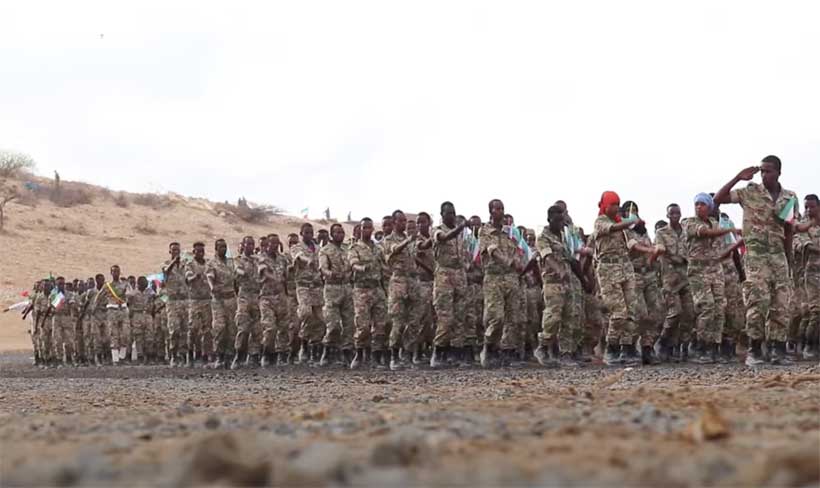
The detention of newly trained Somali soldiers in Ethiopia’s Somali Regional State has brought renewed attention to a Saudi-backed military training programme in Somalia and raised questions about the future deployment of the forces emerging from it.
The incident, however, does not by itself establish that the soldiers were being prepared for deployment to Sudan, as some reports and commentators have alleged. Capital FM report on the Jigjiga detentions
The soldiers crossed from Somalia into Ethiopia’s Somali Region after completing more than a year of training at the Xananbuure military camp in central Somalia. Somalia’s National Security Adviser, Aways Haji Yusuf, confirmed that the troops had crossed into Ethiopia and said they had been granted permission to visit their families. Garowe Online report on the Somali government’s statement Somali Guardian report on the training programme
The Somali government’s explanation is significant because reports about the incident have varied considerably, particularly over the number of soldiers involved. Some reports have put the number at around 300, while other accounts have cited higher figures. Given the conflicting estimates, there is currently insufficient independent evidence to establish a definitive number. Guardian Nigeria report on the incident
Stay ahead of the geopolitical week.
MD Briefing delivers expert analysis across five global fronts — the Indo-Pacific, energy, geoeconomics, European security, and the Middle East — every Monday morning. Free.
What is clearer is that the soldiers belonged to a much larger training programme. Reports have described the programme as involving thousands of Somali recruits, while Somalia’s National Security Adviser confirmed that the soldiers involved in the Ethiopia incident had spent more than a year undergoing training at Xananbuure. Somalia Today report on the Saudi-backed programme Garowe Online report on the Xananbuure training
The development has nevertheless generated questions because of wider reports concerning the regional role of the Saudi-backed programme and allegations that some Somali recruits could eventually be connected to the war in Sudan.
Those allegations require caution.
Recent reporting has cited claims that Saudi Arabia is supporting the training of thousands of Somali recruits and that some graduates could potentially be deployed to Sudan to fight alongside the Sudanese Armed Forces. Such claims have been reported by regional media, but the available evidence does not establish that the soldiers detained in Ethiopia were travelling to Sudan. Capital FM report on the Sudan allegations
Other reporting has alleged that more than 5,000 Somali recruits are involved in the broader Saudi-backed programme and that foreign military trainers from countries including Romania, Ukraine, South Africa and Colombia have been involved. These claims have been reported by regional media, but they have not been independently verified to a standard that would justify presenting them as established facts. Eastleigh Voice report on the alleged foreign trainers Tuko report on the Saudi-funded programme
At present, there is no independent evidence establishing that the soldiers detained in Jigjiga were travelling to Sudan. Nor is there sufficient evidence to conclude that the Saudi-backed training programme was established specifically to provide forces for the Sudanese war.
That distinction is important.
Saudi involvement in the training of Somali troops, and the subsequent movement of some of those troops into Ethiopia, are supported by reporting and statements from Somali officials. The alleged connection between the programme and the recruitment or deployment of fighters for Sudan remains a separate and unproven claim. Somali Guardian report
The issue is nevertheless strategically significant because Somalia sits at the intersection of several overlapping security dynamics in the Horn of Africa and the Red Sea. Somalia is rebuilding its national security forces while continuing military operations against al-Shabaab, while external powers have developed increasingly important security and defence relationships with Mogadishu.
The wider regional context makes the issue particularly sensitive. Sudan’s war has increasingly drawn neighbouring and regional states into its orbit, with military networks extending beyond Sudan’s borders.
For now, the incident raises more questions than it answers.
The central questions are not only why Somali soldiers crossed into Ethiopia, but also how the Saudi-backed training programme is structured, how many personnel have passed through it, what their subsequent assignments are, and whether any graduates have been recruited or deployed outside Somalia.
Those questions will require further evidence from the Somali and Ethiopian governments, Saudi Arabia and independent sources.
Until such evidence emerges, claims that the programme represents a Saudi-backed pipeline for Somali fighters destined for Sudan should be treated as allegations rather than established fact.
The Jigjiga episode is therefore significant not because it proves a Saudi role in recruiting fighters for Sudan, but because it has brought an otherwise relatively opaque military-training programme into public view—and created new questions about the regional security interests surrounding it.
