


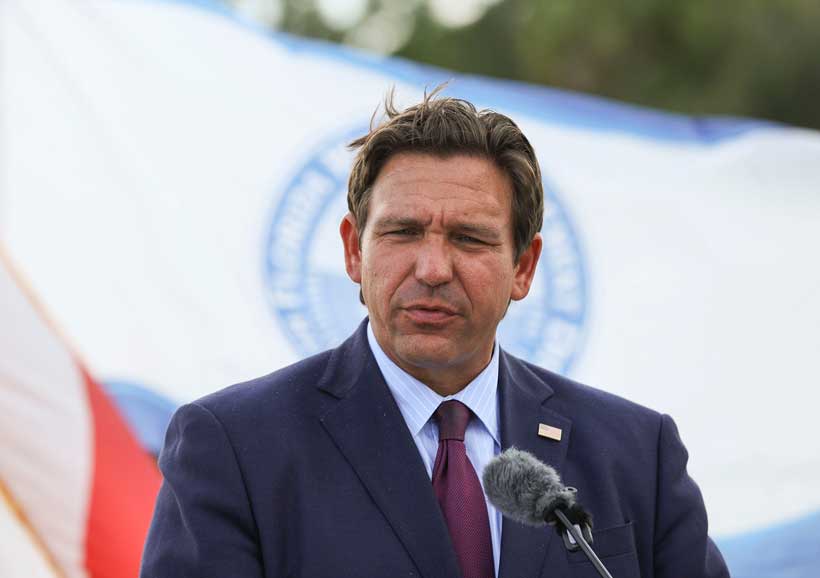
Florida Governor Ron DeSantis and the state Cabinet have designated the Council on American-Islamic Relations (CAIR), the Muslim Brotherhood and antifa as domestic terrorist organisations, escalating a legal and political dispute that has already reached federal court.
The September 29 vote also added more than 90 organisations already designated as foreign terrorist organisations by the U.S. federal government to Florida’s state framework, according to Florida Phoenix. The new designations are scheduled to take effect on November 5.
CAIR describes itself as a leading civil rights organisation serving the Muslim community in the United States. Founded in 1994, it has more than 25 chapters around the country, including in Tampa and Sunrise, Florida, according to Florida Phoenix.
The Florida action is a state-level designation and should not be confused with a federal U.S. terrorism designation. The federal government has not designated CAIR as either a Foreign Terrorist Organization or a Specially Designated Global Terrorist, according to Jason Blazakis, a former U.S. State Department counterterrorism official whose rebuttal was included in the Florida Cabinet materials.
Stay ahead of the geopolitical week.
MD Briefing delivers expert analysis across five global fronts — the Indo-Pacific, energy, geoeconomics, European security, and the Middle East — every Monday morning. Free.
Under Florida’s new framework, the state can impose significant restrictions on designated organisations and individuals. Florida Senate — HB 1471 The law provides for criminal penalties in specified circumstances involving knowingly providing material support or resources to a domestic terrorist organisation, receiving military training from such an organisation, or knowingly becoming a member and serving under its direction or control with the required intent. It also contains provisions affecting certain public funding and educational benefits.
CAIR and the American Civil Liberties Union have challenged the designation in federal court, arguing that it violates constitutional protections. The ACLU said lawyers representing CAIR and CAIR-Florida attempted to address the Cabinet during the September 29 meeting but were not given an opportunity to speak. Hina Shamsi, director of the ACLU’s National Security Project, called the designation baseless and unconstitutional.
A Second Attempt After a Court Block
The September designation followed an earlier attempt by DeSantis to classify CAIR and the Muslim Brotherhood as terrorist organisations.
In December 2025, DeSantis issued Executive Order 25-244, which sought to restrict government contracts, funding, employment opportunities and other public benefits involving CAIR and people alleged to provide material support to the organisation.
CAIR and CAIR-Florida challenged the order in federal court.
On March 4, 2026, U.S. District Judge Mark Walker issued a preliminary injunction blocking enforcement of the executive order against CAIR. The court found that CAIR was substantially likely to succeed on its claim that the order unconstitutionally coerced third parties into suppressing CAIR’s speech, in violation of the First Amendment.
The ruling did not prevent Florida from pursuing a different legal route. DeSantis appealed the decision to the U.S. Court of Appeals for the Eleventh Circuit, while Florida lawmakers moved to establish a statutory framework for state-level terrorism designations.
The Florida Legislature passed House Bill 1471, which authorises the Chief of Domestic Security to designate an organisation as a domestic or foreign terrorist organisation if specified requirements are met. The governor and Cabinet may then approve or reject the designation by majority vote. The law took effect on July 1, 2026.
On July 1, DeSantis announced that Florida officials intended to designate CAIR, the Muslim Brotherhood and antifa under the new framework. CAIR and CAIR-Florida filed a separate federal lawsuit challenging the new designation regime and arguing that it violates their constitutional rights.
The state subsequently approved the administrative process needed to proceed with the designations. On September 29, the governor and Cabinet formally approved them.
Allegations Behind the CAIR Designation
Florida’s case against CAIR relies in part on allegations concerning the organisation’s historical links to Hamas and its appearance in the federal Holy Land Foundation terrorism-financing case.
The Florida Department of Law Enforcement cited CAIR’s identification as an “unindicted co-conspirator” in the U.S. v. Holy Land Foundation for Relief and Development case, according to Florida Phoenix. Federal prosecutors listed CAIR and more than 200 other organisations and individuals as unindicted co-conspirators in 2007. The Holy Land Foundation defendants were subsequently convicted of terrorism-financing charges.
CAIR itself was not criminally charged or indicted in that case. Florida Phoenix and other reporting have noted that the unindicted co-conspirator designation is distinct from a criminal charge or conviction.
Florida’s Cabinet materials also allege that CAIR’s founding members had connections to Hamas leadership and that current CAIR members have connections to an alleged member of Palestinian Islamic Jihad. These are allegations contained in the state’s materials, rather than findings that CAIR has been convicted of terrorist activity.
CAIR has denied the allegations and maintains that it is a Muslim civil rights organisation.
The Cabinet materials included a rebuttal from Jason Blazakis, a former U.S. State Department counterterrorism official and professor at the Middlebury Institute of International Studies. Blazakis argued that the evidence relied upon by Florida was insufficient to justify a terrorism designation and questioned whether the state had assembled an adequate administrative record.
Blazakis also noted that the federal government has never designated CAIR or any of its chapters under the Foreign Terrorist Organization or Specially Designated Global Terrorist regimes.
Wider Debate Over the Muslim Brotherhood
The Florida decision comes amid a broader U.S. debate over organisations alleged by government officials and advocacy groups to have connections to the Muslim Brotherhood.
The federal government has not designated the Muslim Brotherhood as a single organisation. Florida’s designation therefore represents a state-level action rather than a federal determination applying across the United States.
Texas Governor Greg Abbott also designated CAIR and the Muslim Brotherhood in 2025, according to Florida Phoenix.
The United Arab Emirates designated CAIR as a terrorist organisation in 2014, according to the Florida state documents cited by Florida Phoenix. The UAE action cited alleged links to the Muslim Brotherhood and concerns over extremism.
These foreign and state-level designations remain separate from the U.S. federal government’s terrorism-designation system.
The Constitutional Battle Continues
The September vote is unlikely to end the dispute.
CAIR and civil liberties organisations argue that Florida’s designation threatens freedom of speech and association and violates due-process protections. The ACLU, ACLU of Florida and Southern Poverty Law Center are representing CAIR and CAIR-Florida in federal litigation challenging the state’s designation regime.
Florida officials, meanwhile, argue that the state’s framework is intended to prevent public resources from supporting organisations that the state has classified as terrorist organisations and to address what they describe as financial and organisational networks linked to extremist movements.
The dispute now raises broader questions about the extent of state authority to create and enforce its own terrorism-designation system and how such powers interact with First Amendment protections.
For CAIR, the central question is whether Florida can use its state terrorism-designation framework to impose extensive financial and institutional restrictions on a domestic civil rights organisation.
For Florida officials, the case represents an effort to establish state-level mechanisms for identifying and restricting organisations they consider terrorist entities.
The outcome could therefore have implications beyond CAIR itself, potentially shaping the boundaries of state authority, free-speech protections and the relationship between state and federal terrorism-designation regimes in the United States.
