On February 1st, the G7’s price cap on Russian crude oil quietly reset itself to $44.10 a barrel — down from $47.60, and a long way from the $60 ceiling the coalition set with great fanfare back in December 2022. Nobody voted on this. A formula did it automatically, recalculating the cap every few weeks to stay 15% below the trailing market price for Urals crude. The mechanism exists because the flat $60 cap had stopped constraining anything: global oil prices had drifted down into the $40s anyway, so a $60 ceiling was no longer a ceiling at all. The fix was elegant. It was also an admission — the tool had to be redesigned because reality had already made it irrelevant.
That quiet recalibration is worth dwelling on, because it captures something true across the three biggest sanctions campaigns running in parallel right now — Russia, Iran and Sudan. All three have absorbed an accelerating stack of measures since 2025: the EU’s 20th Russia package in April added 46 vessels to its shadow-fleet list (cumulative total: roughly 640) and transaction bans on 20 more banks; Washington has now run 14 sanctions packages against Iran comprising 465 separate measures; Sudan’s Rapid Support Forces sit under layered UN, US and EU designations on top of a two-decade-old Darfur arms embargo. Each round is announced as tightening the net. The question this piece asks is the one none of the individual sanctions stories stops to ask: tightening it around what?
Score the record on the only metric that matters — did target-state behaviour actually change — and it is a bad one for the tool.
Russia is still fighting. Oil revenue’s share of the federal budget did fall, from roughly 30-35% before the war to about 23% shortly after, and Washington’s own Treasury credits the original price cap for a real chunk of that. But that was the first-generation shock of 2022-23, landed before Moscow built its shadow fleet. Since then the fleet has done the job the cap was designed to prevent: something in the range of 600-plus tankers now move Russian crude outside G7-flagged insurance and shipping, and every package that adds a few dozen more names to that list is adding to a roster already built to be disposable — ownership gets reshuffled, flags get repainted, the tanker keeps sailing. The EU is reportedly preparing close to 1,600 additional Russia-related designations for an autumn package. Six hundred and forty vessels sanctioned to date, sixteen hundred more names queued, and the war is in its fifth year with no ceasefire in sight.
Stay ahead of the geopolitical week.
MD Briefing delivers expert analysis across five global fronts — the Indo-Pacific, energy, geoeconomics, European security, and the Middle East — every Monday morning. Free.
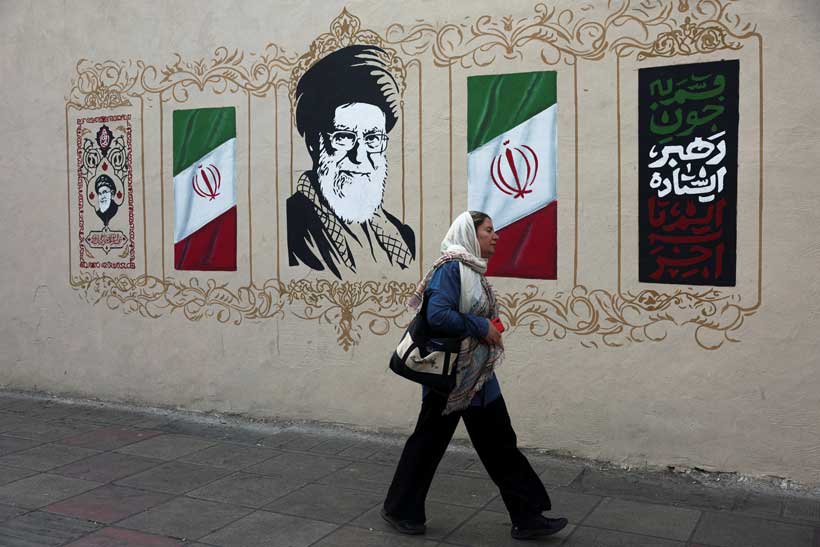
Iran tells the same story with better documentation. Fourteen sanctions packages and 465 measures did not stop Iranian crude from hitting some of its highest export volumes on record through 2025 — shipments to China alone touched 1.8 million barrels a day in parts of the year, up more than a fifth on 2024, almost all of it absorbed by independent “teapot” refineries that have built a business model out of buying oil no state-owned major will touch. Only in 2026, when Washington shifted from designating Iranian counterparties to directly threatening the teapots’ own access to dollar clearing, did some of them visibly start pulling back. That is the tell: the lever that worked was not the fifteenth sanctions package. It was a different, more coercive tool aimed at a different target.
Sudan is the cleanest case because there is no ambiguity about the outcome. The war did not merely continue through 2025’s sanctions rounds — it got worse, with El-Fasher falling to the RSF in October after a 500-day siege, arms embargo notwithstanding. The reason is not hard to find: something like 60 tonnes of Sudanese gold moved through smuggling networks into Egypt in under two years, and the UAE alone absorbed roughly 97% of official gold exports from army-held territory in 2024 — worth $1.52 billion, more than half of Sudan’s entire recorded export base — in a trade multiple investigations tie directly to the drones, anti-aircraft systems and ammunition flowing back to the RSF. No sanctions list has meaningfully touched that pipeline, because it does not run through a jurisdiction that has to answer to one.
The honest counter-argument is that sanctions were never supposed to work like a light switch. The standard academic baseline, from the Peterson Institute’s decades of case studies, puts full or partial sanctions success at around one-third of cases historically, and partial fiscal drag — a weaker rouble, a discounted barrel, a costlier workaround — still counts for something short of policy capitulation. That is fair, and it is also beside the point being made here. The claim is not that sanctions never work. It is that the marginal round has stopped adding anything. The heavy lifting in all three cases was done by the first wave of measures, before target states built durable evasion infrastructure. Everything layered on top since has mostly taxed the compliance department, not the target.
That tax is not trivial, and it is not evenly distributed. German banks alone reported financial-crime compliance costs of $32.5 billion in 2023; UK institutions now put their combined annual bill at roughly £38.3 billion; global regulators have levied $45.7 billion in AML and sanctions-related fines since 2000, with $4.5 billion of that in 2024 alone, and 98-99% of banks surveyed in the US, Canada and Europe reported rising compliance costs that same year. The transshipment side shows exactly why that expense keeps buying so little: one investigation traced $4 billion in restricted US chips through more than 6,000 companies routed via Hong Kong, Turkey, Serbia and half a dozen other jurisdictions — and the EU’s April 2026 package was still naming Hong Kong shell firms for the identical scheme two years after it was first documented. The compliance apparatus grows. The workaround infrastructure grows faster and cheaper. Somewhere in the last eighteen months, the ratio inverted.
What Happens Next
Three paths from here, and which one plays out hinges less on how many further designations get issued than on whether the enforcement style itself changes.
Base case (60%): Numerical escalation continues on autopilot. The EU’s roughly 1,600-name autumn package goes through, Washington adds further Iran designations, Sudan gets another UN Panel of Experts report nobody acts on — while target-state behaviour stays essentially where it is now: Russia’s war continues, Iran’s exports hold near current levels, the RSF-SAF war grinds on. Compliance costs keep climbing on the same trend line. This is the likeliest outcome because it requires no government to admit the current approach has hit diminishing returns.
Downside case (20%): Enforcement pivots from designation to interdiction — more direct action against tankers and refineries, following the 2026 Iran-teapot playbook, rather than simply adding names to lists. This buys real marginal deterrence but raises the risk of confrontation at sea or with third countries — China, the UAE — whose cooperation the West still needs elsewhere, and it only scales to a handful of high-value targets, not the whole evasion ecosystem.
Upside case (20%): A “sanctions reset” — explicit acknowledgment that primary-target designations have plateaued, paired with a shift toward the enabler hubs directly: UAE gold refiners, the handful of Hong Kong and Turkish trading entities that surface in every transshipment investigation, the insurers underwriting shadow-fleet tankers. A smaller, more surgical list — but one that, if it lands on the five or six firms that actually make the workaround economy function, could restore marginal deterrence without another 1,600-name round.
These probabilities reflect the author’s analytical judgment based on currently available information, not a statistical forecast.
Financial statecraft has not failed. But its marginal unit has gone to zero across three of the most heavily sanctioned states on earth, and nobody with the authority to say so has an incentive to. A new sanctions package is a costless political statement; shifting to interdiction or hub-targeting means picking fights with China, the UAE and Turkey that foreign ministries would rather avoid.
Watch for: what is actually inside the EU’s roughly 1,600-name autumn Russia package when it lands. If it is still mostly individuals and vessels, that is the ratchet continuing on autopilot. If it names UAE-based trading houses or Hong Kong intermediaries by function rather than nationality, that is the first sign the marginal-deterrence math is finally being taken seriously.