


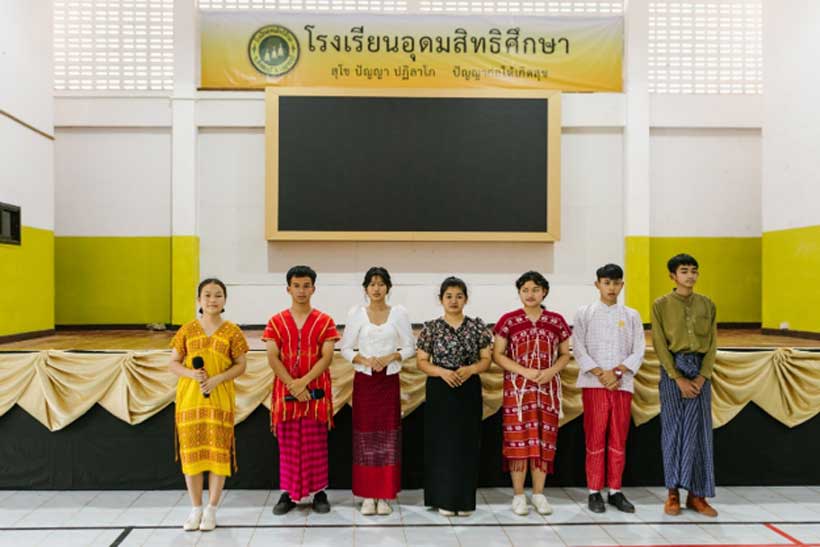
SANGKLABURI – Nearly 500 kilometers away from Bangkok, Sangklaburi is a small-town in Kanchanaburi province, the western part of Thailand. It is surrounded by nature and wrapped in picturesque mountainsides. The province is bordered between Thailand and Myanmar. It is predominantly populated with the Mon and Karen hilltribes – the ethnic minorities of Myanmar who live in Thailand.
There is Uttamanusorn Bridge or Mon Bridge: a 800 meters long wooden bridge that connects Thailand and Myanmar. The bridge represents the faithful respect of Thai and Mon people toward the benevolent Phra Raja Udommongkol or Luang Po Uttama – a Mon Buddhist monk who uplifted the lives of Mon people in Sangklaburi. Luang Po Uttama is not just a religious leader but he has significant impact on the economics, politics and spirituality of the people.
This is especially true for education. He translated people’s commitment to Buddhism to be an unwavering support for education. He supported Thai and Mon people to have equitable access to education. He donated lands and fundraised for the people. Luang Po Uttama built Watwangvivekaram school, a primary school and Udomsittisuksa school, a large scale students secondary school for Mon and Thai to learn together.
Venerable Phra Mahasuchart Siripanyo, the Head Abbot at Watwangvivekaram Temple and a lifelong’s disciple of Luang Po Uttama, shared Luang Po Uttama’s vision on education:
“Before Luang Po Uttama established Watwangvivekaram primary school, there was no school for Mon students. Students had to cross the bridge to get access to education. It was very dangerous in the rainy season. More and more Mon students were born and Luang Po wanted to educate these children. He talked to the Local Education Commission to find teachers and he supported the land and built the schools. It is a collaboration between Luang Po Uttama and the state to support students’ education and well being”
Stay ahead of the geopolitical week.
MD Briefing delivers expert analysis across five global fronts — the Indo-Pacific, energy, geoeconomics, European security, and the Middle East — every Monday morning. Free.
In 1976, Luang Po Uttama gave 17 acre (43 rai) to the Ministry of Education and launched fundraising campaign to build Udomsittisuksa, a secondary school. In the beginning, there were 22 students. The numbers increased substantially. By 2025, there were more than 2,000 students. It is the only secondary school in Sangklaburi. More than 30 small primary schools in Sangkhlaburi send their students to pursue secondary education in Udomsittisuksa. It’s a gateway for the community to pursue higher education.
This secondary school is very special. Luang Po Uttama had a vision that students from all walks of lives will learn to live together, become friends and help each other in the community. There are different ethnicities of students here: Thai, Mon and Karen. They all have studied together peacefully. For nearly 200 students whose homes are far away from the school, they attend a boarding school on the property. The students are nurtured to live harmoniously together – they grow and cook their own food after school hours, help each other to clean their dorms and conduct after school activities together.
The school becomes a playground for students to assimilate to be Thai and learn Thai culture.
Udomsittisuksa is a public school, everything is for free. Students can access quality education equally without worrying about costs.
The racial and language differences do not impede students’ learning. Students are fluent in Thai. Most students speak local language at their homes but when they come to the school, the teachers provide the cultural and language bridge for students to learn Thai. The teachers push very hard for students to use Thai language amongst themselves. Good teachers create conducive spaces for learning both Thai and local languages.
The school respects and maintains local cultures by having local teachers teaching Mon language in the schools’ hours. By focusing on local language, the schools are honoring Luang Po Uttama’s legacy, who could speak five local languages fluently: Thai, Mon, Myanmar, Karen and Bali. He used to use these local languages to help the Thai state mitigate conflicts with the local communities. Venerable Phra Mahasuchart Siripanyo said “there is a ‘panya’ (knowledge) in the language. The more they know languages, the more knowledge they have. We have to preserve the local languages to preserve the local knowledge.”
More than knowing Thai and local languages, students at Udomsittisuksa have the opportunity to attend vocational education classes on the school sites. There are mechanics, culinary and accounting so that after graduation, they can become active members with employment in their community. The school is fostering local connections with Ratchaphat Kanchanaburi and Patumwan Vocational College to send students for cross learning and internship opportunities.
One of the most critical issues is how to make sure students are independent at the same time they can learn to live with others. These are contrasting factors but they must go hand in hand. Students must be able to take care of themselves and provide for their parents but also respect differences and diversity. This will allow them to live happily in the society. Udomsittisuksa is a good example that a good school can do both.
Mr. Surin Ketsuwan, Director at Udomsittisuksa, said “Udomsittisuksa can be the best practice for Sangkhlaburi for being excellent school. My goal for Udomsittisuksa is being a school for everyone, a school that the community can trust, a school that the community is proud of”.
This is a proven record that if we have the right foundation for education, we can have quality education. It does not have to be world class or national level. The right vision matters. Luang Po Uttama showed that good school can happen to help students share together, work in team and live together peacefully.
