


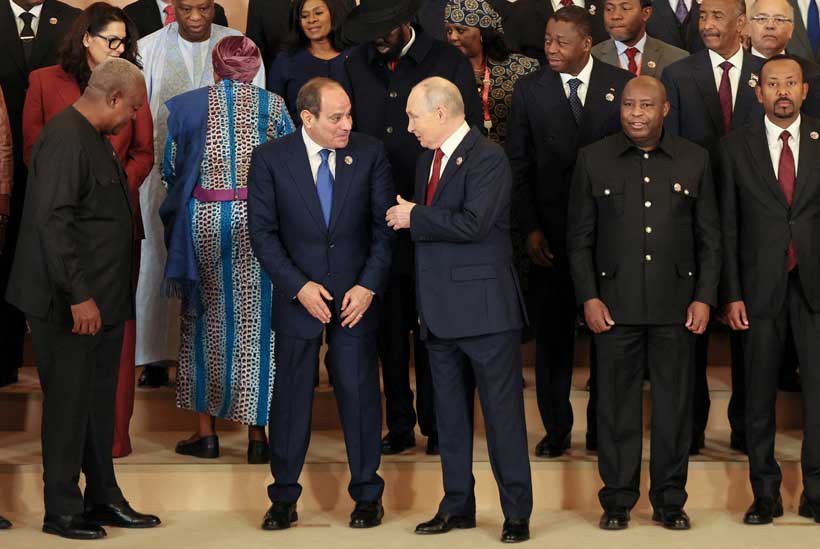
China indirectly benefits from Egyptian President Abdel Fattah El-Sisi’s participation in the third Russia-Africa Summit (held in Moscow in October 2026) through several shared strategic, economic, and political aspects with parallel alliances, such as BRICS and the Global South. President El-Sisi’s participation in the third Russia-Africa Summit in Moscow is a strategic step that strengthens Egypt’s position as a pivotal link between the major powers and the African continent. It has direct implications for the Global South, particularly in comparison with China’s role. This is achieved through:
1) Strengthening the balance of the international system: Egypt’s participation and effectiveness in African blocs with major powers (Russia and China) supports efforts to build a multipolar international system, which serves China’s interests in reducing Western and American hegemony.
2) Convergence of interests in the Global South: There is a declared Egyptian-Chinese agreement to expand coordination on issues of global governance and defend the interests of developing countries and the Global South, which makes any African rapprochement with China’s allies (such as Russia) supportive of the Chinese vision for the continent.
3) Egypt as a Strategic and Logistical Gateway: Egypt possesses a unique geographical location, the Suez Canal, and deep-rooted historical and institutional ties with African countries (being a founding participant in the Russia-Africa Cooperation Initiative since its presidency of the African Union in 2019). This stability and interaction serve the trade and logistics networks that China seeks to expand through its Belt and Road Initiative in Africa.
Stay ahead of the geopolitical week.
MD Briefing delivers expert analysis across five global fronts — the Indo-Pacific, energy, geoeconomics, European security, and the Middle East — every Monday morning. Free.
4) Egyptian-Chinese-Russian Coordination through the BRICS Group and Strategic Partnerships: As Egypt and China are partners in the BRICS Group and share a comprehensive strategic partnership—recently celebrating 70 years of diplomatic relations—Egypt’s strong and influential presence in African and international forums facilitates the coordination of economic and development positions, independent of Western and American pressures.
From this perspective, we can understand the significant strategic benefits, both direct and indirect, that China derives from Egyptian President Abdel Fattah El-Sisi’s participation in the third Russia-Africa Summit held in Moscow in October 2026. Although the summit brought together Russia and Africa, its outcomes and the messages conveyed by Egypt directly serve China’s vision for reshaping the international order, supporting the issues of the Global South, and strengthening the BRICS bloc. This Chinese benefit from Egypt’s participation and that of its president in the Russia-Africa Summit, and its importance to Beijing, can be summarized in the following points:
– First: China’s benefit from President El-Sisi’s participation in the Russia-Africa Summit regarding issues of the Global South (alignment of Chinese, Egyptian, and Russian visions)
The outcomes of President El-Sisi’s participation in the summit intersect with China’s international initiatives, such as the Global Development Initiative and the Belt and Road Initiative, in several areas:
1) The call for a more just international order and institutional reform: In his speech, President El-Sisistressed the need to reform the UN Security Council and address the historical injustices suffered by the African continent to ensure fair representation for the Global South. This demand represents the core of China’s foreign policy, which seeks to end unipolar hegemony and establish a multipolar system that reflects genuine pluralism. Here, coordination at summits like this presents an opportunity for the Global South to push for reform of international financial institutions and explore mechanisms for trade in local currencies to alleviate the economic pressures resulting from the dominance of the dollar.
2) Strengthening Multipolarity: Egypt’s participation in the Russia-Africa Summit supports the efforts of the Global South, led by China, to reshape the international system to be more balanced and equitable. African countries, including Egypt, are working under the leadership of the China-Russia axis to reduce dependence on a single international power and find flexible political and economic alternatives.
3) Energy Security and Logistics Connectivity: Egypt has proposed axes for African development that include establishing strategic corridors, logistics zones, and enhancing electricity interconnection. This infrastructure is a natural complement to China’s Belt and Road Initiative projects on the continent, facilitating Beijing’s expansion of its investments and intra-African trade.
4) African Ownership of Development: Egypt’s emphasis on the need to respect the priorities of African countries and refrain from imposing external dictates aligns perfectly with the Chinese principle of non-interference in internal affairs and the development of partnerships based on mutual benefit, a (win-win) principle. Egypt viewed this as a platform to raise existential issues. Egypt utilized the Russia-Africa Summit as a regional forum to reaffirm its commitment to peace and stability in the Horn of Africa, a region crucial to China’s logistical and vital interests. Egypt also highlighted water security as an existential issue and advocated for resolving the crises in Gaza, Sudan, and Libya. This aligns with China’s vision for serving the development agenda and promoting stability in the Global South.
– Second: The crucial importance of the BRICS group for coordinating positions between Egypt, China, and Africa to serve the development agenda and issues of the Global South
The BRICS group includes China, Russia, and Egypt (as active members). Therefore, any Egyptian-Russian initiative in Africa benefits the cohesion and strength of this bloc regarding issues of the Global South, as follows:
1) Strengthening BRICS’ collective leadership in the Global South: The high level of coordination among the group’s major players (Russia as host and Egypt as a pivotal link and regional leader) demonstrates BRICS’ ability to lead development and resolve conflicts in Africa, thus solidifying the group’s image as a reliable alternative to traditional Western institutions.
2) Advancing the BRICS financial and economic liberalization agenda: The summit explored new mechanisms for financing projects and developing supply chains, bypassing Western complexities and sanctions. This movement supports the BRICS efforts (led by its IMF and ECB) to promote the use of local currencies and reduce reliance on the dollar in intra-regional transactions and with the African continent.
3) Supporting the logistical and trade stability of BRICS partners: Egyptian-Russian talks focused on maritime security in the Red Sea and maintaining stability in the Horn of Africa and Sudan. This stability is of paramount importance to China, as the Red Sea and the Suez Canal are the main arteries for the flow of Chinese exports to Europe and Africa.
– Third: The paramount importance for China (and international competition) within the framework of the Chinese model for emulating the Forum on China-Africa Cooperation (FOCAC)
The China-Russia Forum on Africa is the most powerful diplomatic tool for both China and Russia to consolidate their leadership of the Global South and build a united front against Western pressure. The Forum also serves as the primary platform for integrating the African continent into China and Russia’s massive infrastructure projects, as follows:
1) Emulating the Chinese model: Analysts believe that through these summits, Russia is attempting to emulate the Forum on China-Africa Cooperation (FOCAC), which Beijing launched in 2000 to extend its influence. Therefore, the participation of Egypt and other African leaders reflects the African continent’s desire to leverage this competition for the benefit of its people.
2) Diversifying strategic partners: Egypt and other African countries are not operating on a binary choice between Beijing and Moscow. Instead, Cairo is adopting a policy of balance and openness. China is the largest trading partner and investor in African infrastructure (through the Belt and Road Initiative), while Russia offers strategic partnerships in specific sectors such as military manufacturing, grain production, and nuclear energy (e.g., the Dabaa Nuclear Power Plant project in Egypt).
3) Building Joint Economic Corridors: Egypt seeks to link the interests of these powers. The establishment of the Russian Industrial Zone in the Suez Canal Economic Zone geographically complements the massive Chinese investments in the same area (China’s TEDA Industrial Park), making Egypt a global logistics hub that serves the strategies of both China and Russia toward Africa and the Global South.
4) Strengthening Influence in the Global South: The African Forum represents the most powerful diplomatic tool for China and Russia to consolidate their leadership of the Global South and build a united front against Western and American pressure.
5) Securing Energy and Resources: Africa is the main artery for China and Russia’s supplies of oil, gas, and vital minerals such as cobalt and lithium, necessary for advanced technology industries and the green transition.
6) The Belt and Road Initiative Umbrella: China’s Belt and Road Initiative and its impact on development issues in Africa: The African Forum serves as the primary platform for integrating the African continent into China’s mega infrastructure projects (ports, railways, and energy networks).
7) Mutual Diplomatic Support: Through its African relations, China secures a critical voting bloc in the United Nations and international organizations to support its positions on issues such as Taiwan and human rights.
8) The evolution of the new Chinese model for Africa and the Global South compared to Russia and its importance for Egypt, through:
– Shifting from Quantity to Quality: China has recently shifted its focus from large-scale infrastructure projects (ports and airports) to small and beautiful projects that are more sustainable.
– Focusing on Technology and Green: Prioritizing digital transformation, renewable energy, technology transfer, and training local African personnel.
– Fourth: International Competition Between the United States, the European Union, and Other Powers with China and Russia within the African Forum
Influence in the African continent is witnessing fierce strategic, economic, and military competition between the United States, China, and Russia, with each party seeking to strengthen its presence through different means and approaches. China’s role is based on extensive economic partnerships and infrastructure development, while Russia relies on a security and military presence and grain supplies. The United States seeks to contain these roles through strategic projects and support for democratic reforms. These roles among the major powers can be observed through:
1) The US-China-Russia rivalry: The United States is attempting to offer alternatives to Chinese and Russian financing for Africa through initiatives such as the Partnership for Infrastructure Investment in Africa (PIIA) and the Global Investment Plan (PGII), warning of debt traps, while China focuses on presenting a development model without political conditions.
2) Competition with the European Union: The European Union, through its Global Gateway strategy, seeks to compete with Chinese and Russian influence in the fields of renewable energy and digitalization in Africa.
3) The rise of other regional and international powers: China’s moves in Africa overlap with those of other powers seeking to secure a foothold on the continent, such as Russia (in terms of security), and India, Turkey, and the Gulf States (in terms of economics and investment).
Accordingly, we understand the extent to which China leverages Egypt’s significant presence at international summits, such as the Russia-Africa Summit, as a diplomatic and economic tool. Egypt represents a pivotal link, translating the political understandings between BRICS and Russia into practical development projects on the ground in Africa, thus supporting Beijing’s long-term strategic objectives in leading the issues of the Global South.
