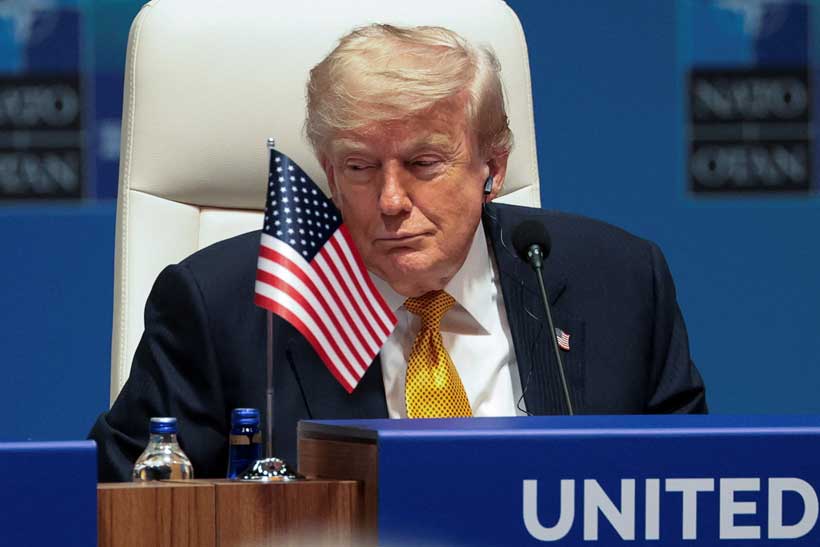
On 17 August 2026, with the deadline for a wider US-Iran peace framework about to expire and the Strait of Hormuz effectively closed to tanker traffic, President Trump said this about Oman, the country that has spent two decades quietly hosting the only working channel between Washington and Tehran: “If Oman gets in the way, we’ll bomb the s*** out of them.” He walked it back within a day, saying the US could handle Oman “very easily” and floating the idea of simply declaring the strait American territory. The retraction is not the story. The story is that a sitting US president found it useful, even briefly, to threaten a mediator with military force for doing exactly what mediators do: talking to both sides. Oman was not the first. Eleven months earlier, Israel had done something no state had ever done to an active mediator before. It bombed one.
Start with the shape of 2026’s mediator triangle. Oman has hosted the only sustained US-Iran channel since Washington and Israel launched a joint air campaign against Iran’s nuclear program on 28 February 2026. Switzerland, protecting power for US interests in Tehran since 1980, brokered a memorandum of understanding between the two governments on 18-19 June at Bürgenstock, setting a 60-day roadmap toward a wider deal. That deadline lapsed on 18 August with nothing signed, and the Strait of Hormuz — the route for roughly a fifth of the world’s seaborne oil — had by then all but seized up, tanker crossings down from around 130 a day before the war to three. Qatar’s file is separate: it has hosted Hamas’s political bureau since 2012, at Washington’s own request, to keep a channel open for hostage and ceasefire talks even as the Gaza war ran alongside the Iran one. All three states share one asset — a reputation for being trusted by both sides in a fight. That asset is now being tested.
Call it the mediator-liability problem: what happens to the broker when the deal collapses is no longer a footnote to the failure. It is becoming a cost serious states have to price in before they agree to host talks at all. 2026 has produced three distinct demonstrations of it, each harsher than the last.
Start with the mildest: coercion by threat. Trump’s Oman remark came after Tehran’s foreign ministry said it had reached its own arrangement with Muscat on shipping routes through the strait — ordinary, low-level diplomatic contact of exactly the kind a mediator exists to facilitate. Iran’s Revolutionary Guard, for its part, dismissed Trump’s suggestion of a parallel US-Oman backchannel as “delusions.” Whatever actually passed between Muscat and Tehran, Washington’s response was to treat routine contact between a mediator and the party it mediates with as if it were sabotage, and to reach for a military threat as the corrective. The threat was walked back inside a day. That it was made at all, by a sitting president, over a matter this narrow, is the point: threatening the host state has become an available first move rather than a diplomatic taboo.
Stay ahead of the geopolitical week.
MD Briefing delivers expert analysis across five global fronts — the Indo-Pacific, energy, geoeconomics, European security, and the Middle East — every Monday morning. Free.
Then there is reputational erosion, the slower and more familiar version. Switzerland’s Bürgenstock mandate rests on a protecting-power relationship with Washington that survived the 1979-81 hostage crisis intact — the kind of institutional memory that makes a mediator credible precisely because it stayed neutral through worse than this. An active war between the two parties it now shuttles between puts that credibility under a different kind of pressure: every meeting Bern hosts is read by each side as evidence of what the other side is really after, and Switzerland has no way to prove its channel is not, at some level, being used for signalling neither party wants attributed to itself.
The sharpest version is Qatar’s, and it happened first. In September 2025, Israel struck Doha, targeting members of Hamas’s political delegation on Qatari soil — the delegation Doha had hosted since 2012 at Washington’s explicit request, according to former CIA director David Petraeus’s own account of how that arrangement began. Researchers who track mediation have called it the first strike in the modern era on a state actively performing a mediator role, rather than on a party to the underlying conflict. Qatar had done nothing but exactly what the United States asked of it thirteen years earlier. It was struck anyway, by a different party unhappy with what the channel had failed to produce.
The strongest objection to calling this a new category is that mediators have always carried risk — Norway’s Oslo channel drew furious criticism from all sides for years, and Qatar has faced accusations of bias since well before 2023. That is true, and it describes reputational risk: a mediator’s standing could be damaged, its motives questioned, its future usefulness curtailed. What changed in 2026 is that the risk crossed into the kinetic and the openly coercive — a strike on one host’s capital, a great-power head of state threatening to bomb another. Reputational risk is a cost a mediator absorbs and manages over years. Being bombed, or threatened with bombing by the very power whose negotiation you are hosting, is a different order of exposure, one that has nothing to do with how well or fairly the mediator did its job.
What most coverage misses by treating the Doha strike as a Gaza story and the Oman threat as an Iran story is that both are instances of the same pattern, visible only when set side by side: convening power, the diplomatic asset that Oman, Qatar, Switzerland, Norway and a handful of others have spent decades building their foreign policy around, is starting to carry a bill. These states built entire strategies of relevance on being useful to everyone by trusting no one enough to take sides. 2026 is the year that bargain stopped being free.
What to watch for next
Base case (roughly 55% likely): mediators keep hosting, but start pricing in insurance rather than walking away. Expect Oman, Qatar and others to extract quieter compensation for the risk — security guarantees, arms deals, diplomatic cover — while publicly downplaying contact with the party a frustrated patron is angry at. Oman’s most likely response to the bombing threat is not to stop talking to Tehran but to talk about it more discreetly.
Downside case: a second kinetic incident against a mediator’s own territory or personnel — not a threat this time, an actual strike or a credible near-miss against Omani or Qatari assets — triggers a visible pullback. Watch for any of the traditional convening states publicly declining a hosting request on an active file, such as Ukraine, Sudan or Venezuela, in the next six to twelve months; that would be the clearest signal the pool of willing mediators is shrinking exactly as demand for it rises, with the vacuum filled by states that have far less claim to neutrality.
Upside case, and the least likely: the mediator states coordinate defensively, whether informally or through an existing body such as the Organisation of Islamic Cooperation or the UN, to raise the political cost of attacking or threatening a host state. Qatar, Oman, Switzerland, Norway and Turkey all share a durable interest in keeping the convening business viable, and a joint norm-setting move — establishing that striking or threatening a mediator carries consequences distinct from the underlying conflict — would cost none of them much and could stabilise the function for everyone. Nothing currently in motion points toward this happening, which is itself informative.
Mediator liability sounds like a phrase for a conference panel. In 2026 it became three concrete facts: a mediator’s capital was struck, a mediator was threatened with bombing by name, and a mediator’s decades-old credibility came under strain simply for continuing its job during an active war. None of that shows up as a line in any communiqué, because none of the parties doing the threatening or the striking has an interest in admitting that is what happened. The tell will not be a diplomatic protest. It will be quieter than that.
Watch for: whether any state is asked, in the next six months, to host a serious round of talks on Ukraine, Sudan or Venezuela — and declines. That is the moment 2026’s pattern stops being three isolated incidents and becomes a shortage.