


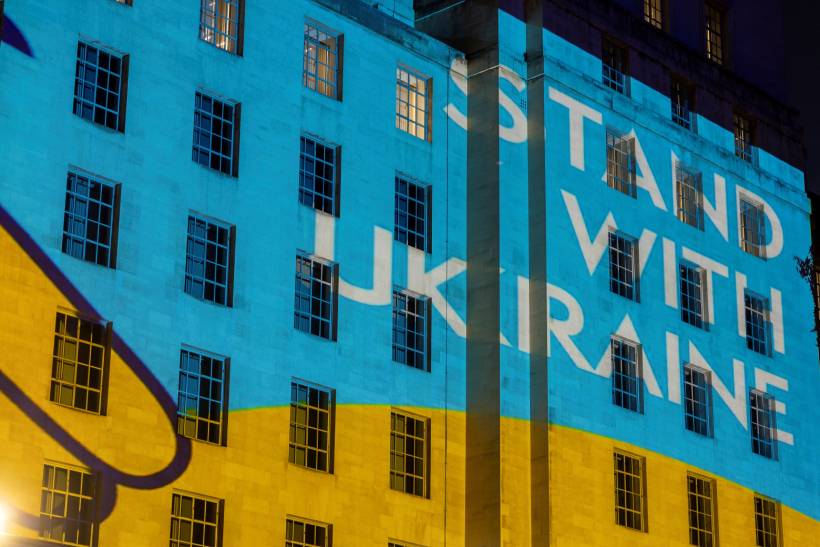
Ukraine wants an end to the war but will not accept peace on terms that amount to surrender, President Volodymyr Zelenskiy said on Monday in a defiant speech marking the country’s Independence Day.
Speaking in Kyiv on the 35th anniversary of Ukraine’s independence from the Soviet Union, Zelenskiy rejected Russia’s demand that Ukraine cede the remaining parts of the eastern Donbas that are still under Kyiv’s control. He argued that giving up territory would not guarantee an end to Russian aggression and warned against allowing Moscow to convince Europe and the wider international community that territorial concessions would quickly end the war.
His remarks came as British Prime Minister Andy Burnham and European Council President Antonio Costa joined other foreign leaders in Kyiv for the celebrations, underscoring continued European political support for Ukraine as diplomatic efforts to end the conflict remain stalled.
Ukraine’s central dilemma
More than four years after Russia launched its full-scale invasion, Ukraine faces a difficult strategic calculation. Kyiv wants negotiations, but Zelenskiy has made clear that it does not believe peace can be secured simply by surrendering territory.
Stay ahead of the geopolitical week.
MD Briefing delivers expert analysis across five global fronts — the Indo-Pacific, energy, geoeconomics, European security, and the Middle East — every Monday morning. Free.
Russia has repeatedly demanded that Ukraine give up the remaining Ukrainian-controlled areas of Donbas. Kyiv has rejected the demand, arguing that territorial concessions would not necessarily prevent Moscow from pursuing further military objectives.
That concern is central to Ukraine’s negotiating position. For Zelenskiy, the issue is not only the territory itself but whether any settlement would provide a durable basis for Ukrainian security.
The war has already inflicted enormous human and economic costs. Hundreds of thousands of people have been killed, while large areas of Ukraine have been devastated. Yet despite the scale of the destruction, Kyiv continues to argue that an agreement that leaves Russia capable of renewing its offensive would not constitute genuine peace.
A stalled diplomatic track
U.S.-led negotiations aimed at producing a lasting settlement stalled earlier this year after Ukraine rejected Russia’s territorial demands.
The diplomatic impasse has coincided with continued fighting along a frontline stretching roughly 750 miles, or 1,200 kilometres.
That combination of stalled diplomacy and continuing military pressure leaves Ukraine dependent on its ability to maintain battlefield resilience while keeping international support for its negotiating position.
Zelenskiy’s Independence Day speech was therefore as much a message to Ukraine’s allies as it was to Russia.
He called on international partners to provide Ukraine with the equipment needed to stop the war, press Russia to return to negotiations and impose additional sanctions on Moscow.
Russia still has military leverage
Although Russia’s battlefield advances have slowed this year and Ukraine has recaptured some territory in the southeast, Moscow continues to exert substantial military pressure.
Russian forces are threatening Kostiantynivka in Donetsk, a strategically important city in the eastern region that forms part of Donbas alongside Luhansk.
At the same time, Russia has intensified its long-range air campaign against Ukrainian cities. Ukraine’s shortage of anti-ballistic missiles has made it particularly vulnerable to Russian missile and drone attacks, allowing Moscow to strike targets well away from the frontline.
The pressure illustrates the difficulty facing Kyiv. Even if Russia’s territorial gains have slowed, Moscow retains the ability to inflict substantial damage through aerial attacks and continued pressure along the frontline.
Ukraine is taking the war deeper into Russia
Ukraine has responded by expanding its own long-range campaign.
Kyiv has increasingly targeted Russian oil refineries and logistics infrastructure in an effort to disrupt the resources supporting Moscow’s war effort.
The strategy reflects Ukraine’s broader attempt to impose costs on Russia beyond the battlefield. Attacking energy infrastructure can affect fuel supplies and military logistics while demonstrating that Russia itself remains vulnerable to the consequences of the conflict.
However, such attacks also carry risks. As Ukraine increases strikes deeper inside Russian territory, the possibility of further escalation remains a major consideration for its Western supporters.
Europe signals continued support
The presence of European leaders in Kyiv on Independence Day highlights the continued importance of European backing for Ukraine.
Burnham’s visit is particularly significant because he was scheduled to co-chair a meeting of the “Coalition of the Willing”, a group of countries supporting Ukraine.
Costa’s presence also reinforces the EU’s political commitment to Kyiv.
For Ukraine, maintaining this coalition is crucial. The longer the war continues, the more difficult it becomes to sustain political unity among allies, particularly as governments face economic pressures and domestic demands.
Zelenskiy’s appeal for allies to give Ukraine “everything” needed to stop the war reflects Kyiv’s belief that stronger military support could improve its position both on the battlefield and at the negotiating table.
Zelenskiy’s message to Washington and Beijing
Zelenskiy also directed his appeal toward the world’s two most influential powers beyond Europe.
He said he hoped that the United States would overcome its “contradictions and fears” regarding Russia, signalling Kyiv’s continuing dependence on Washington despite uncertainty surrounding the future of U.S. policy.
He also called on China to stop remaining silent.
China’s position is particularly important because Beijing maintains close relations with Moscow while presenting itself as a potential supporter of negotiations. Ukraine has consistently sought greater Chinese involvement in efforts to end the conflict, while Western governments have closely watched China’s relationship with Russia.
Zelenskiy’s appeal suggests that Kyiv wants both Washington and Beijing to exert greater pressure on Moscow rather than simply encourage Ukraine to accept territorial concessions.
The question of what peace means
The fundamental disagreement is therefore not simply about whether the war should end. All sides publicly support an eventual end to the fighting.
The deeper question is what conditions can produce a lasting peace.
For Russia, territorial concessions remain central to its demands. For Ukraine, those concessions could undermine its security without guaranteeing that Moscow would abandon its broader objectives.
That leaves diplomacy caught between two incompatible visions of settlement.
Ukraine wants negotiations from a position in which its sovereignty and territorial integrity remain protected. Russia wants negotiations that recognise its territorial gains and demands. Unless those positions move closer, a diplomatic breakthrough will remain difficult.
For Zelenskiy, Independence Day offered an opportunity to make clear that Ukraine’s desire for peace should not be interpreted as willingness to capitulate.
His message was ultimately straightforward: Ukraine is prepared to negotiate an end to the war, but it does not believe peace can be achieved by simply giving Russia what it demands.
As fighting continues and diplomatic efforts remain stalled, the future of the conflict will depend on whether Ukraine’s allies can sustain military and political support, whether Russia’s battlefield strategy continues to deliver gains, and whether Washington and other major powers can find a diplomatic formula that both sides are prepared to accept.
With information from Reuters.
