The first attacks on the Strait of Hormuz had world leaders concerned about effects on global energy supply. 20% of the world’s energy passes through the strait, the erratic closure of which is causing countries to deal with supply depletion by seeking alternative distributors and even diluting petroleum with substances like ethanol to meet demands. The Organization of Petroleum Exporting Countries (OPEC), consists of Iran, Iraq, Kuwait, Saudi Arabia (the four of which are the original OPEC members), plus Algeria, Congo, Equatorial Guinea, Gabon, Libya, Nigeria and Venezuela. This group interacts with external oil-producing countries through the OPEC+ framework post 2016, including Russia, Azerbaijan, Kazakhstan, Bahrain, Brunei, Malaysia, Mexico, Oman, South Sudan, and Sudan. Out of all the OPEC+ countries, Saudi Arabia, Russia, Iraq, Kuwait, Kazakhstan, Algeria, and Oman will be meeting for their Joint Ministerial Monitoring Committee (JMMC) meeting on the 2nd of August. They are in the process of taking organisational supply chain stabilization measures. However, the extent to which such measures will be effective remains in question. The members’ individual strategies are more telling of the situation.
OPEC+’s August Quotas
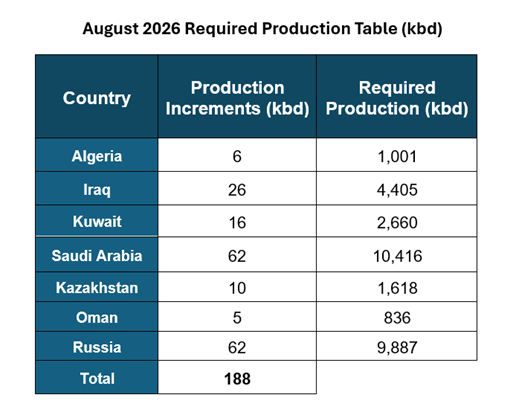
The primary goal of OPEC+ is to coordinate between the countries and determine oil production goals and prices according to international circumstances. For example, throughout the Strait of Hormuz crisis, the organisation has been increasing production quotas to supplement falling global oil supply. The below table shows the countries’ August production targets.
Source: Opec’s official website
Stay ahead of the geopolitical week.
MD Briefing delivers expert analysis across five global fronts — the Indo-Pacific, energy, geoeconomics, European security, and the Middle East — every Monday morning. Free.
The total increase adds up to an 188,000 barrel per day (bpd) increase for August. While the quota increase is sound in a peacetime scenario (where oil tankers are actually able to leave their ports without the threat of strikes), the reality of the strait closure means that the increased production of Gulf countries, including Iraq, Kuwait, and Saudi Arabia, won’t really offset any of the fluctuations in supply. It does, however, prove to be a significant opportunity for non-Gulf states, especially Russia and Kazakhstan, to amp up production efforts and boost their own oil sales, given that the Gulf’s global markets are scrambling for alternatives. Apart from increased production quotas, Oman’s geographical position is also proving to be a strategic tool to control the Strait of Hormuz passage.
Russia as an alternative?
As of 2024, Russia has the capacity to produce 10,533,244 barrels of oil per day, ranked third in global oil producers. While Russia has emerged as a key alternative energy supplier due to the Iran war, two primary factors are influencing whether countries are actually increasing Russian oil imports – Ukraine’s targeting of Russian energy infrastructure and Trump’s retaliatory tariffs.
Ukraine targeted Russia’s Salavat petrochemical complex on the 14th of July, which contains distillation units capable of processing 17,140 tons of crude oil per day, translatable to approximately 300,000 bpd. This is not a one-off attack; Ukraine’s war strategy consists of targeting Russia’s critical infrastructure, especially oil refineries and even oil distribution infrastructure. This strategy is destabilizing Russia’s production capacities and, by corollary, its position as a reliable alternative supplier.
In terms of retaliatory tariffs, take for example India, the third largest crude oil consumer in the world. India’s LPG consumption is 60% imported, 90% of which comes from the Gulf. Given Strait of Hormuz blockages, Russia’s share of Indian oil imports has increased to 38%. The Trump administration has been backing a “Sanctioning Russia Act,” introduced in 2025 and revised in 2026, now stating that the top five buyers of Russian oil are liable to being tariffed up to 100%, posing a significant threat for the buyers’ economies. India is particularly under scrutiny in this case – now, domestic policymakers are seeking to build energy self-sufficiency by mixing locally produced ethanol with petroleum to meet domestic demand.
Borrowing from Kazakhstan?
Kazakhstan’s oil production reaches 1,902,990 bpd, ranked number 13th in the world. With increasing attacks on Russian oil infrastructure, Russian parties have been involved in “fuel trafficking” from Kazakhstan, with trucks smuggling thousands of liters of fuel from the border. With oil shortages around the world, Kazakhstan is planning to ban almost all fuel exports November onwards, potentially extending to May of 2027. This move is reportedly to protect domestic fuel requirements. This move will hit Russia, Turkmenistan, Kyrgyzstan, Germany, and Belgium, Turkey, and South Korea, among others. Some of these countries, including Kyrgyzstan, will be indirectly affected since they import their oil from Russia. Amidst attacks on Russian infrastructure, Russia’s own supply is supplemented by Kazakhstan’s, and will soon be diminished.
Oman’s Balancing Act
Oman, as a part of OPEC and a party palatable to both Iran and the US, holds a unique strategic imperative in the Strait of Hormuz. While the country does not produce as much oil as other stakeholders mentioned above, it’s location near the strait is enabling it to push a plan to collect tolls for ships hoping to pass through. Talks on these new service fees on maritime transit through the strait will also affect oil prices moving forward, although said talks are not solidified into tangible plans yet.
Conclusion
Ahead of OPEC+’s JMMC meeting in August, different parties are reacting to supply shortages according to their own production capacities, among other considerations. Russia, which was initially taking advantage of Gulf shortages as a supply alternative, is now plagued with targeted critical infrastructure and is finding it difficult to maintain production capacities. Countries that are buying from Russia are being targeted by Trump’s tariffs. Kazakhstan is attempting to protect its reserves by blocking exports and preventing fuel trafficking from Russian parties. Oman is taking advantage of its location to plan for toll fees in the strait. The situation remains multi-faceted as strait volatility continues.