


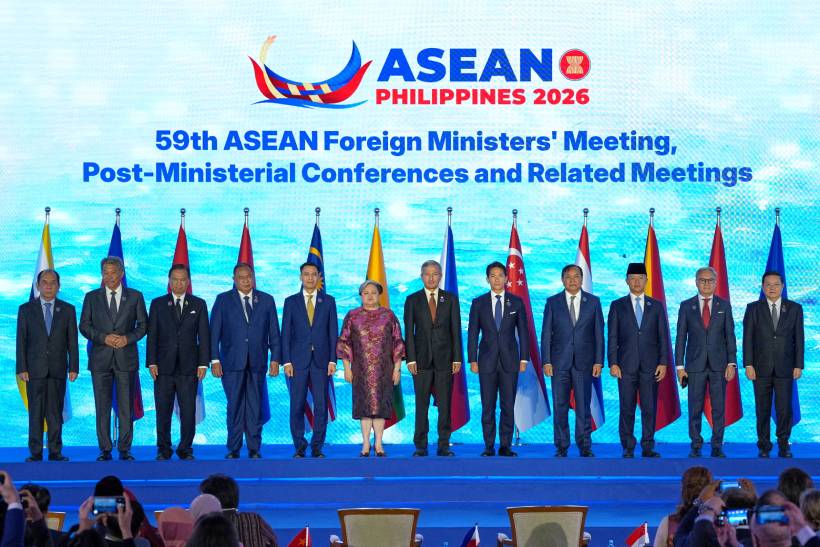
The Association of Southeast Asian Nations (ASEAN) opened a high-level diplomatic summit in Manila on Tuesday with a stark warning that renewed conflict in the Middle East is threatening global stability, energy security and economic growth, even as the bloc confronts mounting security challenges closer to home.
Foreign ministers from ASEAN’s 11 member states expressed “serious concern” over the escalating hostilities between the United States and Iran, warning that the conflict risks undermining diplomatic efforts and further destabilising an already fragile international environment.
The regional gathering, which will also host senior officials from the United States, China, Japan, India, Australia, South Korea, Russia, Britain and the European Union, is expected to focus on the Middle East crisis, Myanmar’s civil war and growing tensions in the South China Sea.
Middle East Crisis Dominates Agenda
In a joint statement issued after closed-door talks, ASEAN foreign ministers said the renewed fighting between Washington and Tehran had significantly reduced the prospects for diplomacy.
Stay ahead of the geopolitical week.
MD Briefing delivers expert analysis across five global fronts — the Indo-Pacific, energy, geoeconomics, European security, and the Middle East — every Monday morning. Free.
“We are deeply concerned that these developments severely undermine the ongoing efforts of key mediators and diminish the prospects for a peaceful resolution through dialogue and diplomacy,” the ministers said.
The concern reflects Southeast Asia’s vulnerability to energy market disruptions. The region relies heavily on imported oil, and the renewed conflict has intensified fears over shipping through the Strait of Hormuz, a waterway that carries roughly one-fifth of global oil supplies.
Those concerns have grown further after Yemen’s Iran-aligned Houthi movement announced a naval blockade targeting Saudi Arabia, potentially expanding the conflict beyond the Gulf and threatening another major maritime trade route.
For ASEAN economies, whose combined GDP exceeds $3.8 trillion, prolonged disruptions could fuel inflation, weaken economic growth and increase energy costs. In response, member states are accelerating discussions on an ASEAN oil-sharing mechanism designed to cushion potential supply shocks.
Myanmar Remains ASEAN’s Biggest Internal Challenge
While global conflicts dominated the opening session, ASEAN continues to struggle with one of its most persistent regional crises.
Foreign ministers are scheduled to hold consultations on Myanmar, where the bloc’s peace initiative has made little progress since the military seized power in 2021. The conflict has evolved into a nationwide civil war that has reportedly claimed around 100,000 lives and displaced millions.
ASEAN’s inability to persuade Myanmar’s military leadership to implement its Five Point Consensus has increasingly drawn criticism, raising questions about the organisation’s effectiveness in addressing regional security crises.
South China Sea Tensions Rise Again
Maritime security is also expected to feature prominently following another confrontation between China and the Philippines.
On Monday, Manila accused Chinese Coast Guard personnel of striking a Philippine navy sailor with a wooden baton during an encounter near Second Thomas Shoal, a disputed feature in the South China Sea.
China rejected the accusation as false and summoned the Philippine ambassador, while the U.S. State Department condemned what it described as China’s “dangerous and aggressive” behaviour.
The incident underscores the continuing failure to finalise a long-awaited ASEAN-China Code of Conduct, negotiations that have stretched on for nearly a decade without producing a binding agreement.
US and China Compete for Influence
The Manila meetings also provide another stage for strategic competition between Washington and Beijing.
U.S. Secretary of State Marco Rubio and Chinese Foreign Minister Wang Yi are both attending and could hold bilateral discussions on the sidelines of the summit.
Ahead of the meetings, Rubio reaffirmed Washington’s commitment to freedom of navigation in an opinion article published in Philippine newspapers, warning against any power seeking to use maritime trade as a geopolitical weapon.
Although he did not mention China directly, Rubio reiterated U.S. support for the 2016 international arbitration ruling that invalidated Beijing’s sweeping South China Sea claims and pledged that Washington would honour its treaty commitments to the Philippines and other regional allies.
China continues to reject the ruling and maintains its extensive territorial claims across the South China Sea.
Why It Matters
This year’s ASEAN foreign ministers’ meeting illustrates how regional security challenges are becoming increasingly interconnected. While Southeast Asia remains focused on longstanding disputes in Myanmar and the South China Sea, instability in the Middle East now threatens to amplify economic pressures through higher energy prices, disrupted shipping and slower global growth.
The convergence of these crises places ASEAN at the centre of several geopolitical fault lines, forcing the bloc to balance regional diplomacy with intensifying competition between the United States and China.
What’s Next
ASEAN ministers will continue discussions throughout the week, with meetings involving the United States, China, Japan, India, Australia, Russia and the European Union expected to shape the diplomatic agenda.
Attention will focus on whether Washington and Beijing can manage growing tensions in the South China Sea while preventing broader strategic competition from overshadowing regional cooperation. At the same time, ASEAN will seek to revive momentum on Myanmar’s stalled peace process and strengthen regional coordination against potential energy disruptions stemming from the Middle East conflict.
The summit is likely to reaffirm ASEAN’s preference for dialogue and multilateral diplomacy, but with crises unfolding simultaneously across several regions, translating those principles into meaningful action will remain the bloc’s greatest challenge.
With information from Reuters.
