


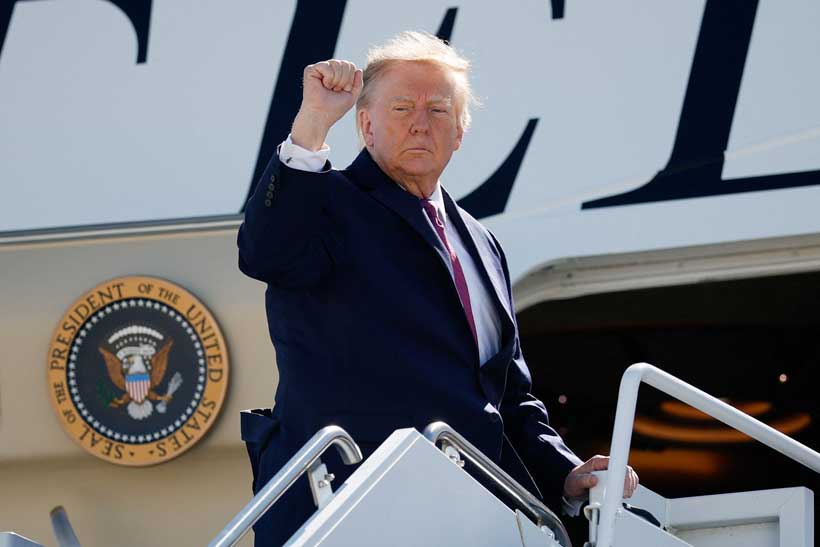
President Donald Trump is intensifying his campaign efforts in South Carolina as a surprisingly competitive Senate race threatens Republican control of a traditionally safe seat. With the midterm elections approaching, the contest between Republican Darline Graham and Democratic challenger Annie Andrews has become a toss-up, forcing Republicans to defend territory they once considered secure.
Trump is scheduled to hold a rally in South Carolina for the second time in two weeks, underscoring growing concerns that weak polling and dissatisfaction with his presidency could undermine Republican candidates beyond the party’s traditional battlegrounds.
Republican Strongholds Become Competitive
South Carolina’s Senate race reflects a broader trend in which Democrats are gaining ground in Republican-leaning states. Trump’s low approval ratings appear to be contributing to the shift, putting additional pressure on Republican candidates in the final days of the campaign.
Republicans are defending Senate seats in Alaska, Iowa, Kansas, Texas, Ohio, North Carolina and Maine, where polling has favoured Democrats. The party is also facing a tighter contest in Mississippi, where Republican incumbent Cindy Hyde-Smith is being challenged by Democrat Scott Colom.
Stay ahead of the geopolitical week.
MD Briefing delivers expert analysis across five global fronts — the Indo-Pacific, energy, geoeconomics, European security, and the Middle East — every Monday morning. Free.
In Nebraska, Republican Senator Pete Ricketts faces independent candidate Dan Osborn, raising further concerns among Republican strategists about the party’s ability to protect its Senate majority.
Democrats are already favoured to regain control of the House of Representatives, while the Senate race remains too close to call. If Democrats win control of either chamber, they could constrain Trump’s legislative agenda and launch investigations into his administration during the final two years of his presidency.
A Historic Seat Under Pressure
South Carolina has not elected a Democrat to the Senate since Fritz Hollings, who first won the seat in 1966 and served until 2005. The current contest has attracted particular attention following the death of Senator Lindsey Graham, one of Trump’s closest Republican allies and a prominent voice on US foreign policy.
His sister, Darline Graham, is seeking to retain the seat for Republicans but has faced criticism over her campaign performance. Lindsey Graham had long relied on his sister as a key political adviser, yet polling suggests that her difficulties on the campaign trail have weakened her position.
Former South Carolina governors David Beasley, a Republican, and Jim Hodges, a Democrat, have endorsed Andrews in a television advertisement. Former Republican governor Nikki Haley, who served in Trump’s first administration before challenging him for the presidency in 2024, has not endorsed either candidate.
Graham has defended her approach by arguing that she is not a career politician and does not speak like one. Her campaign has also sought to downplay the importance of endorsements, stressing that voter support and Trump’s backing matter more.
Trump’s Support Faces a Critical Test
Trump’s intervention highlights the importance of his political influence in determining whether Republicans can hold vulnerable seats. His repeated visits to South Carolina suggest that party leaders are increasingly concerned about the possibility of an unexpected Democratic victory.
The contest also carries broader implications for Trump’s standing within the Republican Party. If candidates struggle even in conservative states, it could raise questions about whether his political influence is sufficient to overcome dissatisfaction with the administration.
In Mississippi, Democratic challenger Scott Colom is seeking to defeat Hyde-Smith. A victory would make him the state’s first Black senator since Reconstruction, the period following the American Civil War.
The South Carolina contest therefore represents more than a local political battle. It is a test of whether Republicans can maintain their traditional electoral advantages as Democrats gain momentum in states that have historically favoured the GOP.
A Nationwide Campaign Under Pressure
Republicans’ defensive efforts in the South are also affecting their strategy elsewhere. The party had hoped to challenge Democrats in Michigan and Georgia and potentially capture another Senate seat in Minnesota. However, the need to protect vulnerable seats has forced Republicans to redirect campaign resources toward states they previously expected to win comfortably.
Trump has responded with an extensive nationwide campaign tour, holding rallies across 19 states since the beginning of October. His remaining appearances include Florida, Kansas and Iowa ahead of Tuesday’s vote.
The growing number of competitive races suggests that Republicans are confronting a more difficult electoral environment than anticipated. Resources spent defending established strongholds cannot be deployed as easily to expand the party’s Senate majority.
What Happens Next?
The midterm elections will determine whether Republicans can retain control of Congress or face a Democratic majority capable of limiting Trump’s legislative ambitions.
South Carolina will be an important indicator of the broader political climate. A Republican victory would help preserve the party’s Senate position, while an unexpected Democratic win could signal that dissatisfaction with Trump is reaching even the country’s most reliably conservative states.
For Trump, the immediate challenge is to turn his personal popularity among Republican voters into electoral victories. The outcome will test both his influence over the party and the Republicans’ ability to defend their congressional majority.
With information from Reuters.
