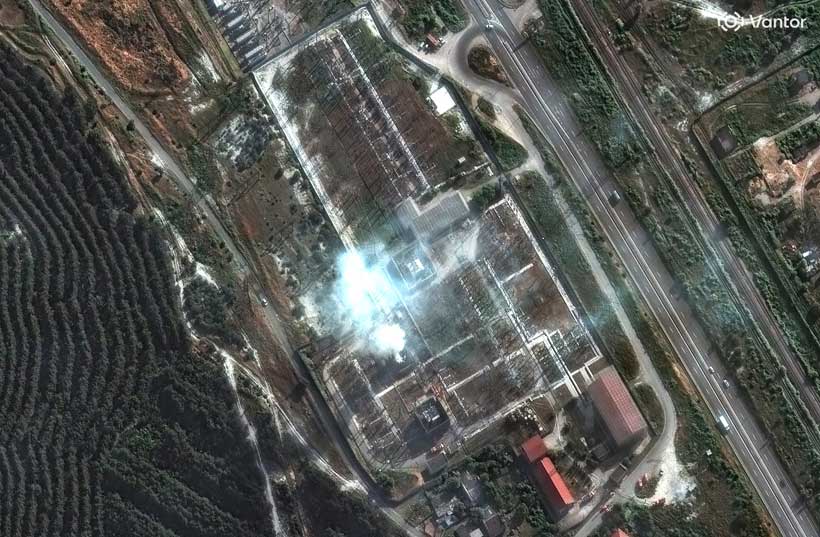
The 24th June Ukrainian drone attacks on Russian-occupied Sevastopol resulted in a complete power outage, requiring authorities to declare a “state of emergency.” The power cuts spread to nearby regions, including parts of Russian-occupied Kherson. The widespread damage caused by the Ukrainian drone strikes brings out a pattern in today’s warfare – critical infrastructure is the jugular to the heart of modern society. Targeting power plants, energy grids, data centers, and ports, among others, cuts off crucial everyday needs, forcing a domestic pivot of priorities. This strategy has found currency as a tactic in Russia-Ukraine as well as the Iran war.
Cutting off the Power Grid: Sevastopol Drone Attacks
Sevastopol, a port city in Crimea, has been occupied by Russia since the occupation of the Crimean Peninsula in 2014. The city is strategically significant for Russia due to its coastline on the Black Sea, offering easy access to the Russian Black Sea Fleet. Ukraine’s territory recovery strategy has included cutting off energy supply routes at various stages, and the 24th June drone attack on Russian-occupied Sevastopol are no different. The drone strikes hit the Sevastopol power plant, causing Russian-installed governor Mikhail Razvozhayev to temporarily suspend public transport, dim streetlights, and request that children stay at home for their safety. The power outages spread to nearby Kherson as well. This tactic demonstrates the impact of targeting power supply to systematically weaken strategic regions such as Sevastopol, with wider implications for local Russian governance and popular support for the war amidst the suspension of basic necessities.
Going for the Jugular: The Case of the Zaporizhzhia
Stay ahead of the geopolitical week.
MD Briefing delivers expert analysis across five global fronts — the Indo-Pacific, energy, geoeconomics, European security, and the Middle East — every Monday morning. Free.
Zaporizhzhia Oblast, the Ukrainian province, has been partially occupied by Russia since the invasion in 2022. The parts of the region militarily controlled by Russia include the Zaporizhzhia nuclear plant, the largest nuclear power plant in Europe. As of a 2022 Guardian report, the plant had an output capacity of 5700 MW, fulfilling 20% of all of Ukraine’s electricity needs. Ever since the Russian occupation, however, the plant’s power supply has been cut off by the military nineteen times as of the 11th of June, either directly or indirectly through artillery attacks. This has caused severe limitations on heat and electricity, erratic blackouts, and a scarcity of drinking water as well, according to the UN Sustainable Development Group. Zaporizhzhia’s strategic significance has made it a contentious battlefield with contradicting claims on continued drone strikes in the region. Ukraine, operating under the immense energy deficit, has been making efforts to retake control over the territory in order to get the nuclear plant running efficiently. Russia is also making efforts to wrangle control over the territory. The specific targeting of Zaporizhzhia demonstrates the tactical importance of the critical nuclear power plant infrastructure, highlighting a crucial juncture in the Russia-Ukraine war.
Holding Court in the Port: The Bandar Abbas Attacks
The erratic closure of the Strait of Hormuz in the Iran war is a geostrategic maneuver at cutting port access for Gulf exports, especially affecting global energy flows. Air strikes at ports follow the same motivations. Iran’s Bandar Abbas port allows for the smooth flow of over 90% of Iranian energy exports. The Iran Revolutionary Guard Corps (IRGC) are also headquartered in the area. The repeated US strikes near the port have come as an effort to cripple Iran’s export flows and strip the country’s strategic foothold near the Strait of Hormuz. US strategy to target the Iranian port displays the dual significance of port infrastructure: economic points of power in peacetime, and a strategic Achilles heel in wartime.
Targeting Data Centers
Iran’s retaliatory strategy has also focused on damaging critical infrastructure, but its out-of-the- (packaging) box drone strikes on Amazon data centers in the UAE and Bahrain hit the nail on physical data infrastructure dependence, with April’s Oracle data center attacks reinforcing the same. These attacks were able to go beyond regional consequences, affecting companies headquartered halfway across the world. Amazon reportedly lost about $150 million, while Oracle incurred minimal damage. Targeting data centers also extends to leverage over extensive database backups and AI processing. Iran’s strike strategy is a keen warning to America’s cloud-rooted economics, sparking discourse on evaluating the geopolitical risks of waging wars in crucial geographies.
Taking these examples into account, it suffices to say that critical infrastructure, including power plants, seaports, and data centers, is now geopolitically perceived as a strategic chokepoint to weaken adversaries. The effects of targeting such infrastructure is felt both regionally and internationally. Striking critical infrastructure effectively calls for a political pivot to focus on the newly created domestic weaknesses, signifying a turn in modern warfare.