


Trump’s latest Gaza roadmap hinges on two deeply contested conditions: Hamas must disarm, while Israel must withdraw from the territory. Hamas has endorsed the roadmap in principle, but Israel has rejected the idea of withdrawing before Hamas’s weapons are fully dismantled.
The plan, announced by U.S. President Donald Trump on July 30, seeks to revive the 2025 ceasefire framework after months of negotiations. It proposes an immediate halt to military operations, the creation of a Palestinian technocratic administration, Israeli withdrawal in phases and the deployment of an international stabilization force.
At the centre of the dispute is the sequencing of disarmament and withdrawal. Israel insists that its forces will not leave Gaza until Hamas and other armed groups have surrendered their weapons. Hamas, meanwhile, says it is committed only to the original roadmap, which provides for negotiations on a timetable for disarmament rather than requiring immediate surrender.
Under the proposed framework, Israel would withdraw sector by sector as areas are verified to be free of usable weapons. A new Palestinian administrative body would oversee the storage and decommissioning of heavy weapons, military production facilities, weapons depots and tunnels.
Stay ahead of the geopolitical week.
MD Briefing delivers expert analysis across five global fronts — the Indo-Pacific, energy, geoeconomics, European security, and the Middle East — every Monday morning. Free.
The plan also envisages an International Stabilization Force deploying to areas vacated by Israeli troops. The force would help maintain security, train Palestinian police and facilitate humanitarian assistance. Morocco and Uganda have so far pledged troops, while Kosovo, Albania and Kazakhstan have offered military planners and medical personnel.
A fragile situation on the ground
Despite the October 2025 ceasefire, Israeli forces continue to control large parts of Gaza and have conducted strikes against what they describe as militant threats. Gaza health authorities say more than 1,200 Palestinians have been killed since the truce, most of them civilians.
Israel says its military operations are necessary to prevent attacks and target militants involved in the October 2023 Hamas assault that triggered the war.
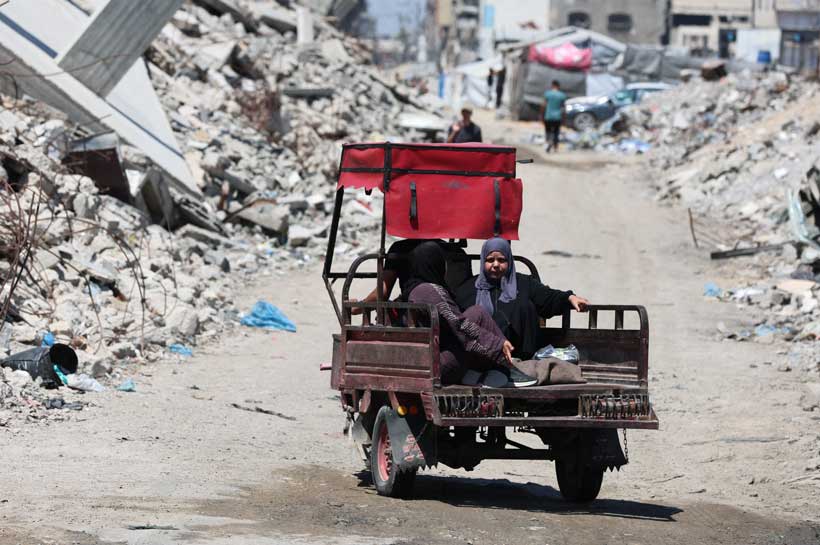
The situation has left much of Gaza’s population concentrated in a small coastal area, with widespread destruction and severe humanitarian needs. Any international stabilization force would therefore face the enormous challenge of establishing security while supporting reconstruction.
Israel and Hamas remain divided
Israeli Prime Minister Benjamin Netanyahu has said Trump’s proposal is unacceptable in its current form and reiterated that Israel will not complete its withdrawal until Hamas is disarmed.
Hamas has accepted the roadmap but objected to subsequent statements suggesting that it must surrender even light weapons before Israeli forces withdraw. The group argues that the original agreement allows negotiations over how and when disarmament would take place.
Trump’s plan therefore faces a fundamental contradiction: Israel wants disarmament before withdrawal, while Hamas expects withdrawal to proceed alongside a phased disarmament process.
The proposed sector-by-sector approach could provide a possible compromise. Under this model, Israel would withdraw from each area once its weapons have been secured and rendered unusable.
But with neither side willing to concede on the central sequencing issue, the success of Trump’s plan will ultimately depend on whether Washington can bridge the gap between Hamas’s demand for Israeli withdrawal and Israel’s demand for complete disarmament.
Analysis
The central problem with Trump’s roadmap is not the absence of a ceasefire framework, but the lack of agreement over who moves first. Hamas appears willing to discuss disarmament as part of a broader political settlement, while Israel insists that its forces cannot withdraw until Hamas is fully disarmed. That sequencing creates a fundamental deadlock: Hamas has little incentive to surrender its principal source of leverage before securing Israeli withdrawal, while Israel is unwilling to withdraw while Hamas retains military capabilities.
The proposed sector-by-sector approach could offer a potential compromise. If weapons are progressively removed from designated areas and Israeli forces withdraw in parallel, both sides would have a mechanism to demonstrate compliance without requiring either to make a complete concession at the outset. However, this would require an effective international monitoring mechanism and credible guarantees, neither of which has yet been fully established.
The International Stabilization Force could therefore become the most important element of the roadmap. Its credibility will depend not only on how many countries contribute troops, but also on whether those forces can operate independently, secure areas after Israeli withdrawal and help establish a functioning Palestinian security structure.
More broadly, the plan exposes the limits of treating disarmament as a purely military issue. Hamas’s weapons are tied to the wider political question of Gaza’s future governance and Palestinian statehood. Without a credible political pathway, disarmament could be viewed by Hamas as surrender rather than part of a negotiated settlement.
Trump’s proposal therefore represents a possible framework for ending the conflict, but not yet a guaranteed path to peace. Its success will depend on resolving the sequencing dispute, establishing credible security guarantees and answering the larger question of who ultimately governs Gaza. The real test is whether Washington can turn competing Israeli and Hamas demands into a phased bargain that neither side sees as capitulation.
With information from Reuters.
