


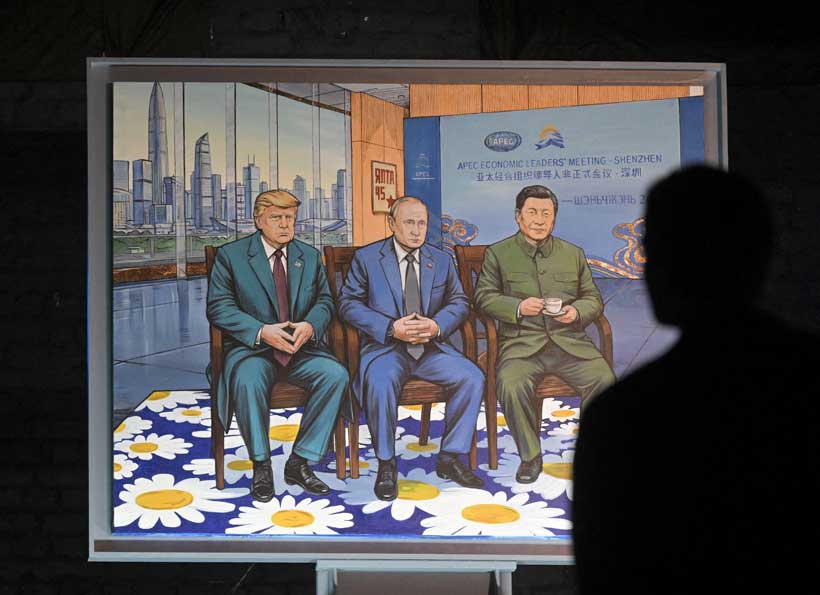
Russia’s deployment of strategic military aircraft across East Asia has highlighted Moscow’s continuing ability to project military power into the Indo-Pacific, despite its prolonged war in Ukraine. The movement of Russian bombers near Taiwan and Japan, followed by their presence at an airport in Vietnam, has raised security concerns and drawn attention to the timing of the operation ahead of a high-profile meeting between Russian President Vladimir Putin, Chinese President Xi Jinping and US President Donald Trump.
Two Russian Tu-95 strategic bombers, known to NATO as “Bears”, accompanied by two long-range refuelling aircraft, remained at Danang airport in Vietnam on Wednesday. Their arrival followed flights across the region that prompted concern among the air forces of Taiwan and Japan.
The deployment coincided with major diplomatic gatherings in Southeast Asia, including the ASEAN summit in Manila and the Asia-Pacific Economic Cooperation (APEC) meeting in China. Its timing has raised questions about whether Moscow is seeking to demonstrate its military reach, reinforce its relationship with Beijing or strengthen its position in Southeast Asia.
Russia Demonstrates Its Military Reach Beyond Ukraine
The movement of Russian strategic aircraft represents a significant display of Moscow’s long-range military capabilities. Although Russia remains heavily engaged in Ukraine, the deployment demonstrates that it can still conduct military operations far beyond its immediate neighbourhood.
Stay ahead of the geopolitical week.
MD Briefing delivers expert analysis across five global fronts — the Indo-Pacific, energy, geoeconomics, European security, and the Middle East — every Monday morning. Free.
The Tu-95 is a long-range strategic bomber that can carry nuclear weapons and is also used for intelligence gathering and surveillance. Its presence near sensitive areas of East Asia is therefore significant, particularly when accompanied by tanker aircraft that extend its operational range.
Ian Storey, a security scholar at Singapore’s ISEAS-Yusof Ishak Institute, said the deployment was intended to remind regional governments that Russia retained the ability to project military power into Southeast Asia despite the war in Ukraine.
The last known deployment of Russian strategic aircraft to Vietnam took place in 2014. At the time, Hanoi provided Russian warships and aircraft with preferential access to facilities at Cam Ranh Bay and Danang, both of which had been developed by US forces during the Vietnam War.
Russia subsequently used tanker aircraft stationed at Danang to support Tu-95 flights near Guam, a strategically important US military hub in the Pacific. According to Storey, he was unaware of comparable deployments in the years that followed. The arrangement may have been suspended after the administration of former US President Barack Obama raised concerns with Hanoi.
The latest operation therefore marks a potentially important development in Russia’s military engagement with Vietnam.
Why the Flights Matter to Taiwan and Japan
The Russian aircraft also attracted attention because of their movements near Taiwan and Japan, two countries closely monitoring military activity in the region.
Taiwan has previously encountered Russian military aircraft near its territory. Chieh Chung, a researcher at Taiwan’s Institute for National Defense and Security Research, pointed to earlier incidents in 1986 and 2010, both involving Tu-95 bombers.
However, the timing of the latest flights has added a political dimension. Chieh said the operation took place shortly before the planned meeting between Trump, Xi and Putin, suggesting that Moscow could be seeking to project an image of close strategic cooperation with Beijing.
Russia and China maintain extensive political and military ties. Moscow has repeatedly supported Beijing’s territorial claims over Taiwan, while China continues to conduct regular military air and naval operations around the island.
Huang Chih-wei, Taiwan’s vice chief of general staff, said the Russian flights posed a threat to the peaceful and stable status quo in the Asia-Pacific region.
For Japan and Taiwan, the concern is not limited to the presence of Russian aircraft. Their movements also illustrate how military activity by multiple powers can complicate an already sensitive regional security environment.
Vietnam’s Strategic Calculations and Its Relationship With Russia
Vietnam’s decision to allow Russian aircraft to use Danang has attracted particular attention because of the country’s longstanding military relationship with Moscow.
Russia remains Vietnam’s largest arms supplier, providing equipment, spare parts and technical support to its armed forces. Although Hanoi has sought to diversify its defence procurement since Russia launched its full-scale invasion of Ukraine in 2022, its military remains heavily dependent on Russian-origin systems.
Nguyen The Phuong, a Vietnam security expert at Australia’s University of New South Wales, said Moscow had sought to revive the previous arrangement last year, although Hanoi was initially hesitant.
He described the latest deployment as ostensibly intended for refuelling, while suggesting that it could indicate a change in Vietnam’s approach and potentially lead to further Russian military deployments.
Hanoi’s decision may also reflect practical defence considerations. Maintaining close relations with Moscow could help Vietnam preserve access to military supplies, technical assistance and future procurement opportunities at a time when it is trying to balance its relationships with several major powers.
However, Vietnam’s calculations extend beyond its relationship with Russia.
Could Vietnam Be Sending a Message to China?
The deployment may also have implications for Vietnam’s relationship with neighbouring China.
Beijing and Hanoi maintain significant economic and diplomatic ties, but their relationship is complicated by competing territorial claims in the South China Sea. Both countries have interests in the disputed maritime areas, making military balance and strategic partnerships important elements of Vietnam’s foreign policy.
According to Phuong, Hanoi could be using the Russian deployment to signal its continuing military relationship with Moscow at a time when China is expanding its regional presence.
The issue has become more relevant following China’s announcement in late September that it was helping build a new military airfield in Laos for training its air force.
Vietnam has not publicly criticised the project but is reportedly monitoring developments to ensure the facility does not eventually become a permanent military base.
The possibility of a stronger Chinese military presence in Laos could raise concerns in Hanoi, given the countries’ geographical proximity and the broader regional balance of power.
Vietnam’s relationship with Russia has historically offered it a degree of strategic flexibility. Maintaining defence ties with Moscow allows Hanoi to avoid relying exclusively on either China or Western powers while preserving its ability to respond to regional security challenges.
Ian Storey suggested that the decision to permit the Russian bombers could therefore also serve as a signal to Beijing that Vietnam’s military relationship with Moscow remains important.
What Happens Next?
The immediate question is whether the latest deployment represents a one-off refuelling arrangement or the beginning of more regular Russian military access to Vietnamese facilities.
Hanoi’s decision will be closely watched by regional governments, particularly given the sensitivity surrounding foreign military activity in Southeast Asia. Further deployments could strengthen Moscow’s regional visibility while creating additional diplomatic considerations for Vietnam.
The timing also places the operation within the wider context of the planned Trump-Xi-Putin meeting. Russia may be seeking to demonstrate that its military influence extends beyond Europe and that it remains an important actor in the Indo-Pacific security environment.
For Vietnam, the challenge will be preserving its defence relationship with Russia without undermining its relations with China, the United States and other regional partners.
Ultimately, the deployment illustrates how Southeast Asia has become an increasingly important arena for strategic competition. Even as Russia concentrates substantial military resources on Ukraine, its latest aircraft movements suggest that Moscow does not intend to abandon its wider geopolitical ambitions.
With information from Reuters.
