The Man Who Brought the Drafts
In January 2022, Sergei Ryabkov sat across from American negotiators in Geneva and said it was absolutely mandatory that Ukraine never become a member of NATO. Six weeks later, Russia invaded. Last week, the same deputy foreign minister sat in Abu Dhabi as part of Russia’s delegation to the first trilateral talks in nine months. Afterwards, he told reporters exactly what Moscow had brought with it: Russia had drawn heavily on the ideas set out in the 2021 draft agreements with the United States and NATO.
Most coverage treated this as rhetoric from a negotiator restating old grievances. It is a statement of method. Russia has put the December 2021 drafts back on the table, and the question for Europe is no longer whether to discuss the continent’s security architecture with Moscow. It is what Europe will put down when the Americans ask what it is offering instead.
What the 2021 Texts Asked For
Stay ahead of the geopolitical week.
MD Briefing delivers expert analysis across five global fronts — the Indo-Pacific, energy, geoeconomics, European security, and the Middle East — every Monday morning. Free.
On 17 December 2021, Russia’s foreign ministry published two documents. The draft treaty with Washington would have required the United States to prevent further eastward expansion of NATO and deny membership to former Soviet states. The draft agreement with NATO would have barred Russia and the alliance’s pre-1997 members from deploying forces and weapons on the territory of other European states beyond what was there on 27 May 1997, which in practice meant removing NATO’s presence from Poland, the Baltic states and the rest of the alliance’s eastern members. It also banned intermediate- and short-range missiles within reach of the other side, and military activity in Ukraine, the South Caucasus and Central Asia. At the time, Brookings judged that some elements, notably the missile provisions, could be engaged, but many were designed to go nowhere.
Five years on, Sergei Lavrov is arguing that the security framework must come first. On 10 November he rejected an immediate ceasefire, saying it is reasonable to establish clear security guarantees first. Russia’s delegation also included military intelligence chief Igor Kostyukov and a senior FSB officer, according to Russian analysts’ accounts of the delegation.
This Time, Washington Can Pay Alone
The comparison with 2021 is instructive less for what is the same than for what has changed. In 2021, almost every Russian demand required collective decisions by NATO’s 30 members. Closing the open door, rolling back force deployments and banning missiles all needed allied consensus, which is why the drafts were easy to reject. In 2026, a large part of the same agenda can be delivered by Washington on its own authority.
Consider the list. Washington planned to deploy Typhoon and hypersonic Dark Eagle missile systems in Germany from 2026. That deployment is a US decision, and it is exactly the class of weapon the 2021 drafts sought to ban. Russia has already declared that it no longer considers itself bound by its moratorium on intermediate-range deployments, and the nuclear-capable Oreshnik missile has been deployed to Belarus. US force posture in Europe is also a US decision. A Pentagon review of American deployments on the continent is reportedly due for decision in December. And NATO’s open door, in practice, depends on whether Washington will sponsor new members.
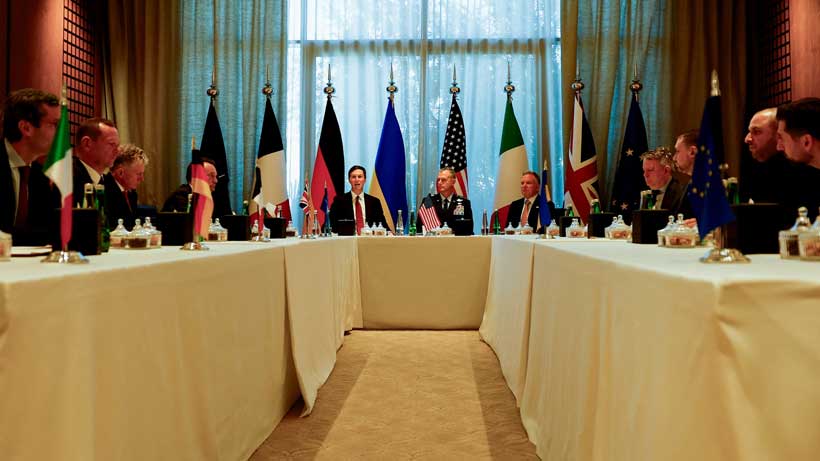
The parts of the 2021 package that would hurt Europe most can now be bought from the Americans without Europe’s consent. Washington’s own framing has drifted towards Moscow’s vocabulary. Jared Kushner’s five pillars for a new framework are permanent security consultations, crisis communication channels, greater military transparency, reciprocal steps to reduce escalation risks, and an enduring long-term framework, modelled on the old NATO-Russia Council. None of these is unreasonable in itself. But “reciprocal measures to reduce escalation risks” could alarm parts of Europe, given Moscow’s long-standing position that NATO’s presence on the eastern flank is itself the escalation. Ryabkov even praised the professionalism of NATO’s top commander, General Alexus Grynkewich, who was in Abu Dhabi as part of the US team, according to his remarks in Moscow. From Moscow’s side, NATO’s command is already at the table; its European members are not.
Europe’s current answer is sequencing and principle. Kaja Kallas has set out the order (ceasefire, then peace settlement, then architecture) and argued that Europe already has a security architecture in the Helsinki Final Act, the Paris Charter and the Budapest Memorandum, which Russia violates. Both points are correct. Neither is an offer. Emmanuel Macron conceded as much this week, saying Europe must now articulate a concrete vision for the future security architecture. As we argued last week, Europe’s leverage in these talks is its ability to refuse what only the 27 can grant. But a veto only covers European decisions. It does not stop Washington trading its own missiles and its own troops.
A European counter-offer would therefore need to do two things at once. It would need to engage the form of Kushner’s pillars while refusing the substance of the 2021 drafts. Four elements would do that. First, reciprocal transparency and incident prevention: a modernised Vienna Document regime of inspections and notifications, plus military hotlines. Europe can accept these because they bind Russia as much as NATO. Second, a reciprocal and verifiable ceiling on ground-launched intermediate-range missiles in Europe that covers Oreshnik in Belarus and Russian systems in Kaliningrad, not only American deployments in Germany. This is the one item from 2021 the West always said it could discuss. Third, notification zones and exercise limits on both sides of the NATO–Russia line, from the Baltic to Belarus, instead of the 1997 force lines. Fourth, an explicit exclusion: Ukraine’s own security guarantees and NATO’s membership policy are not for trade. All four take effect only after a verified ceasefire.
The strongest objection is that any counter-offer legitimises the 2021 framing, rewarding Russia for an invasion launched after those drafts were rejected. That is a serious risk, and it is why the sequencing must hold. But refusing to table anything does not keep the 2021 agenda off the table; it leaves Washington to fill the gap. The alternative to a European offer is not no deal. It is a deal Europe learns about afterwards. As we warned before Abu Dhabi, accepting “security guarantees for Russia” as a negotiating category is the concession with the longest reach. A counter-offer is how Europe sets its own limits on that category.
How the Architecture Talks Could Go
Base case: parallel tracks, no text (roughly 50%). Washington keeps discussing Kushner’s pillars with Moscow in general terms, Europe insists on sequencing, and no architecture document is drafted before a ceasefire. The US decides its European force posture on its own timetable and broadly preserves the eastern-flank presence. The assumption is that Congress and the Pentagon resist trading posture for a deal while the war continues. Watch the December posture decision as the first test.
Downside case: Washington pays in its own currency (roughly 30%). As part of a ceasefire package, the US agrees to pause its missile rotations in Germany and to thin out rotational forces in the east, framed as “reciprocal de-escalation”, without a matching limit on Oreshnik or Russian forces in Belarus. Europe is presented with a fait accompli that partially implements the 2021 drafts by US decision. For frontline states, this is the scenario that turns the eastern flank into a zone of reduced protection. For defence planners and investors, it accelerates European demand for its own long-range strike and air-defence capabilities.
Upside case: Europe tables first (roughly 20%). The E5 and EU institutions present a written European architecture package, combining transparency, a reciprocal missile ceiling and exercise limits, conditional on a ceasefire, before the next major round. Washington adopts it as the Western position, which pushes Russia to negotiate against a European text rather than a blank page. It requires Berlin and Paris to accept that missile deployments in Germany are themselves negotiable on a reciprocal basis.
A Counter-Offer Before a Fait Accompli
Ryabkov’s presence in Abu Dhabi is a reminder that Russia’s war aims were never only about Ukraine. They were set out on paper in December 2021, and Moscow has now said openly that it is negotiating from that paper. The difference from 2021 is that Europe can no longer rely on the alliance’s collective “no”. Many of the levers are now in American hands, and some of them can be traded alone.
The signal to watch is the US decision on European force posture, expected in December, and whether it mentions the missile rotations in Germany. If those are traded without a matching Russian limit, the 2021 drafts will have been partly implemented without a treaty ever being signed.
Europe has spent five years refusing the 2021 drafts. It now needs a draft of its own.