Tanks in Zhoushan
On 9 November, Iran International published a confidential letter from Iran’s acting oil minister. According to the document, Tehran’s Foreign Ministry had negotiated with China to acquire port facilities and oil terminals as a hub for sanctioned Iranian crude. Oil Ministry sources described control of facilities at three locations, including a terminal in the Ningbo-Zhoushan free-trade zone, seven storage tanks and stakes in docks in Shandong, home of China’s independent refiners.
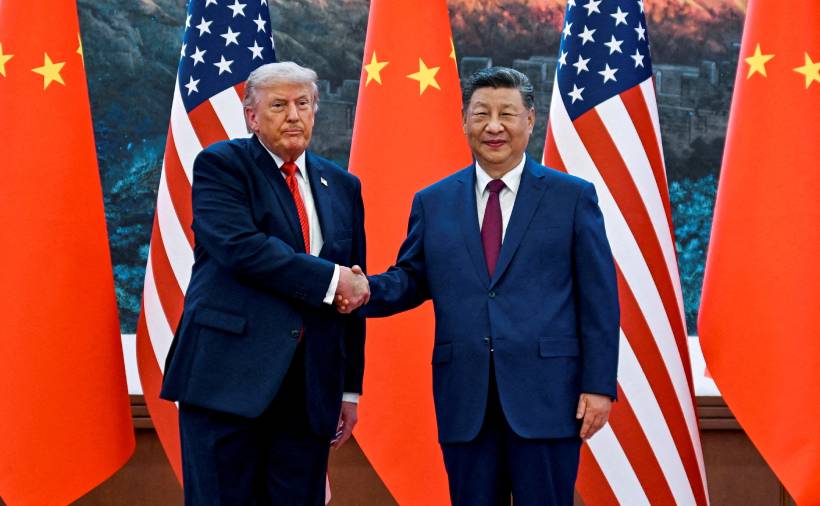
The same day, Donald Trump told reporters he expected to meet Xi Jinping and Vladimir Putin at the APEC summit in Shenzhen on 18–19 November, and that the agenda would include trying to end the war in Iran. Twenty-four hours earlier, China’s Middle East envoy Zhai Jun had arrived in Tehran. Shenzhen is billed as a trade summit. For the war that matters most to oil markets, it is also an Iran summit, and the party with the most leverage is the host.
A Lifeline Under Blockade
Stay ahead of the geopolitical week.
MD Briefing delivers expert analysis across five global fronts — the Indo-Pacific, energy, geoeconomics, European security, and the Middle East — every Monday morning. Free.
Since the US–Israeli strikes of late February, Iran’s economy has depended on one customer. The US Treasury estimates that China buys about 90 per cent of Iran’s oil exports, most of it through small independent “teapot” refineries in Shandong. The US naval blockade has hurt that trade: China’s Iranian imports have fallen 48 per cent since the war began. But they have not stopped. China has also lost much of its wider Gulf supply; the Middle East’s share of its crude imports fell from about 52 per cent in 2025 to 31 per cent in May.
At their Washington summit in September, Trump told Xi that Chinese help for Iran was unacceptable, and the US ambassador said Beijing gave assurances. A senior Iranian official told Reuters the same day that China would not limit its economic, political or military ties with Tehran. Xi’s own message, according to Chinese state media, was that Washington should return to the June memorandum and reach a nuclear deal.
The Customer Who Sets the Clock
Coverage of Shenzhen runs on two tracks. One treats APEC as a trade meeting about tariffs, rare earths and the truce that expires on 10 January. The other treats Iran as a favour Trump will ask of Xi: lean on Tehran, help end the war. Both miss that China’s leverage over the war is already being exercised, passively, every day.
Washington’s strategy against Iran is economic attrition. Trump has argued that the blockade is bankrupting Tehran, posting that Iran is “collapsing financially” and starving for cash. Attrition only works if the money runs out, and the money comes from China. As one analyst told Al-Monitor, Beijing is backstopping the entire Iranian economy with its oil purchases. Whatever the US Navy does at sea, the speed at which Iran runs out of money is set in Shandong.
This is why the leak matters more than its sanctions-evasion headline. Buying terminals and tanks turns a trade relationship into infrastructure. Iranian crude can now be shipped to China before a buyer is found, stored on Iranian-controlled ground and sold through intermediaries that, by the Oil Ministry’s own account, shield China’s major banks and three largest oil companies from US sanctions. Beijing has signalled that it will defend that channel: when the Treasury sanctioned the Hengli refinery in April, China’s commerce ministry issued an injunction blocking US sanctions on five refiners, declaring them a violation of international law. The lifeline is not a leak in the blockade. It is a policy.
What does Beijing want from the war’s end? Not an American victory that leaves a client-free Gulf under US naval control, and not an Iranian collapse that would destroy its cheapest oil supplier. It wants Hormuz, a chokepoint that remains structurally vulnerable, open, since around 45 per cent of China’s oil imports pass through it, and it wants a settlement in which China has a seat. Zhai’s itinerary of Tehran, Muscat and Riyadh traces a Gulf settlement, not a US–Iran one. Oman, which shares the strait with Iran, sent its sultan on the first state visit to China by an Omani ruler since diplomatic relations began in 1978, in the same fortnight. Iran’s parliament speaker, Mohammad Bagher Ghalibaf, who is also Tehran’s special representative for China, has said Beijing will help end the state of “neither war nor peace”. Analysts see China’s natural role as a guarantor of an Iran–Gulf arrangement, likely without military commitments. Beijing has been edging towards this role since Zhai’s first wartime tour in March; the November tour is the second act.
Beijing will not spend that leverage for free. As one former US diplomat put it in April, China does not expend its leverage as a favour to others. In Shenzhen, Trump needs a way out of a war that he concedes contributed to his party’s midterm losses, and lower fuel prices before the next election cycle. Xi needs a longer trade truce, restraint on technology controls and, above all, American quiet on Taiwan, where the PLA has just run undeclared “area denial” drills in the Western Pacific involving more than 100 ships. The linkage will never be stated. It will appear in what each leader leaves out of his readout.
The strongest objection is that China’s leverage is overstated. Beijing can live without Iranian oil. It holds an estimated one billion to 1.4 billion barrels in reserves and has cut imports rather than paying war prices. Iranian barrels are a discount, not a lifeline, for China. All of that is true, and it is the point. Because China does not need Iranian oil, every barrel it buys is a political choice rather than an economic necessity, and a choice can be withdrawn. Reserves cut the other way too: they are, in one analyst’s phrase, a clock rather than a solution. China would prefer the war to end before the clock runs out. It wants the ending to come through a door it holds open.
Three Outcomes From Shenzhen
Base case: words without a commitment (roughly 55%). The Trump–Xi readouts urge a return to negotiations and mention Gulf stability, but China makes no commitment to cut purchases. Privately, Beijing presses Tehran on Hormuz transit in return for a role as guarantor of any eventual Gulf arrangement. The US keeps sanctioning individual refiners and tankers, the “neither war nor peace” standoff continues through the Miami G20 on 14–15 December, and oil trades on headlines. The assumption is that Trump prioritises the trade truce over pressure on Iran’s buyer.
Downside case: the wars merge (roughly 25%). Frustrated by attrition that is not working, Washington designates the Chinese terminals and storage named in the leak, or a major Chinese bank, under secondary sanctions. Beijing responds with its own blocking measures and slows rare-earth licences before the truce expires on 10 January. The Iran war and the trade war become a single conflict. For shipping, insurers and compliance teams, Ningbo-Zhoushan and Shandong port exposure becomes a sanctions risk overnight, and for commodity markets the rare-earth truce stops being a safe assumption.
Upside case: Beijing buys a seat (roughly 20%). A three-way meeting with Putin produces an outline in which China and Russia act as co-guarantors of a deal to reopen Hormuz, based on the June memorandum, with Qatar-led mediation continuing on the US–Iran track. China gets the credit, the Gulf states get a second security partner, and Iran gets a buyer that is now formally invested in its survival. Oil prices fall further. Washington ends the war it wanted to end, but on terms that formalise China’s role in the Gulf.
Who Ends the War
Washington is treating China as a third party that might help end the Iran war. It is already a participant: the customer whose purchases set the pace of the economic war the US chose to fight. The leak from Iran’s Oil Ministry shows that the relationship has gone from trade to infrastructure, and Beijing’s sanctions-blocking order shows it will defend it.
Watch two signals. First, whether the Chinese readout from Shenzhen mentions the Strait of Hormuz or freedom of navigation: if it does, Beijing is positioning itself as a guarantor. Second, whether the US Treasury designates any of the terminals or storage sites named in the leak before the Miami G20 in mid-December. That would mean Washington has decided to go after the clock rather than the man holding it.
Trump will ask Xi to help end the war. Xi already decides how long it lasts.