


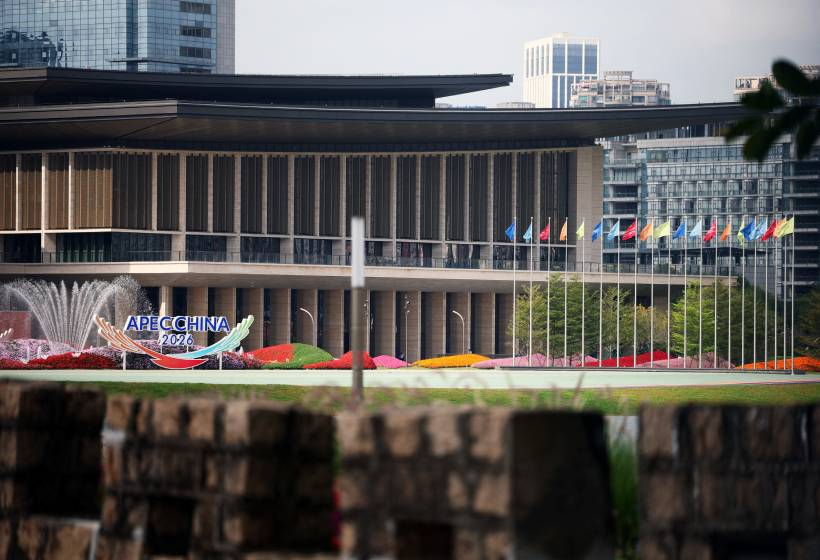
The planned meeting between Chinese President Xi Jinping, Russian President Vladimir Putin and US President Donald Trump has placed the Asia-Pacific Economic Cooperation (APEC) summit in the centre of growing geopolitical tensions. As Xi defended free trade and Putin criticised Western sanctions, both leaders used their appearances in Shenzhen to challenge the international policies of Western powers ahead of their high-stakes discussions with Trump.
The three leaders are scheduled to meet on Thursday on the sidelines of the summit in China’s southern technology hub of Shenzhen. Their discussions could cover Russia’s war in Ukraine, the US war in Iran, trade disputes, artificial intelligence and nuclear weapons. The meeting comes at a time when global competition is increasingly shaped by economic restrictions, military alignments and disagreements over the rules governing international relations.
The gathering has also revived comparisons with the 1945 Yalta Conference, when the leaders of the United States, Britain and the Soviet Union discussed the post-Second World War settlement. Although the circumstances are very different, the comparison reflects concerns that major powers could reach agreements affecting smaller countries without adequately considering their interests.
Xi Presents China as a Defender of Free Trade
In his address to business executives at the APEC summit, Xi called for the preservation of a rules-based multilateral trading system centred on the World Trade Organization. He urged countries to support free and open trade and investment while maintaining the stability of international industrial and supply chains.
Stay ahead of the geopolitical week.
MD Briefing delivers expert analysis across five global fronts — the Indo-Pacific, energy, geoeconomics, European security, and the Middle East — every Monday morning. Free.
His remarks were also an attempt to position China as a predictable economic partner at a time when Washington has increased tariffs and tightened restrictions on Chinese technology.
Xi’s message comes amid renewed tensions over access to advanced artificial intelligence chips. Washington has announced additional restrictions on China’s access to advanced semiconductors produced by companies such as Nvidia, raising the possibility of further complications in an already fragile trade truce between the two economies. Beijing has indicated that it will respond.
China has also faced criticism from Western trading partners over its annual trade surplus, which has exceeded $1 trillion. Washington, Brussels and other governments argue that state support for Chinese manufacturing has contributed to industrial overcapacity, weakened foreign competitors and increased Beijing’s influence over global supply chains.
Beijing rejects this criticism, maintaining that its economic model remains appropriate for a country still developing its industrial and technological capabilities. Xi said China would continue investing in manufacturing and emerging technologies while reducing tariffs and opening its markets further.
The central tension is that China is presenting itself as a supporter of open markets while its trading partners remain concerned about the scale of state intervention in its economy. Nevertheless, Xi’s defence of multilateral trade could appeal to developing economies that view protectionism and unilateral economic restrictions as obstacles to their growth.
George Chen, partner and chair of digital practice at The Asia Group, said Xi’s message was likely to resonate with many Global South countries and reinforce Beijing’s efforts to distinguish its technology strategy from Washington’s approach.
Putin Challenges the Impact of Western Sanctions
Putin’s address offered a similarly confrontational assessment of Western economic power. Speaking after reports that Ukraine had destroyed the strategically important Kerch road bridge linking Crimea to Russia, he described Western powers as former hegemons and argued that sanctions imposed following Russia’s invasion of Ukraine had failed to weaken the country as intended.
Putin also characterised Europe as being in a period of humiliating decline, arguing that traditional instruments of economic pressure were losing their effectiveness.
He maintained that sanctions, tariffs and export restrictions could create obstacles but could not stop economic growth or crush rival economies. His remarks reflected Moscow’s longstanding position that Western sanctions have accelerated Russia’s efforts to develop alternative economic partnerships and reduce its dependence on Western markets.
The Russian president’s appearance at the summit also reinforced Moscow’s effort to present its relationship with Beijing as an important pillar of a changing international system.
In a subsequent bilateral meeting, Xi and Putin praised their partnership, describing it as developing steadily and positively on the international stage. Both leaders also expressed support for initiatives advancing what they called a multipolar world.
Their statements suggest that economic cooperation and diplomatic coordination remain central to their relationship, particularly as both countries face sustained pressure from Western governments.
Why the Yalta Comparison Matters
The planned trilateral meeting has attracted attention beyond the immediate interests of Washington, Beijing and Moscow. Comparisons with the Yalta Conference have raised questions about whether the world’s most powerful countries could use direct negotiations to establish understandings that affect regional security and international political arrangements.
In 1945, the Yalta discussions helped shape the post-war order and became associated with the division of influence among major powers. The comparison is particularly sensitive for smaller countries that fear their sovereignty and security interests could be overlooked in negotiations dominated by powerful states.
European and Asian governments have reasons to watch the Shenzhen meeting closely. Russia’s war in Ukraine remains a major concern for European security, while China’s disputes with Taiwan and several neighbouring countries continue to influence the Indo-Pacific balance of power.
The Kremlin has dismissed comparisons with Yalta as political speculation, although it acknowledged that the trilateral meeting could have a significant impact on international affairs. Beijing has described the gathering as an opportunity to promote global peace.
However, the concerns surrounding the meeting reflect a broader question about the future of multilateral diplomacy: whether major international disputes will increasingly be managed through negotiations among powerful states or through institutions that give smaller countries a formal role in shaping outcomes.
Trump Balances Regional Alliances and Great-Power Diplomacy
Trump’s arrival in China follows meetings with regional allies in Manila, where he pledged to deepen defence cooperation with the Philippines. The commitment comes amid growing friction between Manila and Beijing over disputed features in the South China Sea.
His regional engagements illustrate the competing demands facing Washington. The United States wants to maintain its security partnerships in the Indo-Pacific while managing its economic and strategic rivalry with China. At the same time, Trump’s planned discussions with Xi and Putin could influence issues extending well beyond the region.
The US president has also raised the possibility of meeting North Korean leader Kim Jong Un during his visit to China, although no such meeting has been confirmed.
The diplomatic atmosphere is further complicated by tensions involving Taiwan and Japan. Both countries recently reported incursions by Russian aircraft into their airspace, adding another security concern to an already crowded regional agenda.
For Trump, the Shenzhen meeting offers an opportunity to engage directly with two leaders whose countries have become central to Washington’s strategic calculations. Yet the outcome will depend on whether the discussions produce concrete understandings or remain largely symbolic.
What Happens Next?
Despite the competing positions expressed by Xi and Putin, analysts generally expect Washington and Beijing to avoid a major deterioration in relations. Both sides have economic and strategic reasons to preserve a degree of stability, particularly while trade negotiations and technology restrictions remain unresolved.
The scheduled meeting between Trump and Xi will be especially important in determining whether the latest restrictions on advanced AI chips threaten the fragile trade truce. The two leaders are also expected to meet again at the Group of 20 gathering in Miami in December, making the Shenzhen discussions part of a wider diplomatic engagement.
The Putin-Trump dimension carries equally significant implications. Any discussion of Ukraine could influence expectations surrounding the war, although a meeting between the three leaders does not necessarily indicate that a settlement is close.
Ultimately, the importance of the Shenzhen gathering lies not only in the issues the three presidents discuss but also in the international order their engagement represents. A closer understanding among Washington, Beijing and Moscow could help manage some of the world’s most dangerous disputes. However, if major decisions are made without meaningful consideration of smaller states, the meeting could deepen concerns about great-power politics and the future of multilateral cooperation.
With information from Reuters.
