


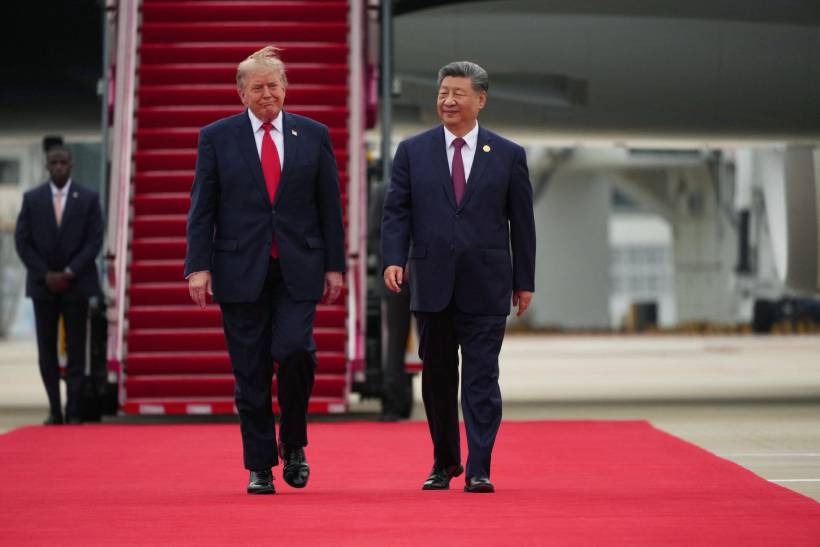
Chinese President Xi Jinping and Russian President Vladimir Putin have criticised Western trade policies, tariffs and economic sanctions ahead of a high-stakes trilateral meeting with US President Donald Trump in China. Their remarks at the Asia-Pacific Economic Cooperation (APEC) summit in Shenzhen highlighted growing disagreements over the international economic order as the three major powers prepare to discuss issues ranging from trade and artificial intelligence to regional conflicts and nuclear security.
Trump arrived in China after meeting regional allies in Manila, where he pledged to deepen defence cooperation with the Philippines amid its disputes with Beijing in the South China Sea. Xi personally welcomed him at the airport, marking the first time since becoming president that he had greeted a visiting leader in this way. The gesture reciprocated Trump’s reception of Xi at Joint Base Andrews in September.
According to China’s state news agency Xinhua, Xi said Beijing valued diplomatic courtesy and looked forward to discussing bilateral relations, Asia-Pacific cooperation and the wider international landscape. Trump described his previous meetings with Xi as very pleasant.
The two leaders are expected to participate in an APEC group photograph and attend a banquet before joining Putin for a trilateral meeting on Thursday. The gathering could address Russia’s war in Ukraine, the conflict involving Iran, trade tensions, artificial intelligence and nuclear weapons.
Stay ahead of the geopolitical week.
MD Briefing delivers expert analysis across five global fronts — the Indo-Pacific, energy, geoeconomics, European security, and the Middle East — every Monday morning. Free.
A New Test for the International Order
The planned meeting has attracted comparisons with the 1945 Yalta Conference, where the United States, Britain and the Soviet Union discussed the post-Second World War settlement and the distribution of influence in Europe. Although the circumstances are different, the comparison reflects concerns that major powers could reach understandings over international security without adequately considering the interests of smaller countries.
European and Asian governments have expressed unease about the possibility of Washington, Beijing and Moscow shaping decisions that could affect their security and economic interests.
The three leaders also represent competing visions of international order. Washington remains central to the existing security architecture, while Beijing is seeking a greater role in global economic and technological governance. Moscow, meanwhile, has increasingly challenged Western influence following its invasion of Ukraine and the sanctions imposed in response.
Their meeting therefore carries significance beyond bilateral diplomacy. Any understanding between the three could influence how major international disputes are managed, although differences over security, trade and regional influence could limit the scope for agreement.
Xi Positions China as a Defender of Open Trade
In his APEC address, Xi called for the preservation of free and open trade, presenting China as a supporter of multilateral economic cooperation at a time when Washington has expanded tariffs and export restrictions.
He urged countries to uphold the rules-based multilateral trading system centred on the World Trade Organization (WTO), while opposing protectionism and unilateral economic measures.
The speech came shortly after Washington announced further restrictions on China’s access to advanced artificial intelligence chips produced by companies such as Nvidia. The measures threaten to complicate an already fragile trade truce between the world’s two largest economies, with Beijing warning that it could retaliate.
Xi also pledged to continue investing in China’s industrial capacity and emerging technologies. He said Beijing would lower tariffs and further open its markets while resisting what he described as protectionist policies.
However, China’s presentation of itself as a defender of open trade faces significant international criticism. Its annual trade surplus has exceeded $1 trillion, prompting concerns among trading partners that state support for manufacturing has contributed to industrial imbalances and weakened domestic consumption.
The United States, European Union and other economies have also raised concerns about China’s dominance across strategic supply chains, arguing that its industrial policies could create economic dependencies and provide Beijing with geopolitical leverage.
China maintains that its development model is appropriate for an economy still catching up with the world’s wealthiest countries.
Xi’s message may nevertheless appeal to developing economies seeking greater access to international markets and alternatives to Western-led economic arrangements. George Chen, partner and chair of digital practice at The Asia Group, said the remarks were likely to resonate with Global South countries and reinforce Beijing’s attempt to distinguish its technology strategy from Washington’s approach.
Putin Challenges the Effectiveness of Western Sanctions
Putin followed Xi at the summit with a speech attacking Western economic influence and the sanctions imposed on Russia after its invasion of Ukraine.
Describing Western powers as former hegemons, the Russian president argued that traditional instruments of economic pressure had lost much of their effectiveness. He also characterised Europe as being in a period of humiliating decline.
Putin maintained that sanctions, tariffs and export restrictions could no longer prevent economic growth or crush the economies of countries targeted by Western governments.
His remarks came after Ukraine crippled the Kerch road bridge linking Crimea to Russia, delivering a significant blow to a strategically important connection during Moscow’s four-year-old war.
The Russian president’s criticism reflects Moscow’s broader effort to challenge the legitimacy and effectiveness of Western economic restrictions. Since the invasion of Ukraine, Russia has sought to maintain trade and economic relationships with countries outside the Western sanctions framework.
However, the long-term consequences of sanctions remain contested. While they have not forced Moscow to abandon its military campaign, restrictions on technology, finance and international trade have continued to shape Russia’s economic environment.
By placing sanctions alongside tariffs and export controls, Putin sought to portray Western economic pressure as an increasingly outdated instrument of international influence.
Japan’s Uneasy Position Highlights Regional Divisions
The summit also exposed tensions within the Asia-Pacific region. Leaders from Australia, Canada and South Korea received formal welcoming ceremonies involving dancers and military personnel. Japanese Prime Minister Sanae Takaichi, by contrast, was taken directly to her vehicle after arriving in China without a comparable reception.
Her visit comes amid strained relations between Tokyo and Beijing. The dispute intensified after Takaichi said Japan could consider military involvement if a Chinese move against Taiwan also threatened Japanese territory.
The diplomatic friction reflects wider disagreements over Taiwan’s security and the balance of power in East Asia. Japan’s position has become particularly sensitive as China increases military pressure around the island and regional governments reassess their security arrangements.
Taiwan and Japan also reported Russian aircraft incursions into their airspace on Tuesday, adding another dimension to an already tense regional environment.
Meanwhile, Trump’s visit to Manila included a pledge to deepen defence cooperation with the Philippines, which has faced increasingly difficult relations with Beijing over disputed features in the South China Sea.
Trump also raised the possibility of meeting North Korean leader Kim Jong Un during his China visit, although no such meeting has been confirmed.
What Happens Next?
The trilateral meeting between Trump, Xi and Putin will test whether the three governments can identify areas of cooperation despite their competing strategic interests.
For Washington, the immediate priorities include managing trade tensions with China, addressing the conflicts involving Iran and Ukraine, and maintaining its security commitments across Asia. Beijing will seek to protect its technological ambitions, strengthen its international economic position and present itself as a constructive diplomatic power. Moscow, meanwhile, will look for opportunities to challenge Western sanctions and secure greater international acceptance of its position on Ukraine.
The Kremlin has dismissed comparisons with the Yalta Conference as political speculation, although it has acknowledged the meeting’s potential importance for global affairs. Beijing has similarly described the gathering as an opportunity to promote international peace.
Yet the interests of the three powers do not necessarily align. Their disagreements over Taiwan, Ukraine, Iran, trade and advanced technology could make substantive agreements difficult.
The meeting’s wider significance will therefore depend not only on what the leaders announce but also on whether their discussions produce practical commitments. For countries outside the three-power grouping, the central concern will be whether renewed great-power diplomacy strengthens international cooperation or reinforces a world in which the strongest states increasingly determine the rules.
With information from Reuters.
