


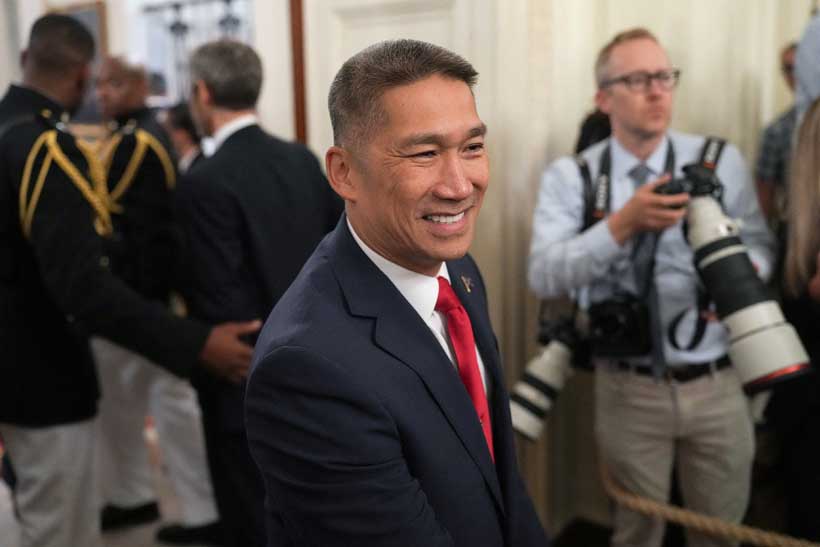
In diplomacy, the value of a visit sometimes lies not in the number of agreements signed or statements made, but in the symbolic message it conveys. The visit to Vietnam by Hung Cao, a Vietnamese-American and high-ranking official in President Donald Trump’s administration, is one such case. This visit coincided with a period of deeper development in Vietnam-US relations. More importantly, Vietnam’s reception and approach to this visit reflected a diplomatic approach honed over generations: diplomacy that emphasizes sincerity, tolerance, and the ability to win hearts and minds as the foundation for building strategic trust. In a world dominated by power struggles, this art of winning hearts and minds is becoming a unique advantage in Vietnamese diplomacy.
Mr. Hung Cao’s impressions during his return to Vietnam.
Within the framework of the Pacific Partnership – Friends of the Pacific 2026 (PP-PF26) program, Acting Secretary of the Navy Hung Cao paid a working visit to Vietnam in late June 2026. From a ceremonial standpoint, this was a diplomatic activity within the framework of defense cooperation between the two countries. This event reflects multiple layers of significance: from the remarkable development of Vietnam-US relations to the transformation in how Vietnam connects with the Vietnamese diaspora abroad.
Hung Cao is a unique case in American politics. Born in Vietnam, he left his homeland with his family after 1975 and grew up in the Vietnamese refugee community in the United States. Before entering politics, he served in the U.S. Navy for over two decades, participating in numerous military campaigns and holding important command positions. His military background and image as a successful immigrant quickly made him a prominent figure in the Republican Party within the Vietnamese American community. Following the 2024 election, President Donald Trump appointed Hung Cao as Deputy Secretary of the Navy in 2025 and then Acting Secretary of the Navy in 2026, making him one of the highest-ranking Vietnamese-American officials in the U.S. government.
Stay ahead of the geopolitical week.
MD Briefing delivers expert analysis across five global fronts — the Indo-Pacific, energy, geoeconomics, European security, and the Middle East — every Monday morning. Free.
For decades after 1975, a significant portion of the Vietnamese community in the United States maintained a certain distance from Vietnam due to differences in political views. Having left Vietnam as a child, Hung Cao also grew up in that political environment and is known for having expressed firm opinions regarding Vietnam. Therefore, the noteworthy aspect of the visit is not the return of a Vietnamese-American official to his homeland, but rather the feelings of someone who has been away from home after directly witnessing Vietnam in 2026. In his meetings with Vietnamese leaders, Hung Cao stated that he was moved on his second return and deeply impressed by the country’s remarkable development and its increasingly prominent international standing. For someone who left Vietnam as a child, directly witnessing Vietnam’s positive transformation demonstrates the effectiveness of firsthand experience in reshaping perceptions.
The visit also demonstrates the growing relationship between Vietnam and the United States. Since the normalization of relations in 1995, the two countries have gradually overcome the legacy of war to expand cooperation. The upgrading of relations to a comprehensive strategic partnership in 2023 marks a new stage of development. In this context, the proactive increased engagement between US officials from various political backgrounds and Vietnam shows that trust between the two countries is expanding from the government level to broader social actors.
This is also a common trend in modern diplomacy, as relations between countries are increasingly multi-stakeholder, involving parliamentarians, businesses, research institutions, media, and expatriate communities, rather than relying solely on traditional diplomatic channels. It conveys a message of reconciliation and Vietnam’s confidence in building trust. This is also the spirit of the “heartfelt diplomacy” approach.
The “Psychological Diplomacy” method
The concept of “psychological warfare” has deep roots in the Eastern tradition of political and military thought, and Vietnam has developed it into a philosophy with its own unique identity. Sun Tzu’s Art of War states, “The best strategy is to attack strategy, the next is to attack diplomacy, the next is to attack troops, and the next is to conquer a fortress.” This means that attacking the will and hearts of the people is always considered a superior choice over using military force. In Vietnamese history, the national hero Nguyen Trai elevated this idea to a new level. In the Proclamation of Victory over the Wu (Binh Ngo Dai Cao), Nguyen Trai affirmed the immortal thought: “Using righteousness to overcome brutality, using benevolence to replace tyranny.” This is a profound concept in governance and foreign policy. According to Nguyen Trai, lasting victory does not come from destroying the enemy through violence but from making the enemy recognize the righteousness of their actions, thereby accepting reconciliation and cooperation. In other words, attacking the hearts of the people is always more effective than attacking a fortress.
In the era of Ho Chi Minh, the concept of “heart-to-heart diplomacy” continued to be inherited and developed into a modern diplomatic method, suitable for the context of the national liberation struggle and international integration. President Ho Chi Minh’s “heart-to-heart diplomacy” was formed on the basis of inheriting the nation’s tradition of peaceful diplomacy while absorbing the essence of Eastern and Western cultures, as well as his own experience in international revolutionary activities. A distinctive feature of Ho Chi Minh’s diplomatic thought is that he always considered people and their hearts as the decisive factors in resolving conflicts and building international relations. Throughout the resistance wars against French colonialism and American imperialism, President Ho Chi Minh repeatedly affirmed, “Vietnam is not fighting against the French people or the American people, but against colonialism and wars of aggression.” This idea is also clearly reflected in how Vietnam handled its relations with other countries after the war. This reflects the ultimate goal, which is not to defeat the enemy but to create a peaceful environment conducive to national development.
Entering the Doi Moi (Renovation) period, the concept of “heartfelt diplomacy” has transformed into a diplomatic approach suited to the context of globalization. While historically, “heartfelt diplomacy” was primarily directed at the enemy during wartime, in modern diplomacy, its target has expanded to include governments, businesses, international organizations, academics, media, and the global public. The goal is to build trust, create a positive image of Vietnam, and broaden the scope of international cooperation.
That is also why Vietnamese diplomacy is highly regarded for its ability to balance steadfastness in principle with flexibility in method. Speaking at the 2021 National Foreign Affairs Conference, the late General Secretary Nguyen Phu Trong likened Vietnamese diplomacy to a “Vietnamese bamboo tree,” with a firm root, a strong trunk, and flexible branches. This image clearly reflects the philosophy of modern diplomacy: steadfast in objectives but flexible in implementation, using sincerity and trust as the glue that binds international relations.
The practical experience of Vietnam-US relations clearly demonstrates the effectiveness of this diplomatic approach. The two former enemies have become important partners in many areas. This process was built step by step through addressing lingering issues of the war, such as searching for missing soldiers (POW/MIA), demining, dioxin decontamination at Da Nang and Bien Hoa airports, and supporting people with disabilities affected by Agent Orange. Vietnam’s proactive cooperation in these humanitarian areas contributed to changing the perception of US politicians about Vietnam, laying the foundation for expanded cooperation in subsequent years. It can be said that the process of building trust preceded the process of expanding interests.
“Mind-based diplomacy” is increasingly evident in Vietnam’s policy towards the Vietnamese diaspora. This perspective was institutionalized in Resolution No. 36-NQ/TW of 2004 and further affirmed in Conclusion No. 12-KL/TW of 2021 of the Politburo, which identifies overseas Vietnamese as an inseparable part and an important resource of the Vietnamese nation. This policy provides a foundation for Vietnam to expand dialogue with various overseas Vietnamese groups with differing viewpoints, including individuals who previously had little contact with the country.
How did Vietnam employ psychological diplomacy during Mr. Hung Cao’s visit?
First, Vietnam’s approach does not view the past as a barrier to dialogue. In Hung Cao’s case, Vietnam could have chosen a cautious approach. However, what actually happened was quite different. From meetings with high-ranking leaders to working sessions with leaders of ministries, sectors, and localities, Hung Cao was received in his capacity as Acting Secretary of the U.S. Navy and a Vietnamese-American. Instead of reviving historical debates, Vietnam chose to steer the meetings towards common interests of the present and future in the new context.
Secondly, Vietnam’s practical development experience became the most compelling argument. Throughout his visit, Mr. Hung Cao witnessed firsthand a Vietnam very different from the image of many decades ago. These direct experiences led Mr. Hung Cao to share that he was moved on his second visit to Vietnam and very impressed by the remarkable development and the country’s increasingly high standing. This is not the assessment of a Vietnamese scholar or researcher, but rather from someone who grew up in an environment with many different perspectives on the country.
Thirdly, Vietnam’s approach to Hung Cao evokes a connection to his roots and identity. This is clearly demonstrated in his visit to Quang Tri – his family’s hometown and also a region that suffered the heaviest losses during the war. It was there that Hung Cao shared, “My heart belongs to America, but the blood in my veins is Vietnamese.” The historical context, the country’s development, and the feeling of returning home create the appeal of psychological diplomacy aimed at changing perceptions through empathy.
Fourth, Vietnam places cooperation in addressing the consequences of war as the foundation of strategic trust. In the main agenda items, both sides emphasized the importance of cooperation in addressing the consequences of war. According to US statistics, Vietnam is one of the most effective cooperating countries in the search for missing soldiers; conversely, the US has spent hundreds of millions of dollars on dioxin remediation and demining programs in Vietnam. These are not new issues, but the persistent cooperation over nearly three decades has laid the foundation for the Vietnam-US relationship today.
Fifth, Mr. Hung Cao’s visit demonstrates Vietnam’s expansion of its diplomatic approach from state-to-state relations to connecting people and communities. Building trust with an influential figure like Hung Cao also creates additional “bridges” to broaden support for bilateral relations within American society. This also reflects the spirit of the policy towards overseas Vietnamese as expressed in Resolution No. 36-NQ/TW and Conclusion No. 12-KL/TW of the Politburo, which consider overseas Vietnamese an inseparable part of the national community, taking dialogue, harmony, and cohesion as the foundation for foreign affairs in the new context.
From the perspective of international relations theory, Vietnam’s approach also reflects the increasing role of soft power. According to scholar Joseph S. Nye Jr. , soft power is the ability to achieve desired results through attraction rather than coercion. While the soft power of many countries is built on cultural appeal, values, or development models, Vietnam’s soft power is further nurtured by a memory of reconciliation, sincerity in conduct, and the motto ” putting aside the past, overcoming differences, promoting similarities, and looking towards the future .” This kind of diplomatic engagement can be seen as a concrete manifestation of soft power in the context of a middle-sized nation.
