


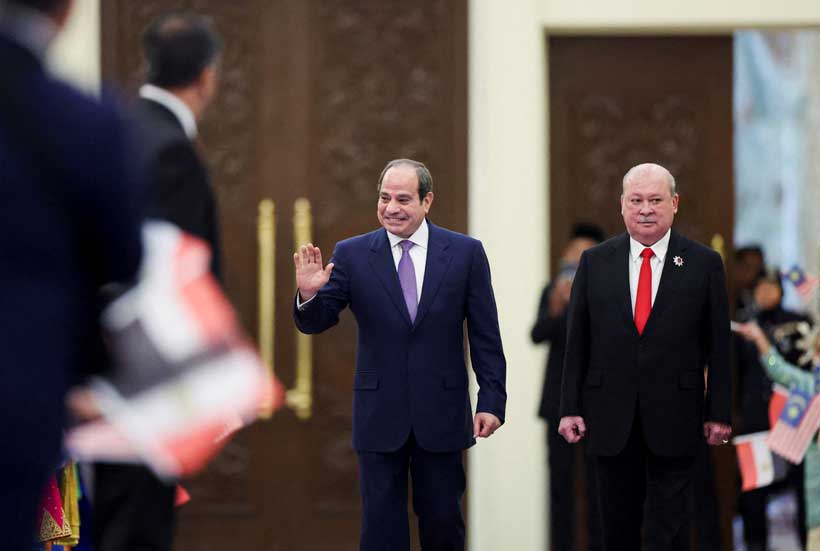
Egyptian President Abdel Fattah El-Sisi’s current Asian tour includes several Asian countries, such as South Korea, Malaysia, and Indonesia. The aim is to strengthen strategic partnerships and diversify economic and industrial alliances. President El-Sisi began this extensive Asian tour on October 6, 2026, with the goal of diversifying international partnerships and enhancing Egypt’s presence in Asia, a major hub for trade, investment, and technology. These moves reflect the convergence of Egyptian strategies with Asian expansion and engagement with emerging economic powers. Herein lies the connection between Chinese President Xi Jinping’s visit to Cairo (which concluded in early September 2026) and President Abdel Fattah El-Sisi’s Asian tour to South Korea, Malaysia, and Indonesia in October 2026. This connection is rooted in a comprehensive Egyptian strategy to diversify international partnerships, localize industry, and attract Asian investments, coinciding with major shifts in the global order and the rise of economic powers in Asia. Its implications are intertwined with the dimensions of President al-Sisi’s Asian tour, as follows:
1) Diversifying Partnerships: Focusing on major economies in East and Southeast Asia that are part of large trade blocs, such as ASEAN and the Regional Comprehensive Economic Partnership (RCEP).
2) Technology Transfer and Industrial Localization: Targeting pure investment based on mutual benefit without interference in internal affairs, with an emphasis on knowledge transfer and the localization of Korean and Asian industries.
3) Gateway to Africa (COMESA): Egypt leverages its geographic location and membership in the COMESA agreement to serve as a launchpad for products manufactured in collaboration with Asian partners, enabling their export to African markets duty-free.
Stay ahead of the geopolitical week.
MD Briefing delivers expert analysis across five global fronts — the Indo-Pacific, energy, geoeconomics, European security, and the Middle East — every Monday morning. Free.
4) Integration with Eastern Powers: Egypt’s outreach to South Korea, Malaysia, and Indonesia aligns with China’s economic and political expansion in the region, positioning Asia as an alternative and complementary partner for diversifying Egypt’s foreign policy.
5) Convergence of Political Visions: Asian countries and Egypt share a commitment to the principles of mutual respect, peaceful coexistence, and the peaceful resolution of conflicts, rejecting Western polarization.
6) Industrial and Economic Alliances: President El-Sisi’s Asian visits aim to establish major industrial alliances that will strengthen Egypt’s regional position as a global logistics and industrial hub.
Here, President Sisi’s visit to these Asian countries can be analyzed from several perspectives, namely:
– First: Aspects of Strengthening Cooperation with ASEAN Countries and South Korea, including:
1) Economic and Investment Cooperation: Discussions with South Korean President Lee Jae-myung and the heads of major Korean companies focused on attracting investments, transferring technology, and increasing trade, including Egyptian exports such as iron, steel, and fertilizers.
2) Partnership with ASEAN Countries (Malaysia and Indonesia): Strengthening trade and industrial ties, as Indonesia and Malaysia are key gateways for Egyptian products to Southeast Asian markets, while Egypt serves as a bridge for Asian products to Arab, African, and European markets.
– Second: The Impact of Middle East Conflicts and the Search for International Alternatives, where:
1) Through its engagement with the Far East and Asia, Egypt seeks to mitigate the negative effects of regional tensions and conflicts in the Middle East.
2) These Asian partnerships offer investment and industrial alternatives, as well as additional sources of energy and technology, insulating them from the volatility of regional crises.
– Third: The relationship between President El-Sisi’s visit to South Korea, Malaysia, and Indonesia, and the Chinese President’s visit to Cairo, and the expansion of the Asian scope, where:
1) The Chinese President’s visit to Cairo strengthened the comprehensive strategic partnership with China (as Egypt’s largest trading partner and a key player in the Belt and Road Initiative): President El-Sisi’s tour of East and Southeast Asia (South Korea, Malaysia, and Indonesia) aimed to broaden this strategic openness to include other powerful Asian players that are technologically and industrially emerging.
2) Localizing Technology and Industry: Discussions in Cairo with the Chinese side focused on artificial intelligence, data centers, and the development of the Suez Canal Corridor. This aligns with the objectives pursued during Sisi’s visit to South Korea (through agreements in clean energy, information technology, and joint defense manufacturing, such as the K-9 howitzer). Similarly, discussions were held with Malaysia and Indonesia to enhance trade and exchange development expertise.
3) Addressing Economic Challenges and Supply Chains: Through both avenues, Egypt seeks to attract direct investments, reduce pressure on foreign currency, and secure global supply chains through major economic deals and comprehensive economic partnership agreements, such as initiating negotiations for a partnership agreement with South Korea and leveraging successful Asian manufacturing models.
4) Coordination in International Forums: The mutual visits reflect a convergence of views between Egypt and these Asian countries and China on regional and international issues, support for multipolarity, and the strengthening of Egypt’s presence in blocs such as BRICS, which includes China and Indonesia as partners or active members.
– Fourth: Military Cooperation and Joint Manufacturing Deals, through:
1) The K-9 Howitzer Deal: In 2022, Egypt and South Korea signed an agreement for the contracting and local manufacturing of K-9 self-propelled howitzers in Egypt. This represents a qualitative leap in localizing defense industries and developing the capabilities of the Egyptian army.
2) Balance with the West: This Egyptian military cooperation with Asian countries does not negate traditional military partnerships with the United States and Europe. Rather, it represents an integrated approach to diversifying arms sources and transferring technical expertise.
– Fifth: The Strategic Role of Egypt’s Geographic Location and Alternative Routes, through:
1) Egypt’s Pivotal Location: Egypt acts as a link connecting the continents of Asia, Africa, and Europe, benefiting from its central position in global trade routes.
2) The Strait of Hormuz and Alternative Routes: With the continued tension and crises in vital waterways such as the Strait of Hormuz, attention is turning to enhancing the security and efficiency of Egyptian navigation, particularly the Suez Canal, and linking it to secure international trade routes to support the flow of goods between Asia, Europe, and Africa.
Accordingly, this tour by Egyptian President Abdel Fattah El-Sisi to several Asian countries aligns with and is linked to Chinese President Xi Jinping’s previous visit to Cairo. Its dimensions and implications are intertwined with Egypt’s strategic direction to strengthen relations with rising Asian powers, such as China, South Korea, and the ASEAN countries. This places it within the framework of a multilateral policy and the diversification of international partnerships to serve Egypt’s economic and industrial development agenda.
