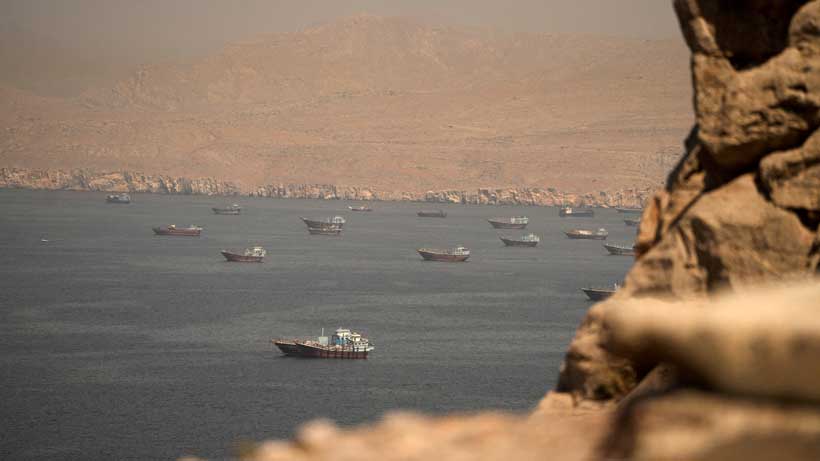
On the morning of 7 July, an Iranian vessel struck three commercial ships transiting the Strait of Hormuz. Within 48 hours — at the NATO summit in Ankara, of all places, a continent away from the Gulf — President Trump stood in front of assembled alliance leaders and declared the US-Iran ceasefire “over.” It was the second time in three weeks that a shipping incident in a channel barely 33 kilometres wide had brought down an agreement built on an assassinated Supreme Leader, a naval blockade, and a 14-point memorandum of understanding. Look closely at what actually killed the last two ceasefires — not the war around them, the specific trigger each time — and a pattern emerges that most coverage of this war keeps missing: it is never the war itself that ends the truce. It is always a ship.
The Backstory
Iran and the United States have now tried, and failed, to make peace twice since Israel’s 28 February strikes killed Supreme Leader Ali Khamenei and triggered five months of war. The first attempt — a two-week ceasefire announced 7 April alongside talks in Islamabad — cracked within a day, as the Strait stayed effectively shut while Iran charged transiting tankers tolls above $1 million, and was functionally dead by 12 April, when the Islamabad talks collapsed after 21 hours and Washington answered with a full naval blockade of Iranian ports. The second attempt was more serious: a 14-point memorandum of understanding signed 17 June, which lifted the blockade, reopened the Strait, offered sanctions relief, and opened a 60-day window to negotiate something permanent. It survived eight days. On 25 June, an Iranian drone struck a ship in the Strait; both sides absorbed that one and kept talking into early July. The second strike, on 7 July, is the one that finally broke it.
What each side actually wants from the Strait
Start with what these two ceasefires got right, because it clarifies what they got wrong. The April truce and the June MOU each contained detailed, functioning provisions on the issues most analysts assumed would be hardest: troop posture around the Lebanese front held for weeks after each deal; the sanctions relief timeline in the June MOU was implemented on schedule, and nobody disputes that it worked as written; even the nuclear file, the ostensible reason for February’s strikes, has not produced a single documented ceasefire violation. The land war and the diplomatic track — Islamabad in April, Doha from late June — kept functioning even while the maritime file was on fire. Whatever broke these ceasefires, it was not a collapse of trust across the board. It was a failure in one specific place.
That place is 33 kilometres wide and has no agreed referee. Neither the April truce nor the June MOU established who determines whether a vessel transiting the Strait is a legitimate target, a sanctions violation, or simply a ship doing what ships do. There is no joint inspection regime, no neutral monitoring body, no agreed mechanism for either side to prove what happened after an incident rather than simply assert it. Compare that to the land war, where both sides can see troop positions and verify strikes through satellite imagery published within hours, so a ceasefire violation there is unambiguous. A tanker in the Strait at night is none of those things — it is exactly the kind of ambiguous, hard-to-attribute event that lets each side act on its own interpretation and call the other the aggressor.
Stay ahead of the geopolitical week.
MD Briefing delivers expert analysis across five global fronts — the Indo-Pacific, energy, geoeconomics, European security, and the Middle East — every Monday morning. Free.
This is not an accident of poor drafting. It is the rational outcome of what each side actually wants from the Strait. For Tehran, tanker interdiction is the cheapest form of pressure available: it does not require crossing the threshold of striking Israeli or American territory, it can be framed domestically as enforcement rather than escalation, and its ambiguity gives Iranian negotiators deniability at the table the next morning. For Washington, any Strait incident is the fastest available lever to reassert leverage without a new use-of-force debate in Congress — which is exactly why the response to the 7 July strikes was not a proportionate naval action but the wholesale revocation of Iran’s oil sales licence, unwinding the MOU’s single most valuable concession in one move. Both sides have discovered that the Strait is the one dial on this conflict that can be turned without a political cost at home. That is precisely why it keeps getting turned.
The strongest objection to this argument is that it understates politics: Iranian hardliners, emboldened by a leadership vacuum since Khamenei’s death, may simply want to demonstrate strength regardless of what any agreement says, and no verification mechanism would stop a government determined to violate a deal. That is a fair challenge, but it does not survive contact with the actual sequence of events. The 25 June drone strike did not end the MOU — both sides absorbed it and kept negotiating for another twelve days, which is not the behaviour of a government racing to reignite the war. What ended the MOU was Washington’s response to the second incident, not Iranian intent to escalate without limit. A structural fix — a mechanism letting both sides establish the facts of a specific incident before either had to respond publicly — would have given both governments room to do exactly what they did after 25 June: absorb it and move on. Without one, the second incident became the one neither side could afford to let stand.
What Happens Next
Base case (roughly 60%): Talks resume — Trump has said the Doha channel is “continuing” even as strikes proceed — and produce a third agreement within weeks, built on the same template as the last two: land-war provisions, a sanctions timeline, a negotiating window. Absent a specific push to add Strait verification, it inherits the same flaw and should be expected to survive on a similar timeline — eight days to eight weeks, not longer. The key assumption is that neither Washington nor Tehran currently sees an advantage in ceding enforcement authority over the Strait to a third party.
Downside case: Gulf Cooperation Council states — Bahrain, Oman and Kuwait, all of which absorbed direct strikes or lost oil infrastructure in the escalation the week of 7 July — conclude they can no longer afford to be collateral in a bilateral US-Iran dispute, and move to establish their own maritime security regime for the Strait, with or without Washington’s blessing. This would fix the structural gap, but it requires GCC states to accept the political and physical risk of policing Iranian conduct directly rather than leaving it to Washington — a step they have avoided throughout this war.
Upside case: The next negotiating round finally puts a narrow, technical fix on the table — a joint inspection or notification protocol for the Strait — not because trust has improved, but because both sides have individually concluded that the current arrangement keeps costing them a functioning agreement every few weeks. This is more likely than a broad political breakthrough, because it requires the two governments to agree on a technical mechanism, not to resolve their underlying dispute.
The Bottom Line
This war has not reignited twice because Washington and Tehran stopped wanting peace. It has reignited twice because both agreements they signed left a single, specific, avoidable gap exactly where the money and the missiles both move — and neither side has had enough incentive yet to close it. Watch the text of whatever emerges from the current Doha channel: if it contains a specific Strait verification or inspection mechanism, this cycle finally breaks. If it reads like April and June — land provisions, a sanctions calendar, a negotiating window, and nothing about who gets to inspect a tanker — expect this piece to be right again within about eight weeks. Until someone answers that question, every ceasefire between these two countries was never really about whether they trusted each other. It was about how long it would take one ship to prove they didn’t.