


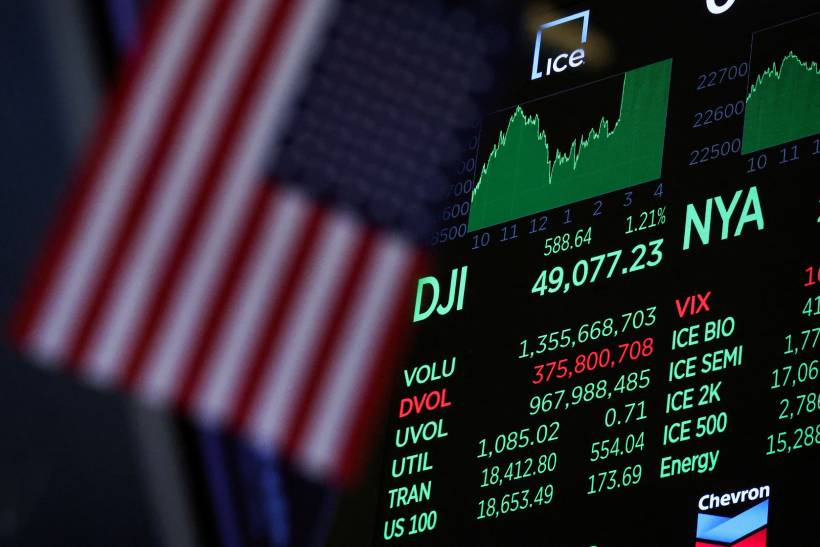
Global stock markets rose on Wednesday after weaker than expected United States inflation data reduced expectations that the Federal Reserve will raise interest rates this month. Investor sentiment also improved after President Donald Trump dropped plans to impose a shipping fee on vessels using the Strait of Hormuz, easing some concerns over global energy costs.
Technology stocks received an additional boost after Dutch chip equipment maker ASML reported stronger than expected revenue, although uncertainty surrounding artificial intelligence related companies continued to weigh on broader market sentiment.
Cooling Inflation Lifts Investor Confidence
Markets reacted positively after data showed United States consumer prices fell 0.4 percent in June, marking the first monthly decline since the Covid 19 pandemic.
Core inflation, which excludes food and energy prices, remained unchanged during the month, suggesting underlying price pressures may be easing.
Stay ahead of the geopolitical week.
MD Briefing delivers expert analysis across five global fronts — the Indo-Pacific, energy, geoeconomics, European security, and the Middle East — every Monday morning. Free.
The softer inflation reading prompted investors to scale back expectations for additional Federal Reserve interest rate increases.
United States Treasury yields fell following the report, while the dollar weakened against major currencies.
Analysts at JP Morgan described the inflation data as stronger than markets had anticipated, saying it significantly reduced expectations of a near term rate increase.
However, Federal Reserve Chair Kevin Warsh cautioned lawmakers that one month’s inflation data was insufficient to conclude that inflation had been fully brought under control.
Global Markets Respond
Asian equities posted broad gains following the inflation report.
South Korea’s KOSPI surged 6 percent, while Japan’s Nikkei 225 rose about 1 percent.
United States futures also pointed higher, particularly technology shares, although European futures traded slightly lower ahead of the opening session.
Bond markets stabilized after recent volatility, with two year United States Treasury yields retreating from multi month highs.
ASML Strengthens Chip Sector Outlook
Investor attention also focused on ASML, the world’s largest supplier of advanced semiconductor manufacturing equipment.
The company reported revenue that exceeded analyst expectations, reinforcing optimism about continued investment in artificial intelligence infrastructure and advanced semiconductor production.
Strong results from ASML could provide support for European technology stocks when trading opens.
However, market participants remain cautious following a sharp decline in IBM shares after the company issued weaker than expected revenue guidance, highlighting growing investor sensitivity toward companies linked to the artificial intelligence sector.
Analysts noted that AI related stocks continue to experience significant volatility as investors increasingly differentiate between companies expected to benefit from the technology boom and those viewed as falling behind.
Corporate Earnings Remain in Focus
Strong earnings from major Wall Street banks supported market sentiment earlier in the week.
Investors are now awaiting additional results from major financial institutions including:
- Morgan Stanley.
- BNY.
- BlackRock.
- Johnson and Johnson.
Corporate earnings are expected to play a key role in determining whether equity markets can sustain recent gains.
China Growth Slows
China reported that its economy expanded 4.3 percent year on year during the second quarter, below analyst expectations.
While exports and industrial production remained relatively resilient, weak domestic demand continued to weigh on overall economic performance.
Economists expect Beijing to introduce targeted policy measures to support sectors experiencing slower growth, although large scale stimulus remains unlikely.
Oil Prices Pause After Recent Surge
Oil prices steadied after rising sharply earlier in the week due to escalating tensions between the United States and Iran.
Brent crude remained near 86 dollars per barrel, having gained almost 13 percent over the past week.
Investor concerns eased slightly after President Donald Trump abandoned plans to introduce a 20 percent transit fee for ships passing through the Strait of Hormuz, although military tensions in the region continue to support higher energy prices.
Why This Matters
The latest inflation figures provide financial markets with tentative evidence that price pressures in the United States may be easing, reducing the likelihood of additional Federal Reserve interest rate increases in the near term. At the same time, geopolitical tensions in the Middle East and uncertainty surrounding the artificial intelligence sector continue to create competing risks for investors, contributing to heightened market volatility.
Analysis
Financial markets are currently balancing three major forces: monetary policy, artificial intelligence driven corporate earnings, and geopolitical risk. The weaker than expected inflation report has shifted investor attention back toward the possibility of a more accommodative Federal Reserve, improving conditions for equities by lowering borrowing cost expectations. Lower interest rates typically benefit growth oriented sectors, particularly technology companies whose valuations are sensitive to financing conditions.
However, enthusiasm remains tempered by growing selectivity within the AI sector. While companies such as ASML continue to benefit from strong demand for semiconductor equipment, disappointing results from firms like IBM demonstrate that investors are increasingly rewarding only those companies with clear competitive advantages in artificial intelligence. This marks a shift from the broader market rally seen earlier in the AI investment cycle.
Meanwhile, geopolitical developments remain a significant wildcard. Although Trump’s decision to abandon the proposed Strait of Hormuz shipping fee temporarily reduced concerns over energy costs, continued military tensions involving Iran continue to pose risks to oil markets. Any renewed disruption to global energy supplies could quickly reignite inflationary pressures, potentially altering expectations for central bank policy once again.
In the near term, investors are likely to focus on upcoming corporate earnings and further economic data to determine whether the recent market rally reflects improving economic fundamentals or merely a temporary reprieve following softer inflation figures.
With information from Reuters.
