


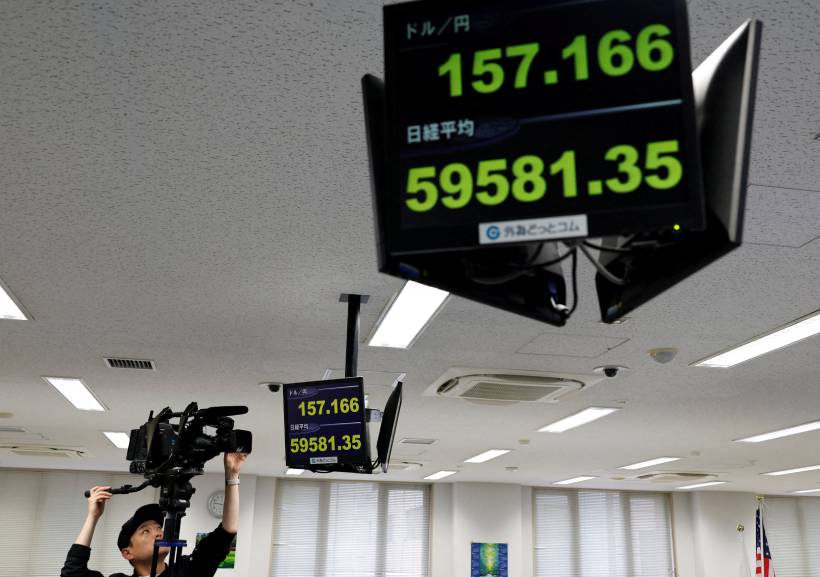
Global markets opened the week on a mixed note as optimism over renewed U.S.-Iran diplomacy sent oil prices sharply lower, while coordinated intervention by the United States and Japan boosted the Japanese yen. Investors welcomed signs that geopolitical tensions in the Middle East may ease, though uncertainty surrounding artificial intelligence valuations continued to weigh on Asian equity markets.
Brent crude futures fell more than 4% to $83.88 per barrel after U.S. President Donald Trump announced that talks with Iran would take place on Monday. The negotiations follow Trump’s decision to suspend a planned military strike in favor of pursuing a diplomatic agreement aimed at reopening the Strait of Hormuz and addressing Tehran’s nuclear program.
Lower energy prices helped lift sentiment in Western markets, with S&P 500 futures rising 0.5%, Nasdaq futures gaining 0.8%, and European futures advancing 0.7%.
Asian Markets Remain Under Pressure
Despite stronger sentiment in Western futures markets, Asian equities struggled after a volatile July marked by sharp swings in technology stocks.
Stay ahead of the geopolitical week.
MD Briefing delivers expert analysis across five global fronts — the Indo-Pacific, energy, geoeconomics, European security, and the Middle East — every Monday morning. Free.
Japan’s Nikkei 225 declined nearly 2%, while South Korea’s KOSPI fell more than 4%. MSCI’s Asia-Pacific index outside Japan also slipped about 1%.
The weakness reflects lingering investor concerns over whether massive spending on artificial intelligence infrastructure will generate returns quickly enough to justify elevated market valuations.
Rare US Japan Currency Intervention Strengthens Yen
The Japanese yen strengthened about 0.5% to 156.47 per U.S. dollar after Japanese authorities confirmed a rare coordinated currency intervention with the United States.
Japan’s Finance Ministry said both governments conducted joint yen-buying operations and signaled they remain prepared to intervene again if necessary to stabilize the currency after months of depreciation toward four-decade lows.
The confirmation marked one of the few occasions in recent years where Washington publicly supported direct foreign exchange intervention alongside Tokyo.
Bessent Signals Continued Support for Dollar Liquidity
U.S. Treasury Secretary Scott Bessent also sought to reassure financial markets by indicating that the United States could expand the Federal Reserve’s repurchase facility, which provides temporary dollar liquidity during periods of market stress.
Analysts viewed Bessent’s remarks as equally significant as the intervention itself.
Market participants believe the combination of official currency support and stronger policy coordination could temporarily halt speculative selling of the yen, although many caution that sustainable gains will ultimately depend on changes in monetary policy and economic fundamentals.
Markets Expect More Action from the Bank of Japan
The intervention has renewed expectations that the Bank of Japan (BOJ) may tighten monetary policy sooner than previously anticipated.
Japan’s two-year government bond yield briefly climbed to its highest level since 1995, reflecting growing expectations that the central bank could raise interest rates earlier than expected.
Analysts argue that intervention alone is unlikely to permanently reverse yen weakness while Japan maintains a significant interest rate gap with the United States.
Lower Oil Prices Ease Pressure on Global Bond Markets
The sharp decline in crude prices also provided relief for global bond markets.
U.S. Treasury yields moved lower, with the 30-year Treasury yield falling from last week’s 19-year high as investors reduced inflation expectations following the drop in energy prices.
The decline comes after Treasury yields surged throughout July amid uncertainty surrounding the Middle East conflict and the Federal Reserve’s policy outlook.
What Investors Are Watching Next
Markets are now focused on two developments that could determine the next phase of trading. The first is whether U.S.-Iran negotiations produce a lasting agreement capable of easing tensions around the Strait of Hormuz and restoring confidence in global energy supplies. The second is whether Japanese authorities back up their intervention with tighter monetary policy, which would provide more durable support for the yen. Together, these factors are likely to shape movements across currencies, commodities, equities, and bond markets in the coming weeks.
With information from Reuters.
