


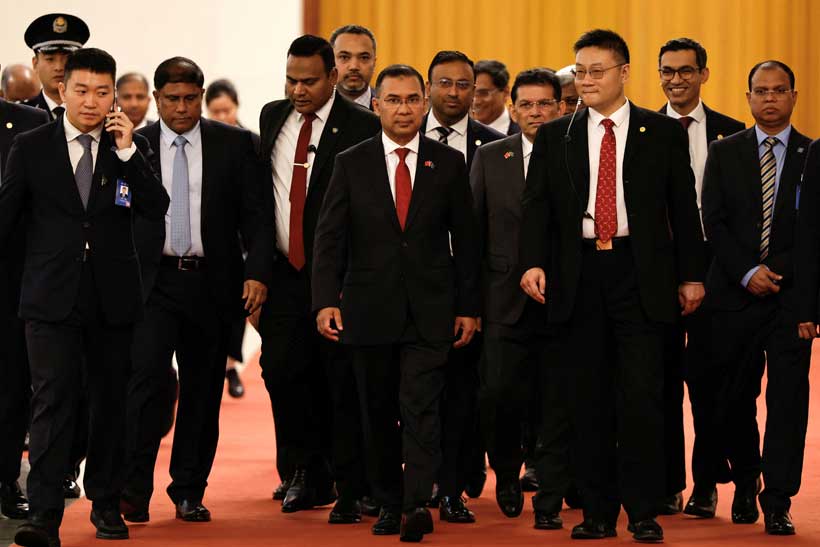
Prime Minister Tarique Rahman completed his four day visit to China on Friday. With so much speculation about his first visit, he completed his first state level visit to China with great success. He even got an ovation from the opposition parties during his first parliamentary session upon returning from China.
This China visit showed new trends in Bangladesh’s foreign policy. This marked the first time after 1996 an elected Prime minister visited China in the first six months. However, visiting China in 1996 and 2026 is different from the geopolitical context. China is challenging India’s regional dominance and the USA’s global position. Engaging in a state-level visit during this era of heightened geopolitical tension demands political nerves, one that Tarique Rahman’s Bangladesh has started to demonstrate.
Thirteen Memorandums of Understanding (MoU) were signed between Bangladesh and China. These covered a broad range of areas on bilateral relations, trade, infrastructure, development and other areas of mutual interest. Among these, two were significant. One concentrated on Teesta Barrage, and another about the China-Myanmar-Bangladesh Economic corridor.
On Monday, 29th June, Prime Minister Tarique Rahman pledged to implement the Teesta Barrage Master Plan at any cost. This reflects the determination of the government, and the confidence that has emerged from the meetings in Beijing.
Stay ahead of the geopolitical week.
MD Briefing delivers expert analysis across five global fronts — the Indo-Pacific, energy, geoeconomics, European security, and the Middle East — every Monday morning. Free.
A Corridor Proposal Decades in the Making
But the issue that can be the most crucial part, not only regionally but also on the global stage, is the proposed China-Myanmar-Bangladesh Economic Corridor. A project that is as much a product of Dhaka’s aspirations on land as it is of Beijing’s concerns about the sea.
The Spokesperson of the Prime Minister Office (PMO) Mahdi Amin has told the media, the proposal of the China-Myanmar-Bangladesh Economic Corridor was proposed during the meeting between Tarique Rahman and President Xi at the Great Hall of the People. This plan has been put with the primary objective of expanding the scope of Bangladesh’s economy, increasing economic exchange, and further strengthening the multimodal transport system.
The idea of this economic corridor isn’t new. In the 1990s, an economic corridor among Bangladesh, China, India, Myanmar was proposed, known as the BCIM Economic Corridor. It was officially recognized in 2013; however, for India’s fall out with China and being suspicious about the Belt and Road Initiative (BRI), New Delhi halted the progression. Later, it pressured Bangladesh to stall any progress of this corridor as well. Bangladesh and China continued to enjoy economic cooperation; nevertheless, Bangladesh didn’t want to antagonise India through a formal corridor or broader strategic alignment with Beijing.
Tarique Rahman and his BNP government may not feel the same. Their fruitful bilateral discussion with China and firm resolve regarding the Teesta Barrage Master Plan is giving a different message.
Economic Promise and the Myanmar Bottleneck
To fully see Bangladesh’s potential gains through this corridor, understanding what such a corridor entails is crucial. A corridor typically gives a nation access to the territory of another sovereign state, occasionally, its coastline. It can be through a third country. In the case of the Bangladesh-China-Myanmar Economic Corridor, Myanmar is the transit state, whose territory will be used to connect Bangladesh and China.
This Corridor will give Bangladesh direct access to the Chinese market. Bangladesh exports goods like pharmaceuticals, leather goods, ceramic and agricultural products to China. Once operational, transportation cost and time will be significantly reduced. The economic benefits might be revolutionary if Bangladesh negotiates lower tariffs on its exports to China in conjunction with this corridor.
China has expressed interest to modernize both Mongla and Chittagong ports. Developing this Economic Corridor is central to China’s regional connectivity ambition. This will boost greater bilateral trade between Bangladesh and China, with investment rising into Bangladesh.
Two economic zones are under discussion at Anwara and Mongla to attract more Chinese investments. This will set up a large number of Chinese factories, which will generate employment in Bangladesh.This would position Bangladesh to play a greater role in regional trade with reduced shipment delays as a logistical advantage.
Landlocked neighbours like Nepal and Bhutan will be benefitted too, with improved access through these ports.
Foreign investments in the Economic Zone will expand more job opportunities for Bangladeshi workforce. Manufacturing machineries will move more efficiently through the corridor once it is operational. Rail links will connect Bangladesh to Southeast Asian states. Bangladesh might see economic diversification alongside lower transportation costs.
However deepening greater strategic partnership with China can bring challenges for Bangladesh too. Bangladesh foreign policy doctrine is “Friendship to All and Malice to None”. Aligning closer to China might contradict this foundational principle.Chinese soft loans, if not managed prudently, risk becoming unsustainable debt burdens. Bangladesh already faces significant trade deficits with China. Direct access to Chinese products to Bangladeshi markets might challenge domestic competitiveness.
For the Corridor to succeed, Myanmar has to achieve political stability. Since 2021, China couldn’t advance with its projects in the China-Myanmar economic corridor. Particularly, in the state of Rakhine, which remains heavily contested between the Military and the Arakan Army.
China has already connected its Yunnan province to Myanmar’s Yangon and Kyaukphyu Deep-Sea Port. The gas and oil pipelines are already operational. The railroad has connected Myanmar’s Ruli and China’s Kuming. Yet projects like, Special Economic Zone (SEZ), and broader connectivity systems are yet to materialise. Myanmar’s unstable politics has halted the progress of China’s broader ambition in the region. The deep sea port of Kyaukphyu is also at a pause.
China has been attempting to mediate between the conflicting parties in Myanmar. China would have a strong foothold over South Asia if Bangladesh formally joined the Corridor deal.
China’s South Western provinces have been long considered as less connected to the Chinese coastal areas. Once this corridor is operational, these states will be granted direct access to the sea. Chinese companies will find greater opportunities across South Asian markets. The transportation cost will be reduced and expected to draw further investment into the region.
Chinese state-owned enterprises have the potential to win large contracts for the construction of power plants, highways, railroads, and sophisticated ports. This corridor is a part of China’s Belt and Road Initiative. The BRI is designed not only to improve connectivity but also to expand China’s economic reach across the region . South Asia will find its market more integrated through this initiative.
The Malacca Dilemma and Bangladesh’s Strategic Calculus
The most strategic advantage China will find is to not only rely on Malacca Strait. Currently, most of China’s trade with Europe, the Middle East, and Africa goes through the South China Sea and the Strait of Malacca, one of the world’s busiest maritime chokepoints. Chinese leaders have long been concerned that strong dependency on this route produces economic and geopolitical vulnerability. This is often referred to as the “Malacca Dilemma.” Although the Bangladesh route would not replace marine commerce, it would diversify China’s access to the Indian Ocean and lessen overreliance on a single sea lane.
Bangladesh has signalled a positive approach towards discussion on the economic corridor. China, for its part, will use this to its own advantage. This will help Bangladesh to counterweight against undue pressure from India. Recently, Bangladesh has faced thousands of cases of push-in from India. The bilateral relation hasn’t been meaningfully recovered in the BNP administration. And now a strategic alignment with China might push away the fear of being alone in the region.
The competition for influence throughout South and Southeast Asia will become much more intense once the China-Myanmar-Bangladesh Economic Corridor is operational. For Dhaka, the corridor is more about making sure it never again feels isolated in the area than it is about China’s chokepoint concerns.
