


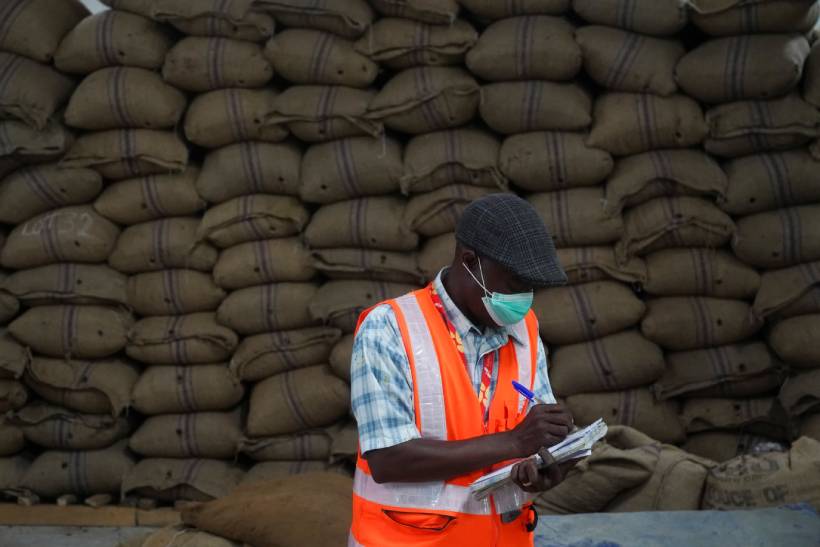
West Africa’s cocoa industry is struggling to comply with new European Union anti-deforestation rules, raising concerns about supply disruptions and higher costs for chocolate makers.
The EU law, known as the EU Deforestation Regulation (EUDR), will require importers to prove that cocoa was not produced on recently deforested land and to trace the beans back to the specific farms where they were grown.
Small Farmers Face the Biggest Challenge
The problem is particularly serious in Nigeria, where about 300,000 mostly small-scale farmers produce cocoa. Industry experts estimate that farmers responsible for more than half of Nigeria’s cocoa production could struggle to meet the EU requirements when the rules take effect at the end of December.
The challenge extends across West Africa, which produces around 70% of the world’s cocoa and sends about two-thirds of its exports to the EU.
Stay ahead of the geopolitical week.
MD Briefing delivers expert analysis across five global fronts — the Indo-Pacific, energy, geoeconomics, European security, and the Middle East — every Monday morning. Free.
In Nigeria, some farmers have been reluctant to allow exporters to map and geolocate their farms. However, exporters warn that farmers who cannot meet the requirements could lose access to the European market.
Compliance Comes at a High Cost
The EUDR requires exporters and importers to establish detailed supply-chain traceability, including mapping individual farms, verifying land use and maintaining digital records.
In Ivory Coast, only around half of cocoa production can currently be traced back to the farms where it was grown, according to the non-profit Trase.
For exporters, establishing these systems has already become expensive.
Sunbeth Global said it spent the past three years mapping 124,000 hectares of farmland covering around 60,000 metric tons of cocoa, at a cost of $30 to $70 per metric ton.
Another major Nigerian exporter, Starlink Global and Ideal, said it has spent $40 to $80 per ton mapping and tracing its supply chain since 2023.
Exporters Face Pressure on Margins
European buyers have so far resisted efforts by exporters to transfer the additional compliance costs to them.
Sunbeth said the expense of meeting the rules is already reducing its profit margins, while companies are also investing in field agents, farmer training and sustainability teams.
The costs could become especially difficult for smaller farmers and exporters with fewer financial resources.
Supply Risks for Europe
Industry experts warn that the new rules could temporarily reduce the amount of compliant cocoa available to European buyers.
Former global cocoa trader Nicko Debenham said EU importers may struggle to obtain enough compliant cocoa from indirect suppliers in countries such as Nigeria and Ivory Coast.
He estimates that a potential supply squeeze could last around two years, potentially giving exporters that have already invested in traceability systems the ability to charge a premium.
Analysis
The EUDR could significantly reshape West Africa’s cocoa supply chain by making traceability and environmental compliance increasingly important to market access. While the regulation is designed to reduce deforestation linked to European consumption, its costs are likely to fall heavily on exporters and small-scale farmers who have limited resources to establish the required systems.
For Europe, the immediate concern is supply. Since West Africa provides the majority of the world’s cocoa and a large share goes to the EU, widespread compliance difficulties could reduce available supplies and increase costs for chocolate producers.
The regulation therefore creates a difficult balance: Europe is seeking to make its cocoa supply chain more sustainable, while exporters are warning that the transition could disrupt supplies and squeeze already limited margins.
With information from Reuters.
